

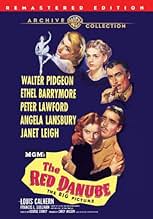
British colonel in post-WWII Vienna must repatriate Soviet citizens. While staying at a convent, he and his team help a ballerina avoiding return to Moscow, challenging his duty and secular ... Read allBritish colonel in post-WWII Vienna must repatriate Soviet citizens. While staying at a convent, he and his team help a ballerina avoiding return to Moscow, challenging his duty and secular views.British colonel in post-WWII Vienna must repatriate Soviet citizens. While staying at a convent, he and his team help a ballerina avoiding return to Moscow, challenging his duty and secular views.
- Nominated for 1 Oscar
- 5 wins & 1 nomination total





- Lt. Guedalia-Wood
- (as David Hydes)
- Major
- (uncredited)
- Devout Pilgrim
- (uncredited)
Featured reviews
There are several levels to this film. One is the agreement among the Allies to repatriate people to their native countries after the war. This film deals with the British sector, led by Pidgeon and his team, who are charged with aiding in the repatriation.
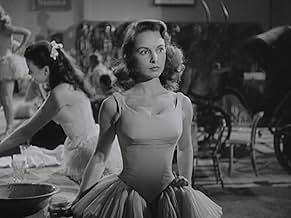
Another level is the spiritual aspect - the Pidgeon character, "Hooky" Nicobar, has begun to doubt the existence of any entity that could allow such horror to happen in the world, including his own personal tragedy. And there's the love story between Maria (Janet Leigh), a Soviet ballerina, and Major 'Twingo' McPhimister.
When displaced Russians would rather commit suicide than return to Russia, Hooky begins to doubt what Colonel Piniev (Louis Calhern) is telling him about what awaits these people back in the homeland. But he has to follow orders, so in spite of protests, he turns over ballerina Maria to the Soviets.
MGM made a film later on, "Never Let Me Go" about a ballerina trying to get out of Russia; here a ballerina tries to keep from going back.
This film has much more depth than "Never Let Me Go," and is more gritty, showing the old and weak DPs, unusable for slave labor, that the Russians foist upon the British sector toward the end of the film.
The spiritual angle in this film is interesting - has God failed man, the nun (Ethel Barrymore) asks, or has man failed God? Is "following orders" when you know you're sending people to certain death sufficient?
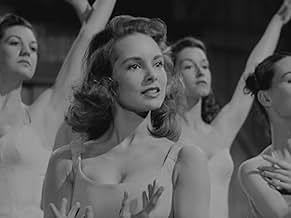
"The Red Danube" is well acted. Discovered by Norma Shearer, Janet Leigh had only been in films two years when she made this, but she had already racked up some experience. She's fresh-faced, sympathetic, and sweet as Maria Buhlen.
Peter Lawford doesn't have much to do; Angela Lansbury is delightful as part of the team, and Walter Pidgeon does an excellent job as the troubled colonel.
As the Mother Superior where Audrey Quail, the colonel, and Twingo are billeted, Ethel Barrymore gives a superb performance as a woman of implacable faith who tries to help Hooky with his crisis and aid Maria.
I thought this was a very good film, thought-provoking, with good direction by George Sidney.
I found others' comments on the relationship to McCarthyism and/or anti-Communism in general to be interesting. I do believe this movie showed the evils of the Soviet system, which to me, is fine. I have no idea if it fed McCarthyism, since I wasn't alive during that period. However, to me, it seems to be more about anti-totalitarianism of all stripes, rather than merely anti-Communism. In particular, the scene of the refugees in boxcars seems to be a direct reference to the Holocaust.
That The Red Danube was nominated for best art direction speaks, as well, to the technical beauty of this black & white film. This film reminded me of The Third Man, in its location, art direction, and storyline. (Orson Welles always said that "Black & white is the actor's friend" -- how true, in both these movies!) Although this film is inferior to The Third Man overall, in terms of its acting, atmosphere, and skill of the director, it is still worthy of viewing. Whereas The Third Man focuses on the moral dilemma of dealing with the evil in one individual (in a corrupt society), this film deals more generally with the morality of living in a corrupt society. In other words, The Third Man asks: "Why do men turn evil in an evil society?" (which, when you think about it, may not be such a profound question; although the further question of "What can be done about it?" is also explored), whereas The Red Danube asks: "How can men stay good in an evil society?" (which is really a much more useful question). So, although there's no denying that The Third Man is the better movie overall, I would highly recommend The Red Danube due to its high production values, the collection of wonderful actors in its ensemble cast, and a very engaging, philosophical script.


Did you know
- TriviaKonstantin Shayne (Professor Bruloff) and Tamara Shayne (Helena Nagard) play husband and wife; in reality they are siblings. They do not share any scenes in the movie.
- GoofsMelville Cooper's role is credited as "Private David Moonlight", but his uniform bears Sergeant's stripes throughout the movie.
- Quotes
Mother Superior: [Referring to a previous conversation about religion and its inefficacy in wartime] Like that ladder...
Col. Michael S. 'Hooky' Nicobar: The ladder?
Mother Superior: There is the ladder, there is the ceiling and there is the paint. If you want the ceiling painted, someone must climb the ladder.
Col. Michael S. 'Hooky' Nicobar: Yes, you, um, need a painter.
Mother Superior: But suppose the painter remains at the foot of the ladder? You cannot say that the ladder has failed you, or the paint has failed you, or the ceiling has failed you.
Col. Michael S. 'Hooky' Nicobar: No, no you can't.
Mother Superior: I know about you more than you know about yourself. You want the ceiling painted but... all the cruelty in the world, all the horror and tragedy you see, these you do not oppose with your own courage. You do not try to replace them with your own high hopes for the world and the human race. You complain that God has failed you. No, my friend. God has not failed man- man has failed God. For every man knows what God wants him to do.
- ConnectionsFeatured in Some of the Best: Twenty-Five Years of Motion Picture Leadership (1949)
- SoundtracksOn the Atchison, Topeka and the Santa Fe
(uncredited)
Music by Harry Warren
[Instrumental version played at the tavern in Rome when Audrey and Twingo say goodbye]
- How long is The Red Danube?Powered by Alexa
Details
- Release date
- Country of origin
- Languages
- Also known as
- Storm Over Vienna
- Filming locations
- Rome, Lazio, Italy(backgrounds)
- Production company
- See more company credits at IMDbPro
Box office
- Budget
- $1,961,000 (estimated)
- Runtime
- 1h 59m(119 min)
- Color
- Aspect ratio
- 1.37 : 1