

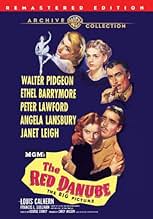
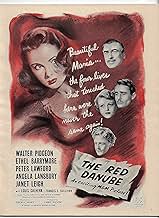
British colonel in post-WWII Vienna must repatriate Soviet citizens. While staying at a convent, he and his team help a ballerina avoiding return to Moscow, challenging his duty and secular ... Read allBritish colonel in post-WWII Vienna must repatriate Soviet citizens. While staying at a convent, he and his team help a ballerina avoiding return to Moscow, challenging his duty and secular views.British colonel in post-WWII Vienna must repatriate Soviet citizens. While staying at a convent, he and his team help a ballerina avoiding return to Moscow, challenging his duty and secular views.
- Nominated for 1 Oscar
- 5 wins & 1 nomination total






- Lt. Guedalia-Wood
- (as David Hydes)
- Major
- (uncredited)
- Devout Pilgrim
- (uncredited)
Featured reviews
It's a good book too.
A better film than 6.1
Good on a few levels
There are several levels to this film. One is the agreement among the Allies to repatriate people to their native countries after the war. This film deals with the British sector, led by Pidgeon and his team, who are charged with aiding in the repatriation.
Another level is the spiritual aspect - the Pidgeon character, "Hooky" Nicobar, has begun to doubt the existence of any entity that could allow such horror to happen in the world, including his own personal tragedy. And there's the love story between Maria (Janet Leigh), a Soviet ballerina, and Major 'Twingo' McPhimister.
When displaced Russians would rather commit suicide than return to Russia, Hooky begins to doubt what Colonel Piniev (Louis Calhern) is telling him about what awaits these people back in the homeland. But he has to follow orders, so in spite of protests, he turns over ballerina Maria to the Soviets.
MGM made a film later on, "Never Let Me Go" about a ballerina trying to get out of Russia; here a ballerina tries to keep from going back.
This film has much more depth than "Never Let Me Go," and is more gritty, showing the old and weak DPs, unusable for slave labor, that the Russians foist upon the British sector toward the end of the film.
The spiritual angle in this film is interesting - has God failed man, the nun (Ethel Barrymore) asks, or has man failed God? Is "following orders" when you know you're sending people to certain death sufficient?
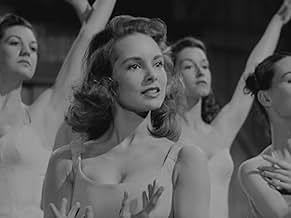
"The Red Danube" is well acted. Discovered by Norma Shearer, Janet Leigh had only been in films two years when she made this, but she had already racked up some experience. She's fresh-faced, sympathetic, and sweet as Maria Buhlen.
Peter Lawford doesn't have much to do; Angela Lansbury is delightful as part of the team, and Walter Pidgeon does an excellent job as the troubled colonel.
As the Mother Superior where Audrey Quail, the colonel, and Twingo are billeted, Ethel Barrymore gives a superb performance as a woman of implacable faith who tries to help Hooky with his crisis and aid Maria.
I thought this was a very good film, thought-provoking, with good direction by George Sidney.
Thriller with Noir Overtones
In a humorous coincidence, I had watched "Mission to Moscow" a few days before this, which is all about how wonderful Russia was and what an advanced, open, happy culture Americans didn't realize it had. Then in "The Red Danube," the Russia we see is the Cold War version, a scary, secretive place where people are controlled and abused. What a difference the end of a war makes.
Janet Leigh is lovely as a musician in hiding who Russia wants back. Walter Pidgeon gets the film's most complicated and compelling character, an officer whose personal work ethic butts up against the morality of what he's being asked to do. He has some great scenes with Ethel Barrymore as a wise nun who acts as his conscience when his conscience stays quiet. Peter Lawford is a whiny love interest and Angela Lansbury is a scene stealer in a role that doesn't feel very necessary to the movie but which nevertheless gives her the chance to bring some needed spunk to all the gloomy soul searching.
"The Red Danube" received an Oscar nomination for its black and white art direction, one of the bazillion nominations over the years that feel completely random in retrospect. There were only three nominees in that category in 1950 -- why this film?
Grade: B+
Repatriating the Red Refugees
The Red Danube came out in 1949 and is set at the time when people thought it possible to keep the wartime Allies on the same page. That was not to be due to the differences in the two political systems that combined to defeat Hitler.
Walter Pidgeon is recently transferred to Vienna and gets an order to find her and turn her over to the Russians. He doesn't count on three things, his aide Peter Lawford falling for Janet, the formidable presence of Mother Superior Ethel Barrymore who is sheltering Leigh, and his own growing conscience about what he sees around him.
People would rather die than return to the worker's paradise that Communism has created. I mean literally, both here in the film and in real life back in the day. It's easy to dismiss The Red Danube as a Cold War inspired film. But the situations are way too real.
Best performance in the film is Ethel Barrymore, followed closely by Pidgeon as the British Colonel with a conscience. Pidgeon is a nonbeliever and his debates with Barrymore about religion are the best thing in the film.
Part of the film has Pidgeon getting Barrymore on a military plane to see the Pope in Rome during a conference concerning refugees. Now mind you this is Pius XII we are talking about who before and as Pope never quite saw the danger Hitler was to the church that Stalin was.
But I'm willing to bet that seeing Ethel Barrymore delineate the character of the Mother Superior this was a woman who walked the Christian walk as well. I'm even willing to bet she probably sheltered a few Jews during the holocaust as well.


Did you know
- TriviaKonstantin Shayne (Professor Bruloff) and Tamara Shayne (Helena Nagard) play husband and wife; in reality they are siblings. They do not share any scenes in the movie.
- GoofsMelville Cooper's role is credited as "Private David Moonlight", but his uniform bears Sergeant's stripes throughout the movie.
- Quotes
Mother Superior: [Referring to a previous conversation about religion and its inefficacy in wartime] Like that ladder...
Col. Michael S. 'Hooky' Nicobar: The ladder?
Mother Superior: There is the ladder, there is the ceiling and there is the paint. If you want the ceiling painted, someone must climb the ladder.
Col. Michael S. 'Hooky' Nicobar: Yes, you, um, need a painter.
Mother Superior: But suppose the painter remains at the foot of the ladder? You cannot say that the ladder has failed you, or the paint has failed you, or the ceiling has failed you.
Col. Michael S. 'Hooky' Nicobar: No, no you can't.
Mother Superior: I know about you more than you know about yourself. You want the ceiling painted but... all the cruelty in the world, all the horror and tragedy you see, these you do not oppose with your own courage. You do not try to replace them with your own high hopes for the world and the human race. You complain that God has failed you. No, my friend. God has not failed man- man has failed God. For every man knows what God wants him to do.
- ConnectionsFeatured in Some of the Best: Twenty-Five Years of Motion Picture Leadership (1949)
- SoundtracksOn the Atchison, Topeka and the Santa Fe
(uncredited)
Music by Harry Warren
[Instrumental version played at the tavern in Rome when Audrey and Twingo say goodbye]
- How long is The Red Danube?Powered by Alexa
Details
- Release date
- Country of origin
- Languages
- Also known as
- Storm Over Vienna
- Filming locations
- Rome, Lazio, Italy(backgrounds)
- Production company
- See more company credits at IMDbPro
Box office
- Budget
- $1,961,000 (estimated)
- Runtime
- 1h 59m(119 min)
- Color
- Aspect ratio
- 1.37 : 1