
A poet in love with Death follows his unhappy wife into the underworld.A poet in love with Death follows his unhappy wife into the underworld.A poet in love with Death follows his unhappy wife into the underworld.
- Nominated for 1 BAFTA Award
- 2 nominations total





André Carnège
- Judge
- (as Maurice Carnège)


Paul Amiot
- Judge
- (uncredited)
Philippe Bordier
- Young Man at Café des Poètes
- (uncredited)

Claude Borelli
- Une bacchante
- (uncredited)

Jean Cocteau
- Narrator
- (voice)
- (uncredited)
- Director
- Writer
- All cast & crew
- Production, box office & more at IMDbPro
7.814.3K
1
2
3
4
5
6
7
8
9
10
Featured reviews
10rdoyle29
A beautiful film
Jean Cocteau is a complete aesthetic package and I love him.
Cocteau seems to get an idea for a film based around some themes that spark ideas in him, and then includes a lot of images purely for aesthetic reasons. His films seem to belong to no real tradition. He's a tradition unto himself.
One of the things that really seems to be on his mind here is the middle aged slump into mediocrity. He was 60 years old when he made this film, so his Orpheus's fear that his artistic power has waned must have been a real concern. If you make a film this beautiful, you needn't worry.
I love that his film has poetry groupies who swarm poets for autographs. The suggestion that Orpheus may have plagiarized Cégeste's work causes poets to storm his house. What a world!
This film is all sleek black leather and beautiful lo-fi special effects.
Juliette Gréco and Jean-Pierre Melville show up.
Cocteau seems to get an idea for a film based around some themes that spark ideas in him, and then includes a lot of images purely for aesthetic reasons. His films seem to belong to no real tradition. He's a tradition unto himself.
One of the things that really seems to be on his mind here is the middle aged slump into mediocrity. He was 60 years old when he made this film, so his Orpheus's fear that his artistic power has waned must have been a real concern. If you make a film this beautiful, you needn't worry.
I love that his film has poetry groupies who swarm poets for autographs. The suggestion that Orpheus may have plagiarized Cégeste's work causes poets to storm his house. What a world!
This film is all sleek black leather and beautiful lo-fi special effects.
Juliette Gréco and Jean-Pierre Melville show up.
Surreal and Poetic
This film is an updating of the Greek myth of Orpheus and Eurydice. The film updates the action to post-war France, with Orpheus (played by Jean Marais) a famous but dis-satisfied poet.
The film focuses on the themes of love and death. Most notably Orpheus falling in love with a glamorous incarnation of Death (Maria Casares).
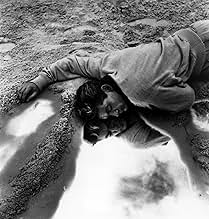
Writer-director Jean Cocteau turns the everyday world into a magical realm. Mirrors turn to pools which are portals to other worlds, car radios pick up coded messages from Death's World. In less talented hands than Cocteau's, the delicate fantasy could have easily become ridiculous but he handles it with brilliance and the film works perfectly.
Here Cocteau creates a truly poetic film. The story is magical and entertaining and the film is filled with wonderously surreal images (particularly striking is the frequent use of filming an action performed backwards, and then reversing it which creates a very strange impression).
The film focuses on the themes of love and death. Most notably Orpheus falling in love with a glamorous incarnation of Death (Maria Casares).
Writer-director Jean Cocteau turns the everyday world into a magical realm. Mirrors turn to pools which are portals to other worlds, car radios pick up coded messages from Death's World. In less talented hands than Cocteau's, the delicate fantasy could have easily become ridiculous but he handles it with brilliance and the film works perfectly.
Here Cocteau creates a truly poetic film. The story is magical and entertaining and the film is filled with wonderously surreal images (particularly striking is the frequent use of filming an action performed backwards, and then reversing it which creates a very strange impression).
"Astonish us"
Although this is definitely Jean Cocteau up to his old cinematic tricks, Orphee is beyond criticism as it's Art that has stood the test of time. And updated Classical Art at that. Keep your guard up and you won't get it. But drop your guard and it's still an astonishing film, an allegorical atmospheric magical poetic potboiler, and a film I've seen over 10 times over the decades without failing to admire its self-possession and panache.
Orphee is a self-obsessed cult poet, who gets immersed in writing down and publishing the cryptic word gems the Princess of Death's talking car tells him. "The bird sings with its fingers" is especially ridiculously impressive, but of course, all of this was a reference to Resistance methods during the War of disguising their intentions from the Nazis. Allegorical to ... what? During this period his wife Eurydice is murdered by the Princess, who fancies Orphee while Heurtebise her Underworld chauffeur fancies Eurydice. Hem. This is not only a four dimensional, but a multi-dimensional tour de force, travelling back and forth through the worlds of life and death. The intellectual complexities involved can be enormous, you can lose the plot by thinking too deeply about one line of dialogue, or why "Orpheus's Death" is coming through the mirror at night to look at Eurydice. On the other hand, you might view it all as totally ridiculous and pretentious and laugh out loud at some of the scenes - but that only makes you a realist and not a poet. Auric's dreamy music helps a lot, although Passport to Pimlico keeps coming to mind!
Cocteau revisited Orphee later on near the end of his life, but The Testament of Orphee unfortunately really was pretentious even if startlingly different for 1960 - to quote: "his life had decayed, rotten with success". But this is the Real Secret of Secrets - Orphee is an utterly unique treasure, conceived and executed by an irreplaceable talent - and his second best effort too, after Belle et la Bete! Worth the weight of its nitrate stock in gold.
Orphee is a self-obsessed cult poet, who gets immersed in writing down and publishing the cryptic word gems the Princess of Death's talking car tells him. "The bird sings with its fingers" is especially ridiculously impressive, but of course, all of this was a reference to Resistance methods during the War of disguising their intentions from the Nazis. Allegorical to ... what? During this period his wife Eurydice is murdered by the Princess, who fancies Orphee while Heurtebise her Underworld chauffeur fancies Eurydice. Hem. This is not only a four dimensional, but a multi-dimensional tour de force, travelling back and forth through the worlds of life and death. The intellectual complexities involved can be enormous, you can lose the plot by thinking too deeply about one line of dialogue, or why "Orpheus's Death" is coming through the mirror at night to look at Eurydice. On the other hand, you might view it all as totally ridiculous and pretentious and laugh out loud at some of the scenes - but that only makes you a realist and not a poet. Auric's dreamy music helps a lot, although Passport to Pimlico keeps coming to mind!
Cocteau revisited Orphee later on near the end of his life, but The Testament of Orphee unfortunately really was pretentious even if startlingly different for 1960 - to quote: "his life had decayed, rotten with success". But this is the Real Secret of Secrets - Orphee is an utterly unique treasure, conceived and executed by an irreplaceable talent - and his second best effort too, after Belle et la Bete! Worth the weight of its nitrate stock in gold.
A great story with great imagery
This is my favorite Cocteau film and the most accessible of the Orpheus trilogy, which includes Blood of the Poet (1930) and The Testament of Orpheus (1960). It tells the story of a poet's love for both his wife and "The Princess", a shadowy figure who conducts humans to the underworld upon their death. Orpheus is obsessed with the figure of Death and, ignoring his pregnant wife, follows her into the underworld. The Princess, in turn, falls in love with Orpheus, conducts Orpheus's wife into the underworld, and is eventually punished for "breaking the rules". The underworld is portrayed as a bureaucracy where drab clerks hold hearings in small drab rooms and bring down the wrath of the "rules" on anyone who does not play out their specified role.
Maria Casares is superb as the Princess but François Périer is my favorite character, Heurtebise, the Princesses assistant who also "breaks the rules" by falling in love with Orpheus' wife. Jean Marais is also excellent as the poet Orpheus. Cocteau comments on the role of the poet in society through the role of Orpheus. The young avant garde crowd has turned against Orpheus and now worships the vacant Cegeste. Orpheus asks his publisher what he must do to regain their admiration and is told to "astonish us". When the police inspector is about to arrest Orpheus and then, upon recognizing him, lets him off and asks for his autograph, you know we're not in Kansas (or anywhere in the US).
Several of the characters (The Princess, Heurtebise and Cegeste), played by the same actors, repeat their roles 10 years later in The Testament of Orpheus, passing judgement on Cocteau himself. Their scenes are the best part of that film.
This is a very beautiful film that I've grown to like more and more upon repeat viewings. 9 out of 10.
Maria Casares is superb as the Princess but François Périer is my favorite character, Heurtebise, the Princesses assistant who also "breaks the rules" by falling in love with Orpheus' wife. Jean Marais is also excellent as the poet Orpheus. Cocteau comments on the role of the poet in society through the role of Orpheus. The young avant garde crowd has turned against Orpheus and now worships the vacant Cegeste. Orpheus asks his publisher what he must do to regain their admiration and is told to "astonish us". When the police inspector is about to arrest Orpheus and then, upon recognizing him, lets him off and asks for his autograph, you know we're not in Kansas (or anywhere in the US).
Several of the characters (The Princess, Heurtebise and Cegeste), played by the same actors, repeat their roles 10 years later in The Testament of Orpheus, passing judgement on Cocteau himself. Their scenes are the best part of that film.
This is a very beautiful film that I've grown to like more and more upon repeat viewings. 9 out of 10.
One of the best I have ever seen
I saw the movie, or most of it, around the age of eight or nine. It made a deep impression on me, and I have wanted to watch it again. Now that I have been able to find out the name and the director, I soon will!
The special effects in the film, as I recall them, must have been fabulous for the time, and were quite dazzling even by the standards of the eighties. The movie is surreal, and though it sounds trite, this is perhaps the best description. It left one with a delicious feeling, and even after almost twenty years I feel quite thrilled when I think about it. I found the notion of being in love with death, who is portrayed by María Casarès, and whom I found incredibly attractive, was overwhelmingly wonderful. That was my interpretation at that time. I am curious to see what I would think of it now.
Certainly a terrific film for a child. I think I would still find it wonderful.
The special effects in the film, as I recall them, must have been fabulous for the time, and were quite dazzling even by the standards of the eighties. The movie is surreal, and though it sounds trite, this is perhaps the best description. It left one with a delicious feeling, and even after almost twenty years I feel quite thrilled when I think about it. I found the notion of being in love with death, who is portrayed by María Casarès, and whom I found incredibly attractive, was overwhelmingly wonderful. That was my interpretation at that time. I am curious to see what I would think of it now.
Certainly a terrific film for a child. I think I would still find it wonderful.


Did you know
- TriviaThe opening scenes set in the Cafe des Poetes were originally set to be filmed with regular extras. However, Cocteau found them to be too self-conscious and artificial so they were all dismissed. Instead, real bohemians from Paris' real café culture were drafted in. These proved to be so natural and relaxed with the café setting, they actually stayed on for two extra days after filming had finished, just hanging out in the cafés that the film crew had been using.
- GoofsWhen the woman shopkeeper summons the female fans over to show them the newspaper article; the newspaper is used as a segue to the next scene of the police chief reading the same article. However, the page displayed to the camera before the segue is different than the page displayed to the camera after the segue.
- Quotes
Heurtebise: I am letting you into the secret of all secrets, mirrors are gates through which death comes and goes. Moreover if you see your whole life in a mirror you will see death at work as you see bees behind the glass in a hive.
- ConnectionsEdited into Histoire(s) du cinéma: Une histoire seule (1989)
- SoundtracksDance of the Blessed Souls -- from Orphée et Eurydice
Written by Christoph Willibald Gluck
- How long is Orpheus?Powered by Alexa
Details
- Runtime
- 1h 52m(112 min)
- Color
- Aspect ratio
- 1.37 : 1
Contribute to this page
Suggest an edit or add missing content