IMDb RATING
7.7/10
2.8K
YOUR RATING

Bucolic scenes from the outskirts of Paris are contrasted with stark footage from slaughterhouses.Bucolic scenes from the outskirts of Paris are contrasted with stark footage from slaughterhouses.Bucolic scenes from the outskirts of Paris are contrasted with stark footage from slaughterhouses.
- Director
- Writers
- Stars
- Director
- Writers
- All cast & crew
- Production, box office & more at IMDbPro
7.72.7K
1
2
3
4
5
6
7
8
9
10
Featured reviews
20 minutes of unspeakable horror
The Criterion DVD "Les Yeux sans visage" aka Eyes without a Face" also includes the 20 minutes long documentary by Georges Franju, "The Blood of the Beasts" (1949) about an ordinary day at the slaughterhouse in Paris. This short film is one of the most horrifying ever made. What makes it even more difficult to see the matter-of-fact efficient way the professional and skilled butchers do their jobs never stop smoking or whistling
. In one of the comments, the author recalls the famous eyeball- slicing scene of "Le Chien Andalou" which was a dead cow's eyeball. That shot only last a second, and it is still shocking. Now imagine much more gruesome and unbearable scenes showing the killing of horses, cows, calves and sheep over and over and over again and that unspeakable terror and fear in their eyes...Paris (or London, or New York City or Rome or any other place in the world) needs their steaks, chops, and burgers
Very shocking,but almost lyrical documentary.
"Blood of the Beasts" by Georges Franju is among the most horrifying documentaries I have ever seen.Its unflinching depiction of animal butchery will certainly upset many potential viewers.The film is set in a Parisian slaughterhouse.We see various butchers slaughtering horses,cows,calves and sheep.This film is very graphic without being exploitative,though-Franju simply documents the activities in a slaughterhouse circa 1949.It's very well done-the images are strong,often disturbing-and the camera acts almost as a neutral observer,seeing all.This is a good film,but I only recommend it with a strong warning about its content.So if you are squeamish don't watch this short.8 out of 10.
The routines of the world
In a suburban outskirt of post-WW2 Paris, we are enamoured by the beauty of one of France's pearls. It's an ordinary day where time seamlessly and relaxingly passes by. We wonder, "what's going on?"
It's only when you search inside the buildings one actually realizes the life (or lack thereof) in the city. Paris, a destination spot for romantics and travellers abroad, has its meat industry displayed--not their biggest attraction. It's not a heinous crime nor an "extreme" act. Yet it's only when peering behind the guarding walls we see the treachery the human race is capable of. Choosing to disregard mass murder is one thing, but the blood on our hands, innocence stolen and suffering caused is something we will take to the grave.
The complete sense of normality is the most sinister aspect of this short film. Rarely do people actively consider what they are consuming. We observe how very regular the acts of slaughter are depicted and it appears to be an outrageous crime. But it's not. It happens in our very own backyard and in the most elegant of places.
It's only when you search inside the buildings one actually realizes the life (or lack thereof) in the city. Paris, a destination spot for romantics and travellers abroad, has its meat industry displayed--not their biggest attraction. It's not a heinous crime nor an "extreme" act. Yet it's only when peering behind the guarding walls we see the treachery the human race is capable of. Choosing to disregard mass murder is one thing, but the blood on our hands, innocence stolen and suffering caused is something we will take to the grave.
The complete sense of normality is the most sinister aspect of this short film. Rarely do people actively consider what they are consuming. We observe how very regular the acts of slaughter are depicted and it appears to be an outrageous crime. But it's not. It happens in our very own backyard and in the most elegant of places.
A hard but poetic documentary about the outskirts of Paris.... and their slaughterhouses
"Le Sang des Bêtes" is a splendid documentary about the life and work of many workers, living just outside the Paris walls after WWII. From the vast and deserted areas that seemed to completely surround the city and its few 'modern' outskirt-constructions, Franju suddenly leads us nearer to the heart of the capital. Where the industrial compounds rise. where, at the fringe of urban and rural worlds, the cattle is being slaughtered. From the horses slaughterhouses of the Porte de Vanves to the huge Halles de la Vilette, where cows, calves and sheep are being prepared to be eaten, this short film is by no means a claim for vegetarianism. Some scenes are certainly hard to watch, but the accurate eye of the director, his tenderness towards the men (and women) doing this very hard work, is the real point here. After all, we've seen animals die before (actually after, from 'Le Cochon' of Jean Eustache and Barbet Schroeder's New Guinea documentaries, to "Benny's Video" and the morbid attraction of Benny towards the film of the cow's death. So let not your prejudices take the better, and let the film deliver its message : that he is the witness of a world not that old, and already so odd to us.
An astonishing document.
An astonishing document.
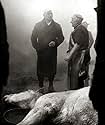
A documentary shot with a surrealist aesthetic; images of unimaginable horror and violence--all perfectly real and unstaged--filmed with a languid and beautiful poetry. The images in this documentary about the slaughterhouse--the "abattoir," in the language of the narrator--are filmed with an almost cavalier, deadpan, unflinching clarity. The images of the lingering struggles of a decapitated calf; the satiny musculature exposed beneath the skin of a butchered cow, and the horrible but poetic moment when we see that the heart still beats beneath the sinews; the bored whistle of the beret-capped worker tapping the steaming spray of a horse's heart's blood; and then, the canal-concealing camera angle that shows us a barge bisecting a field of grass: "Blood of the Beasts" is a breathtaking celebration of the visual philosophy of surrealism.
A documentary shot with a surrealist aesthetic; images of unimaginable horror and violence--all perfectly real and unstaged--filmed with a languid and beautiful poetry. The images in this documentary about the slaughterhouse--the "abattoir," in the language of the narrator--are filmed with an almost cavalier, deadpan, unflinching clarity. The images of the lingering struggles of a decapitated calf; the satiny musculature exposed beneath the skin of a butchered cow, and the horrible but poetic moment when we see that the heart still beats beneath the sinews; the bored whistle of the beret-capped worker tapping the steaming spray of a horse's heart's blood; and then, the canal-concealing camera angle that shows us a barge bisecting a field of grass: "Blood of the Beasts" is a breathtaking celebration of the visual philosophy of surrealism.


Did you know
- TriviaWas awarded the "Grand Prix International du Court Sujet" in 1950.
- ConnectionsFeatured in Cinéma, de notre temps: Georges Franju, le visionnaire (1996)
Details
- Runtime
- 22m
- Color
- Sound mix
- Aspect ratio
- 1.37 : 1
Contribute to this page
Suggest an edit or add missing content