

A poisoned accountant tries to figure out why.A poisoned accountant tries to figure out why.A poisoned accountant tries to figure out why.
- Director
- Writers
- Stars
- Awards
- 2 wins total




Beverly Garland
- Miss Foster
- (as Beverly Campbell)


Cay Forester
- Sue
- (as Cay Forrester)

Frank Jaquet
- Dr. Matson
- (as Fred Jaquet)

Lawrence Dobkin
- Dr. Schaefer
- (as Larry Dobkin)


Bill Baldwin
- St. Francis Hotel Desk Clerk
- (uncredited)
- Director
- Writers
- All cast & crew
- Production, box office & more at IMDbPro
7.213.9K
1
2
3
4
5
6
7
8
9
10
Featured reviews
Perhaps the best noir ever made
I hate formal film evaluation lists that ostentatiously rate the relative value of certain films, such as Citizen Kane for example. I do think Citizen Kane is a great film. But I also think that about fifteen or twenty other films I could quickly name are every bit as good as Kane in their own way. (Almost any Richard Gere movie, for example. Just kidding.)
This brings me to D.O.A., directed by Rudolf Maté. D.O.A. in my book is the Citizen Kane of the noirs. It's so good that I often wonder about how it got made in the first place. Since many of the people who were involved in its production are now no longer with us, I may never learn anything about its origins. That's a frustration, of course, but the more important thing is that I can recognize a great noir when I see it.
Why, you ask, is D.O.A. a great noir? The most obvious reason is its plot. A guy goes out for a night on the town and someone, a total stranger, slips him a mickey in a bar-a lethal mickey. But it doesn't kill him instantly. It kills him slowly, so slowly that he's given the chance to find out who did this terrible thing to him, and why.
Second, the film is exceptionally well made in every other respect. Okay, the Pamela Britton character is one dimensional and embarrassing, we all agree on that, but who really cares when everything else in the film is so good? Edmond O'Brien had one of the best roles of his career in D.O.A., and he took full advantage, though few critics give his performance much credit for the film's success.
O'Brien, a classically trained actor, plays a small-time Southern California businessman living his ordinary little life, minding his own business, regularly boffing his secretary (this was implied rather than made explicit; after all, this was 1949), and avoiding her whiney entreaties that they tie the knot, as he's been promising her he would do for ever so long.
You can't help liking O'Brien in part precisely because of his human flaws. He's basically decent, but harassed, overworked, and stretched to the limit by the pressure put on him by Britton. What adult male couldn't identify with this man, or at least sympathize? His very insignificance as one more human ant on the planet Earth, and the terrible thing that's about to happen to him, are the essence of great film noir. (Detour, although by no means a favorite noir of mine, is nevertheless another perfect example of an ordinary man, a small-timer, minding his own business and unexpectedly colliding with Fate and all that it has in store for him.) We resonate to D.O.A. because fate and contingency have been the fundamental conditions of life on the planet earth since before the beginning of history. Our time on Earth is brief and our lives but little scraps of paper blown about by the wind toward endings we know not. We live noir lives.
The film's particulars are wonderful. From the sunny hick town of Banning, the movie switches quickly to San Francisco. If ever there were a noir town, it's Frisco. (Hitchcock picked up on that real quick; watch Vertigo again to see how he saw the eerie side to that town, with its creepy deserted streets, little ghostlike fog-blown urban hills, and other abandoned places suggestive of loneliness and soullessness.)
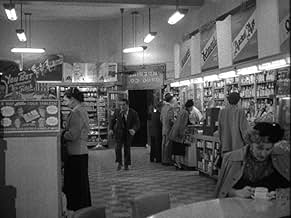
From here one great noir scene follows another in astonishing succession: the smoky, crowded jazz bar where the sweaty black musicians are blowing up a storm (to an all-white 1949 audience of course), while a murder is silently committed with a switched drink. The doctor holding the eerily glowing glass tube of luminescent poison and informing O'Brien, "You've been murdered." O'Brien running through the crowded downtown streets like a madman, as if velocity could help him escape his fate. O'Brien, after being shot at, a gun now in his own hand, looking for his killer in the abandoned processing plant. His encounter with Luther Adler's insane, sadistic henchman played by Neville Brand. Brand, speaking softly, glints of spittle in the corners of his mouth, nutty little eyes lighting up with anticipated pleasure: "I'm gonna give it to you in the belly. You're soft in the belly, aren't'cha? " Then the fantastic night scene in the crowded Los Angeles drugstore with Brand stalking him among oblivious customers-till shots ring out, then screams, followed by death. Finally, again at night, O'Brien's confrontation with his killer, which (inevitably) occurs in the Bradbury Building, that great architectural shrine to noir, scene of so many other noir films.
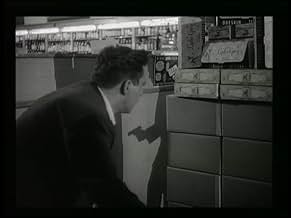
Let's stop for a moment and go back to an earlier part of the film. Fatally poisoned, still not quite believing what has happened to him, exhausted and uncertain of anything, O'Brien has run for block after block, but now his energy has finally petered out and he finds himself alone near the docks. Utterly depleted, all hope lost, he wearily leans against the side of an old wooden newsstand in an otherwise bleak, abandoned area. Eyes glazing over, he's terrified, trying to catch his breath. During a medium close-up we briefly study him, then notice something to his left, a single long vertical row of magazines, all identical covers, arranged down the side of the kiosk just half a hand away from him. He isn't looking at them, isn't really aware of them, but we are. For just a few seconds we see: Life, Life, Life, Life, Life, Life, Life. Then the film quickly moves on and goes about its business, as if we had been shown nothing of importance.
You tell me this isn't a great film noir.
This brings me to D.O.A., directed by Rudolf Maté. D.O.A. in my book is the Citizen Kane of the noirs. It's so good that I often wonder about how it got made in the first place. Since many of the people who were involved in its production are now no longer with us, I may never learn anything about its origins. That's a frustration, of course, but the more important thing is that I can recognize a great noir when I see it.
Why, you ask, is D.O.A. a great noir? The most obvious reason is its plot. A guy goes out for a night on the town and someone, a total stranger, slips him a mickey in a bar-a lethal mickey. But it doesn't kill him instantly. It kills him slowly, so slowly that he's given the chance to find out who did this terrible thing to him, and why.
Second, the film is exceptionally well made in every other respect. Okay, the Pamela Britton character is one dimensional and embarrassing, we all agree on that, but who really cares when everything else in the film is so good? Edmond O'Brien had one of the best roles of his career in D.O.A., and he took full advantage, though few critics give his performance much credit for the film's success.
O'Brien, a classically trained actor, plays a small-time Southern California businessman living his ordinary little life, minding his own business, regularly boffing his secretary (this was implied rather than made explicit; after all, this was 1949), and avoiding her whiney entreaties that they tie the knot, as he's been promising her he would do for ever so long.
You can't help liking O'Brien in part precisely because of his human flaws. He's basically decent, but harassed, overworked, and stretched to the limit by the pressure put on him by Britton. What adult male couldn't identify with this man, or at least sympathize? His very insignificance as one more human ant on the planet Earth, and the terrible thing that's about to happen to him, are the essence of great film noir. (Detour, although by no means a favorite noir of mine, is nevertheless another perfect example of an ordinary man, a small-timer, minding his own business and unexpectedly colliding with Fate and all that it has in store for him.) We resonate to D.O.A. because fate and contingency have been the fundamental conditions of life on the planet earth since before the beginning of history. Our time on Earth is brief and our lives but little scraps of paper blown about by the wind toward endings we know not. We live noir lives.
The film's particulars are wonderful. From the sunny hick town of Banning, the movie switches quickly to San Francisco. If ever there were a noir town, it's Frisco. (Hitchcock picked up on that real quick; watch Vertigo again to see how he saw the eerie side to that town, with its creepy deserted streets, little ghostlike fog-blown urban hills, and other abandoned places suggestive of loneliness and soullessness.)
From here one great noir scene follows another in astonishing succession: the smoky, crowded jazz bar where the sweaty black musicians are blowing up a storm (to an all-white 1949 audience of course), while a murder is silently committed with a switched drink. The doctor holding the eerily glowing glass tube of luminescent poison and informing O'Brien, "You've been murdered." O'Brien running through the crowded downtown streets like a madman, as if velocity could help him escape his fate. O'Brien, after being shot at, a gun now in his own hand, looking for his killer in the abandoned processing plant. His encounter with Luther Adler's insane, sadistic henchman played by Neville Brand. Brand, speaking softly, glints of spittle in the corners of his mouth, nutty little eyes lighting up with anticipated pleasure: "I'm gonna give it to you in the belly. You're soft in the belly, aren't'cha? " Then the fantastic night scene in the crowded Los Angeles drugstore with Brand stalking him among oblivious customers-till shots ring out, then screams, followed by death. Finally, again at night, O'Brien's confrontation with his killer, which (inevitably) occurs in the Bradbury Building, that great architectural shrine to noir, scene of so many other noir films.
Let's stop for a moment and go back to an earlier part of the film. Fatally poisoned, still not quite believing what has happened to him, exhausted and uncertain of anything, O'Brien has run for block after block, but now his energy has finally petered out and he finds himself alone near the docks. Utterly depleted, all hope lost, he wearily leans against the side of an old wooden newsstand in an otherwise bleak, abandoned area. Eyes glazing over, he's terrified, trying to catch his breath. During a medium close-up we briefly study him, then notice something to his left, a single long vertical row of magazines, all identical covers, arranged down the side of the kiosk just half a hand away from him. He isn't looking at them, isn't really aware of them, but we are. For just a few seconds we see: Life, Life, Life, Life, Life, Life, Life. Then the film quickly moves on and goes about its business, as if we had been shown nothing of importance.
You tell me this isn't a great film noir.
Closer Look at a Midnight Classic
I remember seeing DOA for the first time as a kid. It was on the Late, Late Show, a perfect venue for what may be the best of the post-war noirs. As the movie tension mounted, it almost knocked my socks off. After all, how many films in those days ended with a "dead hero" charging around San Francisco, even if he wasn't a cable channel zombie.
Anyhow, don't let those sappy early scenes fool you. They're necessary to set up the contrasting downspiral that ensues. As it happens, Frank Bigelow (O'Brien) may be bored with his accounting job in a quiet little town, along with the prospects of marrying a conventional girl, Paula (Britton), and living out a routine existence there. So, at the first chance there he goes, off to enjoy adventures in the big city, even if only brief ones. And get a load of the available women swarming around his San Francisco hotel. Now that adventure beckons, it's no longer thoughts of Banning or Paula. (But what was musical arranger Tiomkin thinking with those utterly cartoonish wolf whistles, perhaps the movie's only flaw).
So, along with the goodtime gang he's hooked up with, it's off to wild nightspots for the suddenly footloose Bigelow. The trouble is Frank has taken a big step away from the ordered simplicity of his small town and into the unfamiliar world of chaotic city life. And worse, the frenzied chaos of The Fisherman, its strung-out patrons and aggressive atmosphere, clouds the fact that his life will never be the same. In fact, the jazz scene with it's blaring, chaotic close-ups amounts to a superb one-of-a-kind metaphor for the bizarre world the small town accountant has now entered. Just as importantly, it makes anything that happens thereafter seem weirdly possible. As a result, when Frank swallows what turns out to be a deadly neon toxin, it seems perfectly in keeping with this landscape of disorder.
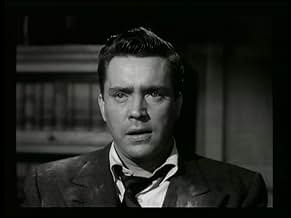
I may be biased, but O'Brien really deserved at least an Oscar nomination for his energetic and nuanced performance, as though Hollywood ever rewarded low-budget B-movies. In fact, I'm ready to enter him in the Olympics, for that 500-yard mad dash down Market Street. What a great natural reaction to the news that he's already a dead man. And filming the sequence with, I suspect, a hidden camera adds a kind of realism to the convoluted remainder of the whodunit.
Another high point is the sequence with the psychotic Chester (Brand). What a great piece of casting. Brand has such distinctive features, which he twists to full effect on the tormented Bigelow. But little does he know that Frank has acquired a peculiar kind of power. After all, what does he need to be afraid of since he's already dead. That scene in the drug store where Chester overplays his hand is another piece of fine filming and staging. I wouldn't be surprised that many in the audience have speculated with what they would do with Frank's kind of power, heavily purchased though it is.
What's so amazing about the movie is how adeptly the theme builds right down to the inevitable climax. We begin with a glimpse of a well-ordered world, but one that quickly descends into the depths of chaos and disorder, as Bigelow travels a nightmare road in pursuit of the where and why of his killer. I take the moral to be a conservative one, something like appreciating the routine and conventional, since it's never certain when an uncaring fate might intervene. After all, Frank really only comes to appreciate Paula and his small town once he's experienced its opposite. It's something that could happen to any of us, since even the most routine act may have unforeseen consequences. That's what's so unsettling about the movie.
Anyway, it's hats off to everyone involved in the making of this memorable noir. It's one of those submerged classics like Invasion of the Body Snatchers (1956) that surfaced only after a period on late night TV. Frankly, I still sometimes slip it out late at night, and pull up my socks real tight. To me, it's got that kind of staying power.
(In passing—living in LA, I occasionally pass the Bradbury Building and think of the movie. It looks pretty much the same as it did then, but has since acquired a kind of cachet among movie makers. I like to think it's because of the sweaty, underrated Eddie O'Brien and the unforgettable Frank Bigelow.)
Anyhow, don't let those sappy early scenes fool you. They're necessary to set up the contrasting downspiral that ensues. As it happens, Frank Bigelow (O'Brien) may be bored with his accounting job in a quiet little town, along with the prospects of marrying a conventional girl, Paula (Britton), and living out a routine existence there. So, at the first chance there he goes, off to enjoy adventures in the big city, even if only brief ones. And get a load of the available women swarming around his San Francisco hotel. Now that adventure beckons, it's no longer thoughts of Banning or Paula. (But what was musical arranger Tiomkin thinking with those utterly cartoonish wolf whistles, perhaps the movie's only flaw).
So, along with the goodtime gang he's hooked up with, it's off to wild nightspots for the suddenly footloose Bigelow. The trouble is Frank has taken a big step away from the ordered simplicity of his small town and into the unfamiliar world of chaotic city life. And worse, the frenzied chaos of The Fisherman, its strung-out patrons and aggressive atmosphere, clouds the fact that his life will never be the same. In fact, the jazz scene with it's blaring, chaotic close-ups amounts to a superb one-of-a-kind metaphor for the bizarre world the small town accountant has now entered. Just as importantly, it makes anything that happens thereafter seem weirdly possible. As a result, when Frank swallows what turns out to be a deadly neon toxin, it seems perfectly in keeping with this landscape of disorder.
I may be biased, but O'Brien really deserved at least an Oscar nomination for his energetic and nuanced performance, as though Hollywood ever rewarded low-budget B-movies. In fact, I'm ready to enter him in the Olympics, for that 500-yard mad dash down Market Street. What a great natural reaction to the news that he's already a dead man. And filming the sequence with, I suspect, a hidden camera adds a kind of realism to the convoluted remainder of the whodunit.
Another high point is the sequence with the psychotic Chester (Brand). What a great piece of casting. Brand has such distinctive features, which he twists to full effect on the tormented Bigelow. But little does he know that Frank has acquired a peculiar kind of power. After all, what does he need to be afraid of since he's already dead. That scene in the drug store where Chester overplays his hand is another piece of fine filming and staging. I wouldn't be surprised that many in the audience have speculated with what they would do with Frank's kind of power, heavily purchased though it is.
What's so amazing about the movie is how adeptly the theme builds right down to the inevitable climax. We begin with a glimpse of a well-ordered world, but one that quickly descends into the depths of chaos and disorder, as Bigelow travels a nightmare road in pursuit of the where and why of his killer. I take the moral to be a conservative one, something like appreciating the routine and conventional, since it's never certain when an uncaring fate might intervene. After all, Frank really only comes to appreciate Paula and his small town once he's experienced its opposite. It's something that could happen to any of us, since even the most routine act may have unforeseen consequences. That's what's so unsettling about the movie.
Anyway, it's hats off to everyone involved in the making of this memorable noir. It's one of those submerged classics like Invasion of the Body Snatchers (1956) that surfaced only after a period on late night TV. Frankly, I still sometimes slip it out late at night, and pull up my socks real tight. To me, it's got that kind of staying power.
(In passing—living in LA, I occasionally pass the Bradbury Building and think of the movie. It looks pretty much the same as it did then, but has since acquired a kind of cachet among movie makers. I like to think it's because of the sweaty, underrated Eddie O'Brien and the unforgettable Frank Bigelow.)
The waking dead
**SPOILERS** Staggering into a L.A police station barely alive Frank Bigelow, Edmound O'Brien, has a story to tell about a murder that he witnessed, his own! It all happened two days ago when Bigelow was straying in San Francisco on vacation from his job as a tax accountant during Market Week. At the Fisherman Club Bigelow got a bit juiced up and during drinks he was slipped a dose of luminous toxin in his glass. It's that toxin that's now on the verge of killing him. The reason that he was poisoned had to do with him notarizing a bill of sale for a shipment of iridium that was stolen and could put the person who shipped it behind bars for at least five years!
It took a while for Bigelow to realize that he had a fatal dose of luminous toxin in his system and by the time he did it was too late to save his life. But it wasn't too late for Bigelow to track down and find the person or persons who had him poisoned. And it's during the rest of the movie, in flashback, that's exactly what he did! And did it with an unrelenting fury as if his life depended on it!
In what is undoubtedly Edmound O'Brien's best role as Frank "Biggie" Bigeow the film "D.O.A" has him move heaven and earth to find the person who eventually murdered him. From San Francisco to Los Angeles as well as parts in between Bigelow finally track him down to the Philips Inport-Export office at the Bradbury Building in downtown L.A. It in fact was Philips who was murdered, by being thrown to his death, because of the illegal iridium shipment that he later realized he was tricked into handling. With Philips dead the only person who could connect both his murderer and the person whom he shipped the iridium for is Frank Bigelow who handled, by notarizing the bill of sale, the shipment!
Non stop action thriller as a dying, or murdered, man turns L.A upside down in trying to find his killer and exact punishment on him before he himself expires! Bigelow also gets involved with L.A mobster Majak, Luther Adler, whom the illegal iridium was delivered for. In knowing about Majak's involvement in it had Bigelow targeted by him and his sadistic and unstable hit man Chester, Naville Brand, for immediate termination. That's if the luminous toxin doesn't kill him first!
Even though the movie is a scant 83 minutes long it packs enough action to fill some half dozen films of it's type: Film Noir Thrillers. Frank Bigelow is a man who knows that he hasn't long to live and therefore throws caution to the wind in trying to find his killer before the curtain comes down on him. It was in fact that almost suicidal determination on Bigelow's part that in the end brought him results!
It took a while for Bigelow to realize that he had a fatal dose of luminous toxin in his system and by the time he did it was too late to save his life. But it wasn't too late for Bigelow to track down and find the person or persons who had him poisoned. And it's during the rest of the movie, in flashback, that's exactly what he did! And did it with an unrelenting fury as if his life depended on it!
In what is undoubtedly Edmound O'Brien's best role as Frank "Biggie" Bigeow the film "D.O.A" has him move heaven and earth to find the person who eventually murdered him. From San Francisco to Los Angeles as well as parts in between Bigelow finally track him down to the Philips Inport-Export office at the Bradbury Building in downtown L.A. It in fact was Philips who was murdered, by being thrown to his death, because of the illegal iridium shipment that he later realized he was tricked into handling. With Philips dead the only person who could connect both his murderer and the person whom he shipped the iridium for is Frank Bigelow who handled, by notarizing the bill of sale, the shipment!
Non stop action thriller as a dying, or murdered, man turns L.A upside down in trying to find his killer and exact punishment on him before he himself expires! Bigelow also gets involved with L.A mobster Majak, Luther Adler, whom the illegal iridium was delivered for. In knowing about Majak's involvement in it had Bigelow targeted by him and his sadistic and unstable hit man Chester, Naville Brand, for immediate termination. That's if the luminous toxin doesn't kill him first!
Even though the movie is a scant 83 minutes long it packs enough action to fill some half dozen films of it's type: Film Noir Thrillers. Frank Bigelow is a man who knows that he hasn't long to live and therefore throws caution to the wind in trying to find his killer before the curtain comes down on him. It was in fact that almost suicidal determination on Bigelow's part that in the end brought him results!
Over his dead body
Great B-movie film noir, played as if his life depended on it (and it does) by Edmond O'Brien as a small-town notary who pays a big price for signing the wrong document at the wrong time, turning what should have been a pleasure trip to the west coast into a murderous affair altogether.
It starts with a bang, O'Brien staggering into the local homicide unit to tell the cops that there's been a murder - his, before launching into the massive flash-back which takes up pretty much the rest of the movie. The action from there on is hectic and as convoluted as all the best noirs are as O'Brien, infected by a deadly poison, races against the clock to track down his own killer and the reason behind it.
The film makes fine use of actual San Francisco and Los Angeles locations as well as authentically depicting the hot and steamy atmosphere at a Frisco jazz club. O'Brien is great as the doomed Bigelow, racing, often literally, against the clock, stopping only to palm off his adoring secretary girl-friend, Pamela Britten, who of course doesn't find out what's wrong with him until too late.
The pacing is almost non-stop once it gathers momentum, unfortunately when it does, some of the scene-writing gets over-ripe and correspondingly over-acted as O'Brien and his girl pour out their hearts somewhat unnecessarily. The film ends bravely though with a downbeat conclusion, delivering what the title says it must and at least tying up all the loose ends by that time.
It starts with a bang, O'Brien staggering into the local homicide unit to tell the cops that there's been a murder - his, before launching into the massive flash-back which takes up pretty much the rest of the movie. The action from there on is hectic and as convoluted as all the best noirs are as O'Brien, infected by a deadly poison, races against the clock to track down his own killer and the reason behind it.
The film makes fine use of actual San Francisco and Los Angeles locations as well as authentically depicting the hot and steamy atmosphere at a Frisco jazz club. O'Brien is great as the doomed Bigelow, racing, often literally, against the clock, stopping only to palm off his adoring secretary girl-friend, Pamela Britten, who of course doesn't find out what's wrong with him until too late.
The pacing is almost non-stop once it gathers momentum, unfortunately when it does, some of the scene-writing gets over-ripe and correspondingly over-acted as O'Brien and his girl pour out their hearts somewhat unnecessarily. The film ends bravely though with a downbeat conclusion, delivering what the title says it must and at least tying up all the loose ends by that time.
Marvelous Metaphor!
D. O. A. is an intriguing, fast paced movie, rife with metaphor. A mood of chaos and uncertain boundaries is introduced early in the film. At a hotel in San Francisco, businessman Frank Bigelow, seeking little more than the ephemeral pleasure of a brief trip, finds himself in the midst of party revelers. With unsettling frivolity, they roam randomly about their various guest rooms which appear unlocked and opened. The mood of strident, forced conviviality climaxes when they move the party to a local bar called "The Fisherman." As the jazz played in the venue intensifies in volume and rhythm, uneven camera angles catch the various musicians playing to the point that they're breaking sweat and literally, physically vibrating. Bigelow himself is jostled about in the crowd, actually losing his footing for a moment. The setting is that of a little world both frenzied and crazed. Bigelow appears detached as all react excitedly and emotionally to music that he admits isn't his taste.
This memorable key scene portends his disconnection from those around him and represents a crack, however slight, in his life's foundation. Though initially reticent about socializing and imbibing with people he just met, he has unwittingly been thrust into a reality more threatening than is immediately apparent. Later in the film, a jarring example of his full blown isolation occurs when he finds himself in an outdoor, public area. In unbearable turmoil, he momentarily encounters a little girl innocently playing with a toy. She appears in soft lighting, contrasting starkly to the shadows surrounding Bigelow, whose face registers the painful shock of awareness that ordinary activity continues unabated even while he grapples with extreme danger. This is reinforced when seconds later he observes a young couple embracing, compounding his agonizing realization that all simple pleasures are now unattainable to him. Noticeably, when he is literally "up against the wall" his back is touching signage of "Life Magazine" logos. All that once comprised his own life, that which he had considered to be little more than mundane minutiae, is heightened in significance and irrevocably at stake.
This memorable key scene portends his disconnection from those around him and represents a crack, however slight, in his life's foundation. Though initially reticent about socializing and imbibing with people he just met, he has unwittingly been thrust into a reality more threatening than is immediately apparent. Later in the film, a jarring example of his full blown isolation occurs when he finds himself in an outdoor, public area. In unbearable turmoil, he momentarily encounters a little girl innocently playing with a toy. She appears in soft lighting, contrasting starkly to the shadows surrounding Bigelow, whose face registers the painful shock of awareness that ordinary activity continues unabated even while he grapples with extreme danger. This is reinforced when seconds later he observes a young couple embracing, compounding his agonizing realization that all simple pleasures are now unattainable to him. Noticeably, when he is literally "up against the wall" his back is touching signage of "Life Magazine" logos. All that once comprised his own life, that which he had considered to be little more than mundane minutiae, is heightened in significance and irrevocably at stake.


Did you know
- TriviaThe scene in which Bigelow runs in panic through the streets after learning he has been poisoned was what is considered a 'stolen shot' where the pedestrians along the sidewalk had no idea a movie was being made and no warning that Edmond O'Brien would be plowing through them.
- GoofsAfter finding out who's in the photo, Bigelow leaves the photography studio and immediately starts getting shot at. He heads toward the factory (screen right) where the shots are supposed to be coming from, but all the shots being fired and ricocheting off the ground, pipe, barrel, etc. are coming from the other direction (screen left).
- Quotes
[first lines]
Homicide Detective: Can I help you?
Frank Bigelow: I'd like to see the man in charge.
Homicide Detective: In here...
Frank Bigelow: I want to report a murder.
Homicide Captain: Sit down. Where was this murder committed?
Frank Bigelow: San Francisco, last night.
Homicide Captain: Who was murdered?
Frank Bigelow: I was.
- Crazy creditsThe end credits read "The medical facts in this motion picture are authentic. Luminous toxin is a descriptive term for an actual poison. Technical Adviser, Edward F. Dunne, M.D."
- Alternate versionsAlso available in a colorized version.
- ConnectionsEdited into Déjà-vu (2000)
Details
- Release date
- Country of origin
- Language
- Also known as
- Con las horas contadas
- Filming locations
- Production companies
- See more company credits at IMDbPro
- Runtime
- 1h 23m(83 min)
- Color
- Aspect ratio
- 1.37 : 1
Contribute to this page
Suggest an edit or add missing content