

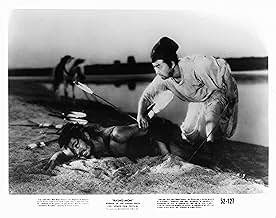
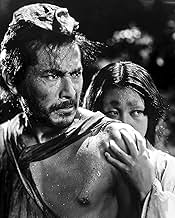
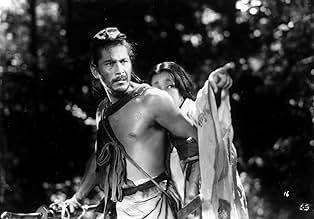
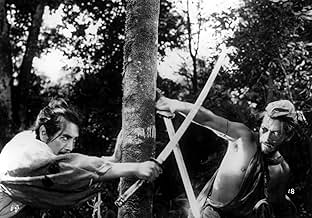
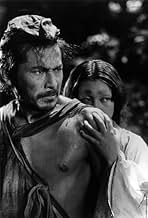
The rape of a bride and the murder of her samurai husband are recalled from the perspectives of a bandit, the bride, the samurai's ghost and a woodcutter.The rape of a bride and the murder of her samurai husband are recalled from the perspectives of a bandit, the bride, the samurai's ghost and a woodcutter.The rape of a bride and the murder of her samurai husband are recalled from the perspectives of a bandit, the bride, the samurai's ghost and a woodcutter.
- Director
- Writers
- Stars
- Nominated for 1 Oscar
- 9 wins & 5 nominations total



- Director
- Writers
- All cast & crew
- Production, box office & more at IMDbPro
8.1193.7K
1
2
3
4
5
6
7
8
9
10
Summary
Reviewers say 'Rashomon' delves into the nature of truth and reality through multiple conflicting perspectives of a crime. Characters like the bandit, wife, samurai, and woodcutter offer varied accounts, showcasing subjective truth and human perception's unreliability. The film challenges viewers to question truth and personal biases' impact on storytelling. Its innovative narrative and cinematography highlight human nature's complexity and the struggle to find objective truth, receiving both acclaim and critique for its profound themes and structure.
Featured reviews
A superb Classic
Kurosawa's magic film is a composite of 2 Japanese short stories by Ryunosuke Akutagawa: One, "Rashomon," the title tells of a confrontation of a young man at Rashomon, the large, fortified gate at one entrance to Kyoto where people would abandon children and corpses; the other, yabu no naka ni, "In a Grove," tells of the confrontation between the bandit, the samurai and his wife, told from the point of view of the woodcutter. In 1950, Kurosawa weaves this tale of human vanity and duplicity with the young Toshiro Mifune, as the bandit, Machiko Kyo as the lady and Masayuki Mori as the samurai. The tale unfolds through the flashbacks in the narration of the great Takashi Shimura as the woodcutter, supported by character actors Minoru Chiaki as the monk and Kichijiro Ueda as the bum. Basically, with a cast of six and the stark settings of a woods and a dilapidated castle gate in pouring rain, Kurosawa the magician gives us four views of human vanity, excessive pride and cultural conflict. The foibles of human needs are exposed but redeemed in the final scene where the basic act of kindness brings closure to the bizarre display of greed, lust and mendacity that has gone before. For a Kurosawa film, this one is short, to the point with an economy of emoting-- for which Mifune was never accused of under doing and the viewer is left somewhat exhausted by all the twists and turns, confused by the mix of contradictions and seeming paradox, but satisfied with a feeling of hope.
Art!
This was Kurosawa's first big international hit, from then on his films would be avidly watched and (usually) feted as Art. His style was always so breathtakingly simple that you can't help but get sucked into the rainy and sunny bestial world depicted in here, with a beautiful use of the black and white nitrate film stock contrasting against a sordid storyline. I've probably seen it 10 times now over the decades and it seems to get better every time I settle down to it - it's been a continual treat.
A horror story from a few days previous is recounted on a ferociously wet day: beautiful woman is (apparently) raped by animalistic bandit in front of her husband who is then (apparently) murdered. But who really did what to who and why? It's told from four viewpoints: the bandit's, the honourable woman's, the heroic dead husband's via a rather startling medium and lastly a breathless version from a timid eye-witness. The event becomes a crime scene with the beauty of forest surrounding us and splintered sunlight beaming down on us through the trees bearing mute witness to the savage few moments. It's a salutary lesson in Human Beings vs Objectivity; the psychologies of the main protagonists are laid bare, as well as the story-tellers, even to Kurosawa and the viewers themselves. Who's telling the truth/ was it a mixture of all versions/ was there another truth untold? Only you can decide!
I urge all innocent bystanders who have a problem with b&w non-HD 4:3 subtitled Japanese films from 1950 to try to get over it! Because it's a riveting journey, expertly handled by probably the best film director who's ever lived, all subjective of course.
A horror story from a few days previous is recounted on a ferociously wet day: beautiful woman is (apparently) raped by animalistic bandit in front of her husband who is then (apparently) murdered. But who really did what to who and why? It's told from four viewpoints: the bandit's, the honourable woman's, the heroic dead husband's via a rather startling medium and lastly a breathless version from a timid eye-witness. The event becomes a crime scene with the beauty of forest surrounding us and splintered sunlight beaming down on us through the trees bearing mute witness to the savage few moments. It's a salutary lesson in Human Beings vs Objectivity; the psychologies of the main protagonists are laid bare, as well as the story-tellers, even to Kurosawa and the viewers themselves. Who's telling the truth/ was it a mixture of all versions/ was there another truth untold? Only you can decide!
I urge all innocent bystanders who have a problem with b&w non-HD 4:3 subtitled Japanese films from 1950 to try to get over it! Because it's a riveting journey, expertly handled by probably the best film director who's ever lived, all subjective of course.
What did we just see?
'People forget the unpleasant things. They only remember what they want to remember.'
In Rashomon the editing tells ½ of the story. It may feel experimental or unconventional, but Kurosawa perfects the concept second by second, directing and editing. This film didn't need a big budget to come perfectly to the point. It's a simple tale, but not a superficial tale. Different points of view and selective memories ('It's true! I saw it!') don't only make the woods unsafe, but are one of the most universal topics of humanity. 'We humans are weak creatures. That's why we lie, even to ourselves' says it all actually: it's about what people want to hear and when they start being interested at all, apart from wishful thinking. Selfish excuses vs trust in other people.
Rashomon gets masterful when in one instant there is literally a different point of view: the camera takes another position to shoot the same sequence, thereby forcing the audience to reconsider what they just saw. That is the sort of storytelling that the supposed masters of cinema in our time yet have to equal, or try to copy when they fail. Admitted 'Memento' (2000, Nolan) is a truly great one. Still not THAT universal. 'Pulp Fiction' (1994) didn't come close, 'La Commare Secca' (1962) also didn't. 'Ghost dog: the way of the samurai' (1999) touched another border of the concept, or does it?
The use of (non-original) music in my opinion reveals a certain interest for western influence, not only in Rashomon, but also in Kurosawa's forthcoming films, and is probably why his films were so influential on western filmmakers too.
The cinematography is dynamic and changes scene by scene to emphasize exactly what is going on. The shadows of leaves and branches, captured by cinematographer Kazuo Miyagawa, make you really feel 'in the woods', while the actors (Toshirô Mifune, Takashi Shimura) convince the remaining part of the audience (which adds up to 100% breathless viewers). It may be after days that you first realize you saw an important film. After weeks you realize that you must see it again to comprehend (despite it's only 85 min), and ironically that is just one of the crucial points that Kurosawa made. 10/10
In Rashomon the editing tells ½ of the story. It may feel experimental or unconventional, but Kurosawa perfects the concept second by second, directing and editing. This film didn't need a big budget to come perfectly to the point. It's a simple tale, but not a superficial tale. Different points of view and selective memories ('It's true! I saw it!') don't only make the woods unsafe, but are one of the most universal topics of humanity. 'We humans are weak creatures. That's why we lie, even to ourselves' says it all actually: it's about what people want to hear and when they start being interested at all, apart from wishful thinking. Selfish excuses vs trust in other people.
Rashomon gets masterful when in one instant there is literally a different point of view: the camera takes another position to shoot the same sequence, thereby forcing the audience to reconsider what they just saw. That is the sort of storytelling that the supposed masters of cinema in our time yet have to equal, or try to copy when they fail. Admitted 'Memento' (2000, Nolan) is a truly great one. Still not THAT universal. 'Pulp Fiction' (1994) didn't come close, 'La Commare Secca' (1962) also didn't. 'Ghost dog: the way of the samurai' (1999) touched another border of the concept, or does it?
The use of (non-original) music in my opinion reveals a certain interest for western influence, not only in Rashomon, but also in Kurosawa's forthcoming films, and is probably why his films were so influential on western filmmakers too.
The cinematography is dynamic and changes scene by scene to emphasize exactly what is going on. The shadows of leaves and branches, captured by cinematographer Kazuo Miyagawa, make you really feel 'in the woods', while the actors (Toshirô Mifune, Takashi Shimura) convince the remaining part of the audience (which adds up to 100% breathless viewers). It may be after days that you first realize you saw an important film. After weeks you realize that you must see it again to comprehend (despite it's only 85 min), and ironically that is just one of the crucial points that Kurosawa made. 10/10
Most of the time we can't even be honest with ourselves.
To have a film that holds the coveted title of being the reason that the "Best Foreign Film" category was created for the Oscars is one thing, but to be able to back up that myth with a powerful film that speaks both about humanity and the strength of truth is a whole new angle. Often we witness powerful foreign films that slip through the lines of cinema, regarded by so many as valuable assets to the film community, but never see the gold of Oscar. In the same sense, sometimes the most popular of those foreign films eventually become Oscar contenders, not because they are worthy enough, but because studios had the funds to allow bigger distribution to audiences, thus allowing popularity to do the rest. Rashômon is one of those few films that succeed in giving us both a quality film and the accolades to represent it. Rashômon is a rare breed of film. The Japanese filmmaker Akira Kurosawa took many bold steps with this film (pointing his camera at the sun, filming deep within the jungle, and the mockery of truth), that it is unlikely that you could go to a modern day Hollywood film without seeing one of these techniques being "borrowed". His bold storytelling, creative camera work, and powerful characters give us a unique story that should be included in everyone's film library.
While the characters were strong, the direction was flawless, and the story was compelling, there is a theme that needs to be discussed while talking about Rashômon. This is the story of murder, betrayal, and rape and in any typical "courthouse" film you would have some spineless witness finally break down and confess the truth. At the end of these films the truth is discovered, but not in Rashômon. Kurosawa gives us the "black sheep" of themes by never really giving us what we really wanted from the beginning of this story. As I began this film, I thought I was going to get a clear-cut story with honesty and troubled souls, but instead I was handed no prize at the end. What I sought after the most is not handed to me in a Happy Meal container at the end, but instead trapped still within the film. Kurosawa gives us the meaning behind the story, that there possibly is no way of knowing the true "truth". Four different souls, seeing the same event all culminating to four different results means that the "truth" may never be known. Kurosawa has taken the story and provided us with the main character being truth, and like Kaiser Soze, the greatest trick it ever pulled was convincing us that "it didn't exist". Deep within Rashômon the truth is hidden, and it may never emerge, but that is what Kurosawa intended. A viewer could walk away from this film, after several viewings, and discover different truths about the characters and story. This is a constantly evolving film that will continually get better with time.
Outside of these beautiful themes, Rashômon is a flawless film. From the execution of the actors to the simplicity of the direction, there is plenty in this film to keep your mind busy and your jaw nearly dragging on the floor. To begin, the performance by Toshiro Mifune ranks among the best in film history. In each of the stories he is portrayed differently (even in his own) and with precise execution he delivers every time. He is insane, passionate, loyal, and villainous all at the same time. While some may see his acting as eccentric or over-the-top, I found each of his portrayals as accurate and astute. When Mifune is on the screen his presence commands your eyes and you cannot help but become involved. Second to his performance is that of the troubled wife. While her characters is the most confusing/suspicious of them all, Masayuki Mori keeps us intertwined with the story by controlling her character with the greatest of ease. When it is time for her to be unleashed, the true drama of the story is thrown in your face with brilliance and expertise.
Overall, I thought that this was a near perfect film. Kurosawa is intense, original, and adeptly secure about his stories. I have seen the same passion in Ran, and it cannot be denied. My only concern with this film is that if you are going to watch this movie, make sure that you can devote your entire mind to it. I found myself watching it three times because I could not stay focused (outside factors) enough to see those darkly hidden themes. I especially enjoyed the unearthed darkness of humanity, which is hinted on at the end. The fact that after hearing these stories of murder and rape, it doesn't stop one from continuing along a similar path. It is a powerful tale that should be enjoyed by all!
Grade: **** out of *****
While the characters were strong, the direction was flawless, and the story was compelling, there is a theme that needs to be discussed while talking about Rashômon. This is the story of murder, betrayal, and rape and in any typical "courthouse" film you would have some spineless witness finally break down and confess the truth. At the end of these films the truth is discovered, but not in Rashômon. Kurosawa gives us the "black sheep" of themes by never really giving us what we really wanted from the beginning of this story. As I began this film, I thought I was going to get a clear-cut story with honesty and troubled souls, but instead I was handed no prize at the end. What I sought after the most is not handed to me in a Happy Meal container at the end, but instead trapped still within the film. Kurosawa gives us the meaning behind the story, that there possibly is no way of knowing the true "truth". Four different souls, seeing the same event all culminating to four different results means that the "truth" may never be known. Kurosawa has taken the story and provided us with the main character being truth, and like Kaiser Soze, the greatest trick it ever pulled was convincing us that "it didn't exist". Deep within Rashômon the truth is hidden, and it may never emerge, but that is what Kurosawa intended. A viewer could walk away from this film, after several viewings, and discover different truths about the characters and story. This is a constantly evolving film that will continually get better with time.
Outside of these beautiful themes, Rashômon is a flawless film. From the execution of the actors to the simplicity of the direction, there is plenty in this film to keep your mind busy and your jaw nearly dragging on the floor. To begin, the performance by Toshiro Mifune ranks among the best in film history. In each of the stories he is portrayed differently (even in his own) and with precise execution he delivers every time. He is insane, passionate, loyal, and villainous all at the same time. While some may see his acting as eccentric or over-the-top, I found each of his portrayals as accurate and astute. When Mifune is on the screen his presence commands your eyes and you cannot help but become involved. Second to his performance is that of the troubled wife. While her characters is the most confusing/suspicious of them all, Masayuki Mori keeps us intertwined with the story by controlling her character with the greatest of ease. When it is time for her to be unleashed, the true drama of the story is thrown in your face with brilliance and expertise.
Overall, I thought that this was a near perfect film. Kurosawa is intense, original, and adeptly secure about his stories. I have seen the same passion in Ran, and it cannot be denied. My only concern with this film is that if you are going to watch this movie, make sure that you can devote your entire mind to it. I found myself watching it three times because I could not stay focused (outside factors) enough to see those darkly hidden themes. I especially enjoyed the unearthed darkness of humanity, which is hinted on at the end. The fact that after hearing these stories of murder and rape, it doesn't stop one from continuing along a similar path. It is a powerful tale that should be enjoyed by all!
Grade: **** out of *****
Kurosawa's first milestone, one of the top foreign films of the 20th century
Akira Kurosawa was one of those directors, the first from the Eastern hemisphere, to develop the form and structure of cinema in ways it hadn't been. The story he used for Rashomon is now, like Seven Samurai, Hidden Fortress, and Yojimbo, a near archetype that at this point in the history of film has become formula and common knowledge for writers and directors. In that sense, Rashomon is as important and entertaining as a film as Citizen Kane, Battleship Potemkin, Rear Window, or Open City. Tee basic premise- Four different people give four different accounts on the rape and murder of a couple in the woods. A key ingredient to the success of Rashomon, is that the recollections given to the courts by the woman, the bandit, the as well as the four in discussion, is that their emotions reveal their humanity, even if their details reveal nothing, or everything. It's difficult to say whether character goes over story here, or if they have equal importance to understand Kurosawa's psychology with these people.
The opening shot of the house is a perfect representation of the mature of the picture, something that has fallen apart over time due to disasters that go beyond control of individuals. The man who heard the testimonies of the trial says "I don't understand". This has been a discussed line, since essentially he's saying the point right up front. All the information won't ease his puzzlement. The three who discuss the details of the crimes and confessions are crucial- they speak for us, what our opinions might be, and we listen to each version of the story, the characters, the fears, the pride, the shame, and the search for judgment and/or truth in the situation.
Along with being director and co-adapter, Kurosawa's mastery is revealed heavily in his use of editing- there are short, fleeting moments that hint, or rather pronounce, emotions and thoughts. For instance, when we first see Tajomaru, the bandit, played by action-legend Toshiro Mifune, he is looking up at the sky, bound in straps to keep him from moving, and for a second, or less than a second, there's a shot of what he sees in the sky, then back to his face which reveals an expression that borders on skeptical, and a bit crazed, or more. Mifune's part is of a barbarian, but all the more believable as a human barbarian since he acts as such with animal desires- he sees the woman in the woods, and knows he wants her, and while he reflects that he didn't have to have killed the man, he did as a last resort as a man with an urge. This is intensified by a sadistic flee with his actions.
What's intriguing about that first description/recollection of the battle between him and the other man, is that it seems like it could be the truth, and to one viewer it could, and to another it seems like it could all be apart of his hyperactive and trapped imagination. And in the attack of the bandit on the woman, at first to him, it's like a game, then in later descriptions, he feels a little more un-easy, then later, it's of neither pleasure or discomfort, it just is. This kind of technique later happens with the woman who was victim (who has conviction, though is herself an archetype of Lifetime women), the presence who saw it "all", and with the man who in the beginning didn't understand. In each telling the expressions, the cut-aways, the lighting and movement by Kazuo Miyagawa, it's equally startling, exhilarating.
That the film gives off such a hypnotic aura isn't surprising, or perhaps it is for those in the grips of the emotion of it all- the dead man's story is like the hook ripping into a twelve foot bass. The final accouter of the tale proves the most accurate to the common observer, yet Kurosawa knows that's not the point- if he made it as such to be bold AND had a definite concrete point, the ending would be as poignant when revealed is the truth, or what one could believe as the closest thing to it is. We know why that last person didn't want to get involved with the courts with what he knows: his story is no more a revelation, of any comfort or consolation to the listeners, than the others. I highly recommend this to anyone, and to those who have distaste to foreign films should view it once anyway- it's certainly not a long movie, and it won't loose its grip on anyone willing to give itself to the tale(s). For me, it's another to add to my top 50 of all time.
The opening shot of the house is a perfect representation of the mature of the picture, something that has fallen apart over time due to disasters that go beyond control of individuals. The man who heard the testimonies of the trial says "I don't understand". This has been a discussed line, since essentially he's saying the point right up front. All the information won't ease his puzzlement. The three who discuss the details of the crimes and confessions are crucial- they speak for us, what our opinions might be, and we listen to each version of the story, the characters, the fears, the pride, the shame, and the search for judgment and/or truth in the situation.
Along with being director and co-adapter, Kurosawa's mastery is revealed heavily in his use of editing- there are short, fleeting moments that hint, or rather pronounce, emotions and thoughts. For instance, when we first see Tajomaru, the bandit, played by action-legend Toshiro Mifune, he is looking up at the sky, bound in straps to keep him from moving, and for a second, or less than a second, there's a shot of what he sees in the sky, then back to his face which reveals an expression that borders on skeptical, and a bit crazed, or more. Mifune's part is of a barbarian, but all the more believable as a human barbarian since he acts as such with animal desires- he sees the woman in the woods, and knows he wants her, and while he reflects that he didn't have to have killed the man, he did as a last resort as a man with an urge. This is intensified by a sadistic flee with his actions.
What's intriguing about that first description/recollection of the battle between him and the other man, is that it seems like it could be the truth, and to one viewer it could, and to another it seems like it could all be apart of his hyperactive and trapped imagination. And in the attack of the bandit on the woman, at first to him, it's like a game, then in later descriptions, he feels a little more un-easy, then later, it's of neither pleasure or discomfort, it just is. This kind of technique later happens with the woman who was victim (who has conviction, though is herself an archetype of Lifetime women), the presence who saw it "all", and with the man who in the beginning didn't understand. In each telling the expressions, the cut-aways, the lighting and movement by Kazuo Miyagawa, it's equally startling, exhilarating.
That the film gives off such a hypnotic aura isn't surprising, or perhaps it is for those in the grips of the emotion of it all- the dead man's story is like the hook ripping into a twelve foot bass. The final accouter of the tale proves the most accurate to the common observer, yet Kurosawa knows that's not the point- if he made it as such to be bold AND had a definite concrete point, the ending would be as poignant when revealed is the truth, or what one could believe as the closest thing to it is. We know why that last person didn't want to get involved with the courts with what he knows: his story is no more a revelation, of any comfort or consolation to the listeners, than the others. I highly recommend this to anyone, and to those who have distaste to foreign films should view it once anyway- it's certainly not a long movie, and it won't loose its grip on anyone willing to give itself to the tale(s). For me, it's another to add to my top 50 of all time.


Did you know
- TriviaDuring shooting, the cast approached Akira Kurosawa en masse with the script and asked him, "What does it mean?" The answer he gave at that time and also in his autobiography is that the movie is a reflection of life, and life does not always have clear meanings.
- GoofsAt the beginning when the woodcutter finds the dead body, the arms and hands are stiff and raised. However, both arms can be seen slightly moving. Apparently, a real person was used, and the actor was unable to keep the arms perfectly still.
- Alternate versionsCriterion Collection releases of this film feature an English Dubbed Version in addition to the traditional, original Japanese version. This is unusual in that Criterion are usually film purists that do not put English language dubs on their discs that contain a foreign language film.
- ConnectionsEdited into Papillon d'amour (2004)
- SoundtracksWoman's Tale Theme (Bolero)
Written by Fumio Hayasaka inspired by Maurice Ravel's "Bolero", using the same background rhythm, and similar orchestration and build-up, but different melodic lines.
Details
Box office
- Budget
- $250,000 (estimated)
- Gross US & Canada
- $46,808
- Opening weekend US & Canada
- $15,942
- Jul 28, 2002
- Gross worldwide
- $141,888
- Runtime
- 1h 28m(88 min)
- Color
- Aspect ratio
- 1.37 : 1
Contribute to this page
Suggest an edit or add missing content