IMDb RATING
7.6/10
5.2K
YOUR RATING
A determined priest and a Communist mayor develop a grudging friendship in spite of their official rivalry.A determined priest and a Communist mayor develop a grudging friendship in spite of their official rivalry.A determined priest and a Communist mayor develop a grudging friendship in spite of their official rivalry.
- Nominated for 1 BAFTA Award
- 3 wins & 3 nominations total
Vera Talchi
- Gina Filotti
- (as Vera Talqui)
Charles Vissières
- Il Vescovo
- (as Charles Vissiere)
Clara Auteri Pepe
- Woman saying 'Viva Peppone!'
- (as Clara Auteri)
Manuel Gary
- Il delegato
- (as Manoel Gary)
7.65.1K
1
2
3
4
5
6
7
8
9
10
Featured reviews
Such a treat!
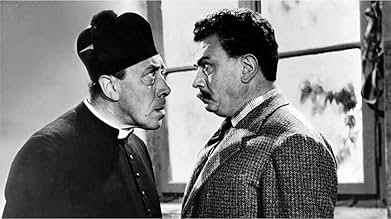
This movie is so much fun to watch! Tells us the story of Don Camillo, a Roman Catholic priest in a small Italian parish. Life in the village is change forever when Peppone, the communist mayor, is elected. The two are put one against the other. And what follows is a wacky list of situations! What I like most about this movie, it's the simple way it puts things. You can actually believe that this village exists and that what's being told in the movie really happened.
Fernandel is great as Don Camillo, the hot-headed priest. And Gino Cervi shines in the role of Peppone. See this one, you won't regret it. Fun from beginning to end!
Out of 100, I gave it 87. That's good for ***½ out of ****.
Seen at home, in Toronto, on September 1st, 2002.
Fernandel is great as Don Camillo, the hot-headed priest. And Gino Cervi shines in the role of Peppone. See this one, you won't regret it. Fun from beginning to end!
Out of 100, I gave it 87. That's good for ***½ out of ****.
Seen at home, in Toronto, on September 1st, 2002.
A marvellous, warm, charming, adorable Italian film.
...Actually, of all those adjectives, `Italian' was the first to leap to mind. I can't believe the IMDb has decided to classify this film under a French name. `Things happen there that could happen nowhere else in the world,' says the narrator. It's easy to believe.
The Catholics and the communists are battling for the soul of a small village. It's to be hoped that neither side ever wins. Nor is it likely that either side ever will win. This would spoil everyone's fun.
The communist mayor, is, so to speak, the Anglican of the two: someone who will gruffly talk about burning all the capitalists, while letting it be understood that he doesn't really intend his words to be taken literally. The priest (Don Camillo) is hot-headed, as fiercely loyal to the Catholic Church as the mayor is to his party, at once highly intelligent and preternaturally simple minded. He's the kind of Catholic who avoids absurdity by the time-honoured trick of simply not thinking about the doctrines to which he officially subscribes. His `prayers' are impromptu conversations with Jesus, or perhaps simply with the icon of Jesus that hangs on his wall - whichever it is, the film humours his fancy by having Jesus (or the icon) talk back to him. To this day I'm not sure if Jesus (or the icon) is REALLY talking back, or if it's just Don Camillo's imagination. What does it matter? It is, after all, no more than a private eccentricity. It's not as if he talks to or about Jesus in PUBLIC.
No one - not atheists, not communists, not Christians, not Norse pagans - could object to the film's big-hearted fantasy, or fail to like either of the two very likeable protagonists. I gather there are several sequels: the one I've seen isn't nearly as good; and the original feels so much like an archetype that I suspect any sequel would be little more than a footnote.
The Catholics and the communists are battling for the soul of a small village. It's to be hoped that neither side ever wins. Nor is it likely that either side ever will win. This would spoil everyone's fun.
The communist mayor, is, so to speak, the Anglican of the two: someone who will gruffly talk about burning all the capitalists, while letting it be understood that he doesn't really intend his words to be taken literally. The priest (Don Camillo) is hot-headed, as fiercely loyal to the Catholic Church as the mayor is to his party, at once highly intelligent and preternaturally simple minded. He's the kind of Catholic who avoids absurdity by the time-honoured trick of simply not thinking about the doctrines to which he officially subscribes. His `prayers' are impromptu conversations with Jesus, or perhaps simply with the icon of Jesus that hangs on his wall - whichever it is, the film humours his fancy by having Jesus (or the icon) talk back to him. To this day I'm not sure if Jesus (or the icon) is REALLY talking back, or if it's just Don Camillo's imagination. What does it matter? It is, after all, no more than a private eccentricity. It's not as if he talks to or about Jesus in PUBLIC.
No one - not atheists, not communists, not Christians, not Norse pagans - could object to the film's big-hearted fantasy, or fail to like either of the two very likeable protagonists. I gather there are several sequels: the one I've seen isn't nearly as good; and the original feels so much like an archetype that I suspect any sequel would be little more than a footnote.
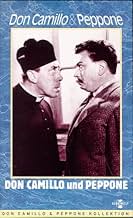
Right and left.
French comic actor Fernandel embodied the title role while remarkable Italian character actor Gino Cervi played his spiritual and political opponent. More than a rustic comedy, the film epitomizes the postwar political polarization in Italy and symbolizes the famous "compromesso storico"---historical compromise---under which Italy would long continue to be governed. This successful film spawned a series of popular sequels, mostly with the same two actors, all based on the Giovanni Guareschi novels. A point of clarification: this was a French-Italian co-production and was first released in the U.S. in its French-language version with English subtitles before the dubbed English version with narrator Orson Welles went into circulation. The Italian-language version, not readily available, is the most appropriate one.
Quiet, funny and heartwarming
I have recently watched so many American gangster and noir films that I felt I needed something different for a change. What better than a French-Italian co-production from the immediate post-war period? It got to be 'The Little World of Don Camillo'. Fernandel plays the eponymous priest of a small town in Northern Italy who is the friend and enemy of the newly elected communist mayor 'Peppone' Bottazzi (Gino Cervi with a moustache that makes him look like Stalin). The film, set in 1946, concerns Camillo and Peppone's friendly quarrels about how best to serve their little town (the 'little world' of the title): they want the same things but differ about the best ways to get them. Director Julien Duvivier has adapted episodes from Guareschi's novel and cleverly intervove them so that they make up a charming and amusing whole: a film that's heartwarming and funny, though there are no moments when you laugh out loud. Fernandel is outstanding and Cervi does very well as his frenemy. The picture is interesting non the least because it offers a glimpse of life in post-war Italy and an insight into the political and social atmosphere of the time. Highly recommended!
One of my all-time classics
This is, and has been since I was a young boy, one of my favorite movies.
It's the story of a Catholic priest and a Communist mayor who are each others worst enemy and best friend. The dialogs are just great, but what I like most about these movies (there a are 5 in total) is that both main characters (Don Camillo and Peppone) are "real people". They act on impulse, say one thing but think the other, manipulate... they are real humans. When one of Peppone's people dies and asks for the church-bells to be rang at his funeral, Don Camillo refuses because he was no Catholic. Peppone orders a big bell to be placed in the town square which Don Camillo sabotages. The bell is broken and sounds horrible but at the end, Don Camillo rings his bells because "by asking for the bells, the boy was asking for God". This is one of these typical things I like about these movies.
I've got the good fortune I also understand French and can watch these movies in that language. I can't imagine what they would sound like in English but I would advice anyone to watch them in the French version. I hate dubbed movies and can't imagine Fernandel speaking English (although in one movie he does which is hilarious). But in all, I think even the English version still is one of the best movies ever made.
If you're not prejudiced against black and white and foreign movies, this is a movie you have to see. If you are, you don't know what you're missing.
It's the story of a Catholic priest and a Communist mayor who are each others worst enemy and best friend. The dialogs are just great, but what I like most about these movies (there a are 5 in total) is that both main characters (Don Camillo and Peppone) are "real people". They act on impulse, say one thing but think the other, manipulate... they are real humans. When one of Peppone's people dies and asks for the church-bells to be rang at his funeral, Don Camillo refuses because he was no Catholic. Peppone orders a big bell to be placed in the town square which Don Camillo sabotages. The bell is broken and sounds horrible but at the end, Don Camillo rings his bells because "by asking for the bells, the boy was asking for God". This is one of these typical things I like about these movies.
I've got the good fortune I also understand French and can watch these movies in that language. I can't imagine what they would sound like in English but I would advice anyone to watch them in the French version. I hate dubbed movies and can't imagine Fernandel speaking English (although in one movie he does which is hilarious). But in all, I think even the English version still is one of the best movies ever made.
If you're not prejudiced against black and white and foreign movies, this is a movie you have to see. If you are, you don't know what you're missing.
Did you know
- TriviaThe whole film was shot twice; there is a French and an Italian negative, that can be distinguished by details in editing and content (watch the position of the dog during the procession for example).
- Quotes
Crocefisso: Where did you get that cigar, Camillo?
Don Camillo: Peppone had two. I think I took it without asking him. You know he believes in equal distribution of wealth.
- Alternate versionsGerman version runs 2 minutes shorter than the Italian original version.
- ConnectionsFeatured in Cinema forever - Capolavori salvati (2001)
- How long is The Little World of Don Camillo?Powered by Alexa
Details
- Release date
- Countries of origin
- Languages
- Also known as
- Don Camillo und Peppone
- Filming locations
- Production companies
- See more company credits at IMDbPro
- Runtime
- 1h 47m(107 min)
- Color
- Aspect ratio
- 1.37 : 1
Contribute to this page
Suggest an edit or add missing content