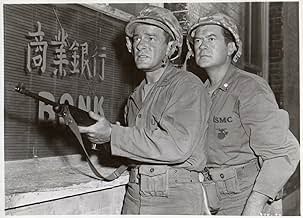
The saga of a battalion of U.S. Marines during the Korean War, starting with their training, landing at Inchon in 1950, advance into North Korea and their subsequent retreat back to the 38th... Read allThe saga of a battalion of U.S. Marines during the Korean War, starting with their training, landing at Inchon in 1950, advance into North Korea and their subsequent retreat back to the 38th parallel.The saga of a battalion of U.S. Marines during the Korean War, starting with their training, landing at Inchon in 1950, advance into North Korea and their subsequent retreat back to the 38th parallel.
- Director
- Writers
- Stars
Russ Tamblyn
- Jimmy W. McDermid
- (as Rusty Tamblyn)
Nedrick Young
- Sgt. Novak
- (as Ned Young)
Morton C. Thompson
- Capt. Kyser
- (as Mort Thompson)
John Bradford
- Radio Operator
- (uncredited)
William Cabanne
- Boxum
- (uncredited)
Sue Fawn Chung
- Child
- (uncredited)
Jack Daley
- Doctor
- (uncredited)
Fred Datig Jr.
- Marine
- (uncredited)
- Director
- Writers
- All cast & crew
- Production, box office & more at IMDbPro
6.5610
1
2
3
4
5
6
7
8
9
10
Featured reviews
A War Film For Men Who Cry
Now, don't get me wrong, `Retreat Hell' is an action-packed film, full of tension and combat, with the expected heroism and violence.
It's just that it has a...sensitive side. It somehow seems out of place for its time, more suited for the 70's than the '50s.
Richard Carlson is an unlikely hero for a war picture, particularly one from the hard-edged, patriotic 1950's. He's such a sensitive, nice fellow, and, to those of us accustomed to seeing him portray science-nerds (as in `Creature from the Black Lagoon' and `It Came from Outer Space') he may seem a tad intellectual for a leader of a Marine company. Even more unlikely is baby-faced Russ Tamblyn (who was still billing himself as `Rusty' at the time) as a rough-necked Marine Corps grunt. But that's the kind of picture this was: a war movie that dealt with the human face of war, even to the point of making `our boys' seem downright sentimental, but without being even remotely a vehicle for pacifist sentiments. It's an unusual, even eccentric approach, and at times it doesn't work, while at others it surprises with effectiveness.
There aren't very many war movies about Korea, today called `the forgotten war' in America. The most well-known one, `MASH,' was an unabashed allegory for Vietnam, and one quickly loses sight of the distinctions. `Retreat Hell' is much more specific, and accurate, in its portrayal of a war most Americans don't really know what to make of. It was the war we didn't quite lose, but certainly didn't win, and for the post-WWII generation, that was a perplexing legacy. Many of the more extreme patriots of the day chose to rationalize it by asserting we had been railroaded into the war by the UN, possibly as part of a Communist conspiracy. `Retreat Hell' avoids political uncertainties by focusing on the lives of brave but sympathetic soldiers, who did their duty as the American leadership saw fit to define it.
The title, which sounds like a statement of defiance (`like Hell we'll retreat') is actually a somber quotation from General MacArthur. At the time the forces in Korea had overextended themselves, and become surrounded on all sides. The order was given to break through the enemy lines to the sea. When asked about the retreat in Korea, the general replied `Retreat Hell, we're advancing in the other direction.' A retreat normally means falling back through your own lines to reach a stronger position, but this was an advance, through enemy lines, to a position that would allow a retreat.
Unlike many WWII pictures that were being made at the time, actual Asian actors were used to portray Asians, and not all of them were evil. The filmmakers evidently thought enough of their audience to remind them that the war was being fought for our Asian allies, not as a racist war against a generic enemy. In light of recent political developments, it is interesting to note that the British also make an appearance on our side. The Communist soldiers are portrayed as devious and callous, but not beyond the realities of the war (obviously Bad Things committed by our side are not shown) - they are not inhuman, merely the enemy.
This movie gives us both action and drama, and probably was a precursor to `Saving Private Ryan' in more ways than one.
It's just that it has a...sensitive side. It somehow seems out of place for its time, more suited for the 70's than the '50s.
Richard Carlson is an unlikely hero for a war picture, particularly one from the hard-edged, patriotic 1950's. He's such a sensitive, nice fellow, and, to those of us accustomed to seeing him portray science-nerds (as in `Creature from the Black Lagoon' and `It Came from Outer Space') he may seem a tad intellectual for a leader of a Marine company. Even more unlikely is baby-faced Russ Tamblyn (who was still billing himself as `Rusty' at the time) as a rough-necked Marine Corps grunt. But that's the kind of picture this was: a war movie that dealt with the human face of war, even to the point of making `our boys' seem downright sentimental, but without being even remotely a vehicle for pacifist sentiments. It's an unusual, even eccentric approach, and at times it doesn't work, while at others it surprises with effectiveness.
There aren't very many war movies about Korea, today called `the forgotten war' in America. The most well-known one, `MASH,' was an unabashed allegory for Vietnam, and one quickly loses sight of the distinctions. `Retreat Hell' is much more specific, and accurate, in its portrayal of a war most Americans don't really know what to make of. It was the war we didn't quite lose, but certainly didn't win, and for the post-WWII generation, that was a perplexing legacy. Many of the more extreme patriots of the day chose to rationalize it by asserting we had been railroaded into the war by the UN, possibly as part of a Communist conspiracy. `Retreat Hell' avoids political uncertainties by focusing on the lives of brave but sympathetic soldiers, who did their duty as the American leadership saw fit to define it.
The title, which sounds like a statement of defiance (`like Hell we'll retreat') is actually a somber quotation from General MacArthur. At the time the forces in Korea had overextended themselves, and become surrounded on all sides. The order was given to break through the enemy lines to the sea. When asked about the retreat in Korea, the general replied `Retreat Hell, we're advancing in the other direction.' A retreat normally means falling back through your own lines to reach a stronger position, but this was an advance, through enemy lines, to a position that would allow a retreat.
Unlike many WWII pictures that were being made at the time, actual Asian actors were used to portray Asians, and not all of them were evil. The filmmakers evidently thought enough of their audience to remind them that the war was being fought for our Asian allies, not as a racist war against a generic enemy. In light of recent political developments, it is interesting to note that the British also make an appearance on our side. The Communist soldiers are portrayed as devious and callous, but not beyond the realities of the war (obviously Bad Things committed by our side are not shown) - they are not inhuman, merely the enemy.
This movie gives us both action and drama, and probably was a precursor to `Saving Private Ryan' in more ways than one.
grim Korean War story
The Korean War doesn't have the glory that goes with WW2, although there are a few films about that war that have helped shape an image of bitter fighting carried out in even more bitter weather conditions. Retreat, Hell! should be right up there with Pork Chop Hill as the definitive Hollywood depiction of that conflict. It has that deft mix of grim authenticity, of action, and of fine characterizations. It has to be one of Russ Tamblyn's best dramatic parts. A lot of well interspersed and well done action scenes of fighting in barren snow swept hilltops and ravines, with the finale being a furious Chinese charge right into the colonel's tent. In black and white, this film has a pervasive grimness to it, that contrasts with the story of a unit of Marines trying to keep up a sunny and positive spin on a desperate situation. It's a flag-waver, but exceedingly well done.
Marine life.
This is a war movie which focuses more on the feelings, emotions and insecurities of the platoon as well as providing a shed load of action & explosions. For this to work, you have to care about the characters. The hard edged Colonel is well portrayed and you can see the humanity leaking out of him as the pressure intensifies. The Captain who is centre of attention early n, fades into the background somewhat. The real star is young, fresh faced McDermid. You feel as if you are with him every step of his journey, you feel his nerves, pain & bravery. Although in black and white, you can almost see the red mist descend in one poignant scene. There are loads of explosions and plenty of action for the late night viewer but this is a war film with a deeper than average plot line.
A fighting retreat is not a defeat
War is hell. This grim movie bears that out. At least this black and white movie is consistent from start to finish as it portrays United States Marines landing and later retreating in the frozen hell of Korea. The movie's redeeming qualities are its educational aspects and the actual combat footage. Story, dialog, casting, acting and special effects are all about average. I thought the characterization was better than average at times, as it showed Marines struggling with loss, despair, fear, hope, joy and even expressing compassion. Korea has been termed the forgotten war. That is unfortunate as it was and still is very relevant, even to this day. Witness the recent demonstration of nuclear power by North Korea and the consternation it has generated. The younger generation should be aware of our nations history and this movie can be a fun and enlightening way to do so. They might wonder what Chinese soldiers are doing there. At one point our movie's characters are almost saying a famous line from a later movie--"Who are these guys?" Overall, Retreat, Hell! is a respectable war movie.
A decent overview of the first half of the Korean War
"Retreat, Hell!" is an unusual film because Hollywood didn't make all that many movies about the Korean War compared to WWII. It follows a Marine unit from the invasion of Inchon through the first tough winter when the Chinese entered the fray.
The film does what too many war films do...uses too much stock footage that is scratchy and clearly NOT made for the movie in the first place. Aside from this, the story is reasonably well done, though most of the characters are a bit one-dimensional. Not a bad overview of this period, though.
Did you know
- TriviaWhen asked if they were retreating, Frank Lovejoy's character, Lt. Col Steve Corbett, says, "Retreat, hell! We're not retreating, we're just advancing in a different direction." This was actually said by Maj. Gen. O.P. Smith, who was Commanding General of the 1st Marine Division at the Battle of Chosin Reservoir.
- GoofsAfter Captain Hansen interviews Private McDermid at Camp Pendleton, he tells him to put his cap on. Marines do not use the term 'cap'. The correct term is 'cover'.
- Quotes
Lt. Col. Steve L. Corbett: Retreat hell! We're not retreating, we're just advancing in a different direction.
Details
- Runtime
- 1h 35m(95 min)
- Color
- Aspect ratio
- 1.37 : 1
Contribute to this page
Suggest an edit or add missing content