
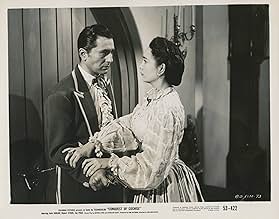
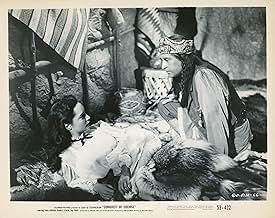
A cavalry officer tries to keep a lid on a volatile situation when Indian leader Cochise is being prodded into starting a war.A cavalry officer tries to keep a lid on a volatile situation when Indian leader Cochise is being prodded into starting a war.A cavalry officer tries to keep a lid on a volatile situation when Indian leader Cochise is being prodded into starting a war.


Robert Griffin
- Sam Maddock
- (as Robert E. Griffin)

Victor Adamson
- Townsman
- (uncredited)

Chris Willow Bird
- Apache Brave
- (uncredited)
Buck Bucko
- Townsman
- (uncredited)

Bill Coontz
- Trooper
- (uncredited)

John Crawford
- Capt. Bill Lawson
- (uncredited)

Art Felix
- Comanche Brave
- (uncredited)
- Director
- Writers
- All cast & crew
- Production, box office & more at IMDbPro
5.5425
1
2
3
4
5
6
7
8
9
10
Featured reviews
Positively Cleopatra like
Sam Katzman formerly of Monogram Studios probably could not believe the budget he had with Columbia Pictures for Conquest Of Cochise. Color and location shooting. I can hear him saying I know I'm not at Monogram any more.
This story about Cochise takes place as the USA has formally taken over the Gadsden Purchase in 1853, the last bit of continental USA that we acquired. The Mexicans sold it to us for a tidy sum, it was mostly desert and its largest city was a desert settlement that was called Tucson. But it did sit across a possible southern continental railway route and we bought it for that purpose.
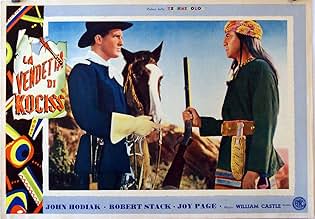
Now to enforce some law there because Cochise and his Chiracahua Apaches rule most of that bit of turf with Comanches occasionally raiding in there as well. That's what Major Robert Stack of the US Cavalry is sent there to do, make a treaty. Of course there are forces who don't want a treaty made.
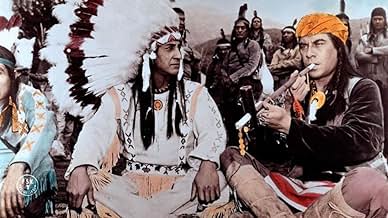
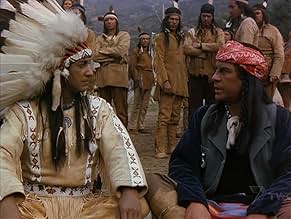
Nevertheless Stack goes to negotiate with Cochise who is played most impressively by John Hodiak.
Broken Arrow which is set post Civil War has a lot of similarities and an actor who got great acclaim for playing Cochise. Jeff Chandler got an Oscar nomination for his performance. Broken Arrow got a far bigger budget than Conquest Of Cochise. Still what Hodiak did should have gotten more acclaim.
Conquest Of Cochise was not a bad film and for a Sam Katzman production its positively Cleopatra like.
This story about Cochise takes place as the USA has formally taken over the Gadsden Purchase in 1853, the last bit of continental USA that we acquired. The Mexicans sold it to us for a tidy sum, it was mostly desert and its largest city was a desert settlement that was called Tucson. But it did sit across a possible southern continental railway route and we bought it for that purpose.
Now to enforce some law there because Cochise and his Chiracahua Apaches rule most of that bit of turf with Comanches occasionally raiding in there as well. That's what Major Robert Stack of the US Cavalry is sent there to do, make a treaty. Of course there are forces who don't want a treaty made.
Nevertheless Stack goes to negotiate with Cochise who is played most impressively by John Hodiak.
Broken Arrow which is set post Civil War has a lot of similarities and an actor who got great acclaim for playing Cochise. Jeff Chandler got an Oscar nomination for his performance. Broken Arrow got a far bigger budget than Conquest Of Cochise. Still what Hodiak did should have gotten more acclaim.
Conquest Of Cochise was not a bad film and for a Sam Katzman production its positively Cleopatra like.
A routine western with a few good moments
I saw this movie when it was new, back in 1953, and the only thing I remembered about it was the final reel in which Cochise (John Hodiak) is sentenced to suffer three tortures: (1) scalded by hot steam, (2) sliced with knife blades, and (3) burned by fire. Many years later I saw the movie again and, what do you know?, the only thing worth remembering about it is that final reel. Robert Stack makes a serviceable, though undistinguished, hero, and the color photography has that "brightness" so common in early 1950's movies.
Is it really useful?
I don't think so, as so many Sam Katzman productions, maybe not every of them however, but most of them for sure. Watch it only as a time waster, and also only if you are a die hard movie buff. Never look for historical facts, never with Katzman, it would be foolish. Directing is always bland, actors often ridiculous but the result rather surprisingly agreeable. It is a western about Chief Cochise and it could have been about any Indian leader: Chirf Crazy Horse, Sitting Bull, Geronimo.... Just non sense. Here, for the one millionth time, it is question of treacherous White dude selling booze to Indians, with predictable results.... I repeat, it is bearable. Nothing more. One thing very interesting though, the explanations that John Hodiak gives about Indians customs, for instance the water in the mouth that the Indians kids, future warriors, had to keep during a long run, without swallowing it. Thats was the only interesting thing in this tepid programmer. However I have seen far far worse and lousier. Especially from Katzman productions. Forget William Castle, the future director of som many excellent horror thrillers. He was just a yes man in this kind of films.
"Survival is our religion"
This is an interesting film of the Indians with John Hodiak as the legendary chief of the apaches Cochise, who finds himself in a quandary, whether to make war with the white Americans or with his brothers the comanches. He chooses what he thinks is the lesser evil and gets trouble with the comanches. The diplomatic efforts to make peace between Robert Stack as the white major and Cochise encounter difficulties and lead inevitably to a violent serttlement with the comanches. John Hodiak was always interesting as a character on film, always playing personalities with great integrity, and here he is perfect as Cochise, an apache chief of superior self control. He never shows his feelings, but the audience must understand them all too well. The film is directed by William Castle, who made all the Crime Doctor films, and this is made with equal efficiency with no waste on nonsense. The film is mainly worth watching because of the insight into the apache way of life that it offers, and of course there is a lady involved (Joy Page) who also knows her own mind: she actually kills an Indian here in a raid. The colours are brilliant, they always are in films of Arizona, and that is an extra credit to the film to make it more than worth while. It is one of the first major westerns that take sides with the Indians or at least shows a deeper understanding and interest in them, which makes it important in the line of westerns. Robert Stack as the major is more standard military officer routine soldier, while it is the actions of Cochise that keep you engaged.
Two steps forward, one big step back.
The 1950s saw a change in the average western. In many of the era's films, the American Indians are seen in a very sympathetic light and often Indian unrest is due to evil white folks. In this one, it's about the Chiracahua Apache war chief, Cochise, and how he was agreeable to becoming peaceful...but this is undermined by greedy jerks intent on provoking war.
While the story is laudable, it's also sad to see what ALSO was common in the 1950s...having big-name white actors portraying the chiefs. In most of these cases, they sure don't sound like Native Americans...and John Hodiak paints up and wears a wig and looks like a convincing Indian...and sounds exactly like John Hodiak! It really takes you out of the story...especially because his diction makes it sound as if Cochise went to charm school!
The story begins with the Gadsden Purchase at the end of 1953. With this land treaty with Mexico comes a new problem...what to do with marauding Chiracahua Apaches who go back and forth across the border of the USA and Mexico to attack folks. Major Burke (Robert Stack) is assigned the task to make peace with Cochise, the leader of these natives as well as making peace with the Mexicans who just became Mexican-Americans. But when negotiations go sour, the Chiracahua and Comanche get together and decide to make war on the white men. Can the Major convince them to do otherwise?
While it was nice to see the Indian portrayed more sympathetically and the film in vivid color, it's still a poor western. The dialog is often ridiculous, Hodiak is terrible and the story is in need of editing and improvement. Worth skipping.
By the way, EVERYONE in this film uses repeating rifles and handguns. Such things were pretty rare in 1853 and even during the Civil War, most of the troops used single-shot rifles. So much for attention to historical accuracy.
While the story is laudable, it's also sad to see what ALSO was common in the 1950s...having big-name white actors portraying the chiefs. In most of these cases, they sure don't sound like Native Americans...and John Hodiak paints up and wears a wig and looks like a convincing Indian...and sounds exactly like John Hodiak! It really takes you out of the story...especially because his diction makes it sound as if Cochise went to charm school!
The story begins with the Gadsden Purchase at the end of 1953. With this land treaty with Mexico comes a new problem...what to do with marauding Chiracahua Apaches who go back and forth across the border of the USA and Mexico to attack folks. Major Burke (Robert Stack) is assigned the task to make peace with Cochise, the leader of these natives as well as making peace with the Mexicans who just became Mexican-Americans. But when negotiations go sour, the Chiracahua and Comanche get together and decide to make war on the white men. Can the Major convince them to do otherwise?
While it was nice to see the Indian portrayed more sympathetically and the film in vivid color, it's still a poor western. The dialog is often ridiculous, Hodiak is terrible and the story is in need of editing and improvement. Worth skipping.
By the way, EVERYONE in this film uses repeating rifles and handguns. Such things were pretty rare in 1853 and even during the Civil War, most of the troops used single-shot rifles. So much for attention to historical accuracy.


Did you know
- TriviaProducer Sam Katzman refused to shave the Indians' heads, because it would take a too long for their hair to grow again for other films. He then decided that the actors should wear swimming caps. But Columbia mogul Harry Cohn was very angry because of this and asked why Indians fighters wore bathing caps.
- GoofsThe film states that there were 40,000 Apache warriors at war in Arizona, when in fact there were never anywhere near 40,000 Apaches in the entire state and never more than several hundred fighting the white settlers and the US Army at any one time.
- Quotes
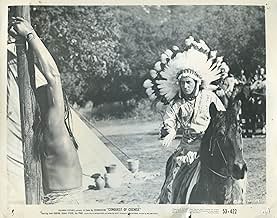
Red Knife, Comanche Chief: [to Cochise] You will suffer three deaths... The first death will be the Death of the Boiling Spring... The second death will be the Death of Knives... The last death will be the Death of Fire.
- ConnectionsReferenced in They Came from Beyond - Sam Katzman at Columbia (2023)
- How long is Conquest of Cochise?Powered by Alexa
Details
- Runtime
- 1h 10m(70 min)
- Aspect ratio
- 1.37 : 1
Contribute to this page
Suggest an edit or add missing content