
In Post-Bellum Texas, an army captain tries to keep the peace between overtaxed, impoverished farmers and greedy carpetbaggers.In Post-Bellum Texas, an army captain tries to keep the peace between overtaxed, impoverished farmers and greedy carpetbaggers.In Post-Bellum Texas, an army captain tries to keep the peace between overtaxed, impoverished farmers and greedy carpetbaggers.



- Hodges' Sergeant
- (uncredited)
- Texan
- (uncredited)

- Walter Morgan
- (uncredited)


- Trooper
- (uncredited)
- Texan
- (uncredited)

- Kehoe
- (uncredited)
- Director
- Writer
- All cast & crew
- Production, box office & more at IMDbPro
Featured reviews
Solid Western
First, there's an intelligent script by Russell Hughes, who wrote for some good radio shows like "Nightbeat" and Alan Ladd's "Box 13", as well as such films as Anthony Mann's "Last Frontier", Delmer Daves' "Jubal", and even the best of the giant-bug movies, "Them".
Then, there's the look and feel of the film. Director Andre De Toth and his great cinematographer Bert Glennon (who had done remarkable work with the likes of Josef von Sternberg and John Ford) light and shoot for realism and emotional impact. Glennon had also shot "Man Behind the Gun" (available on the flip side of this DVD), so I suppose director Felix Feist could be blamed for that film's phony-looking stage sets. Here, in "Thunder... ", a barroom scene looks like it was shot in a real barroom (foreshadowing Clint Eastwood's "natural lighting" technique by decades) and exteriors are shot outdoors. To be fair, the Feist film may have had budget or producer issues, but given that film's potential (dealing with water rights, corrupt politicians, the possible secession of southern California, even the semi-legendary Joaquin Murrietta as a supporting character) it still seems like a typical, entertaining, 40's-style B-movie. "Thunder...", released the same year, 1953, seems more forward-looking, more compelling, more of the age of the "adult" Westerns, even though the literally flag-waving ending with its narrative paean to the great state of Texas kind of pulls us back to B-movie-land.
Complex but Entertaining
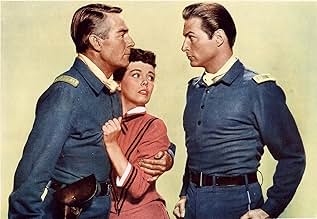
The rivalry between the two captains, Scott and Barker, is an interesting feature, especially when it extends to Scott's wife (Kirk). That scene where the home-sick wife is captivated by the handsome Barker is both well played and unusual for a western. Note too how Scott is compelled by the byplay to fade into the background, another unusual feature for a western hero.
Though filmed just west of LA, the rolling scenery makes a good Technicolor backdrop to the action. Much credit for making the elements work should go to director de Toth who was skilled at handling conflict as shown in his masterwork, Ramrod (1947). The redoubtable Sam Peckinpah also selected de Toth to direct many episodes of his groundbreaking TV series The Westerner (1960).
On the whole, it's a complicated story of personal and political conflict but still delivers the goods for fans of westerns.
Frankly good main and support cast in an acceptable Western professionally directed by Andre De Toth
This is a tornado and adventure movie from Warner Bros , containing thrills , emotion , suspense , go riding and crossfire . A decent cavalry western with a twisted and complex intrigue written by Russell Hughes . As our captain Randolph Scott has to confront a nasty powerful owner : Hugh Sanders , while must avoid a new and envious officer : Lex Barker who attempts to take his wife Phyllis Kirk . As the trío of decent protagonists : Randolph Scott , Phyllis Kirk and Lex Barker give acceptable interpretations . They are well accompanied by a pretty support cast with plenty of familiar faces , such as : Henry Hull , Charles McGraw , Elisa Cook Jr , Lane Chandler , uncredited Trevor Bardette, James Brown of Rin Tin Tin TV series and Fess Parker of Daniel Boone TV series.
The motion picture was well directed by Andre De Toth , though it has some flaws and gaps . De Toth was a good artisan of long career , writing , producing and directing several movies . As he made all kinds of genres , outstanding in Western , such as : Ramrod , Carson City , The Indian Fighter , Day of Outlaw , Thunder over Plains . And he made other genres including films as The other love , Pitfall , None Shall escape , Crime Wave , Dark Waters , Monkey on my Back , Play Dirty . Being his biggest hit , the boxoffice terror House of Wax . Rating : 6/10 . Passable and acceptable Western that will appeal to Randolph Scott fans . Worthwhile seeing .
Thunderation - just whose side is everybody on?
Tale set in post Civil War Texas where carpetbaggers ruled almost supreme, and the occupying Federal troops seemed to let them. There's a gang of patriotic outlaws led by a Robin Hood character trying to redress the balance and a complicated set of sympathies and antagonisms with which to contend. And Lex Barker was playing a nutter. But if I correctly remember my extensive Frank Yerby reading when I was a kid surely in reality the Ku Klux Klan couldn't have been far away in matters of this kind in their role of Southern saviours? There's time in this shortish formula fiction film for lots of plot twists, cold business, love, jealousy, rage, backstabbings, murders galore, some honour and integrity, all of it delivered with plenty of panache, a nice colour and sporadically excellent camera-work.
It's enjoyable hokum up to a point but ultimately loses its way because there's no one you can really root for but many you can root against. Naturally, Scott is as dependable as usual.
Texas, 1869, a powder keg waiting to explode.
It's 1869, and Texas is still not part of the Union. Carpetbaggers rule the state and criminal activity is high. Captain Porter (Scott), a proud Texan himself, finds he has to carry out orders against his own countrymen. When a man in town is murdered in cold blood, suspicion falls on rogue cowboy Ben Westman (McGraw), but Porter believes he's innocent and strikes a deal to bring him in for a fair trial. However, this sets off a chain of events that leads to Porter himself becoming a wanted man.
Knowing direction, fine acting and a darn good script, all make Thunder Over The Plains essential viewing for the 50s Western fan. The bonus, aside from the impressive support cast, is the story itself. This was a troubled time, a time when only two states were not yet accepted back into the Union post the Civil War. Toth and Hughes paint a murky town, one of corruption, tax oppression and shifty shenanigans. There's even room in the story for strains on the family home of Porter and an attempt at adultery. Throw in the nice colour and scenery, pace it briskly with enjoyable action set-pieces (the shoot out at the end is familiar but excellently done), and it's a fictionalised winner. 7/10


Did you know
- TriviaCharles McGraw and James Brown both appeared in Corvette K-225 (1943), which starred Randolph Scott.
- GoofsThe Cavalry men are seen using Colt Model 1873 pistols in a movie that takes place in 1869. This model was developed for the US Army in 1873. Civilian sales started in 1875, and the 4-3/4 barrel length wasn't available until 1877.
- Quotes
Norah Porter: Whatever became of Frances Bilky?
Captain Bill Hodges: I don't know. She married a colonel, I think. Maybe it was a general. At any rate, she outranks all of us.
Norah Porter: But that's wonderful! Now she'll have her lifelong ambition to lead the cotillion. Well, I guess that's what I always wanted too.
Captain Bill Hodges: You don't have anything like that around here, do you, Captain?
Captain David Porter: Oh, I don't know. The Indians come down once a month and dance for us.
- ConnectionsReferenced in They Came to Rob Las Vegas (1968)
- How long is Thunder Over the Plains?Powered by Alexa
Details
- Runtime
- 1h 22m(82 min)
- Aspect ratio
- 1.37 : 1