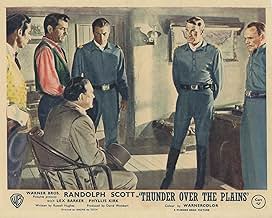
In Post-Bellum Texas, an army captain tries to keep the peace between overtaxed, impoverished farmers and greedy carpetbaggers.In Post-Bellum Texas, an army captain tries to keep the peace between overtaxed, impoverished farmers and greedy carpetbaggers.In Post-Bellum Texas, an army captain tries to keep the peace between overtaxed, impoverished farmers and greedy carpetbaggers.
- Hodges' Sergeant
- (uncredited)
- Texan
- (uncredited)
- Walter Morgan
- (uncredited)
- Trooper
- (uncredited)
- Texan
- (uncredited)
- Kehoe
- (uncredited)
- Director
- Writer
- All cast & crew
- Production, box office & more at IMDbPro
Featured reviews
Complex but Entertaining
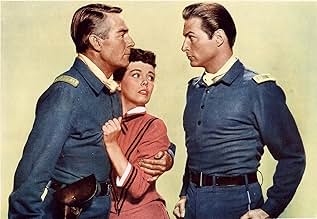
The rivalry between the two captains, Scott and Barker, is an interesting feature, especially when it extends to Scott's wife (Kirk). That scene where the home-sick wife is captivated by the handsome Barker is both well played and unusual for a western. Note too how Scott is compelled by the byplay to fade into the background, another unusual feature for a western hero.
Though filmed just west of LA, the rolling scenery makes a good Technicolor backdrop to the action. Much credit for making the elements work should go to director de Toth who was skilled at handling conflict as shown in his masterwork, Ramrod (1947). The redoubtable Sam Peckinpah also selected de Toth to direct many episodes of his groundbreaking TV series The Westerner (1960).
On the whole, it's a complicated story of personal and political conflict but still delivers the goods for fans of westerns.
Solid Western
First, there's an intelligent script by Russell Hughes, who wrote for some good radio shows like "Nightbeat" and Alan Ladd's "Box 13", as well as such films as Anthony Mann's "Last Frontier", Delmer Daves' "Jubal", and even the best of the giant-bug movies, "Them".
Then, there's the look and feel of the film. Director Andre De Toth and his great cinematographer Bert Glennon (who had done remarkable work with the likes of Josef von Sternberg and John Ford) light and shoot for realism and emotional impact. Glennon had also shot "Man Behind the Gun" (available on the flip side of this DVD), so I suppose director Felix Feist could be blamed for that film's phony-looking stage sets. Here, in "Thunder... ", a barroom scene looks like it was shot in a real barroom (foreshadowing Clint Eastwood's "natural lighting" technique by decades) and exteriors are shot outdoors. To be fair, the Feist film may have had budget or producer issues, but given that film's potential (dealing with water rights, corrupt politicians, the possible secession of southern California, even the semi-legendary Joaquin Murrietta as a supporting character) it still seems like a typical, entertaining, 40's-style B-movie. "Thunder...", released the same year, 1953, seems more forward-looking, more compelling, more of the age of the "adult" Westerns, even though the literally flag-waving ending with its narrative paean to the great state of Texas kind of pulls us back to B-movie-land.
thunder over the plains
Plus, there's Phyllis Kirk.
Good Studio B-Picture
Thunder Over The Plains sags just a bit in the middle, but has great production values and is fairly ambitious for a 1950's B-western, with some pretty complex characters. The cinematography and direction by Andre De Toth are excellent.
Elisha Cooke Jr. is pretty good as a sniveling tax collector. Lex Barker's character is especially vile, kind of a surprise considering the times in which this was made and the fact that Barker is so handsome and all-American looking!
Fairly Good Western
Did you know
- TriviaCharles McGraw and James Brown both appeared in Corvette K-225 (1943), which starred Randolph Scott.
- GoofsThe Cavalry men are seen using Colt Model 1873 pistols in a movie that takes place in 1869. This model was developed for the US Army in 1873. Civilian sales started in 1875, and the 4-3/4 barrel length wasn't available until 1877.
- Quotes
Norah Porter: Whatever became of Frances Bilky?
Captain Bill Hodges: I don't know. She married a colonel, I think. Maybe it was a general. At any rate, she outranks all of us.
Norah Porter: But that's wonderful! Now she'll have her lifelong ambition to lead the cotillion. Well, I guess that's what I always wanted too.
Captain Bill Hodges: You don't have anything like that around here, do you, Captain?
Captain David Porter: Oh, I don't know. The Indians come down once a month and dance for us.
- ConnectionsReferenced in They Came to Rob Las Vegas (1968)
- How long is Thunder Over the Plains?Powered by Alexa
Details
- Runtime
- 1h 22m(82 min)
- Aspect ratio
- 1.37 : 1