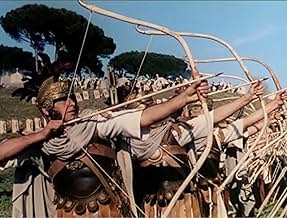
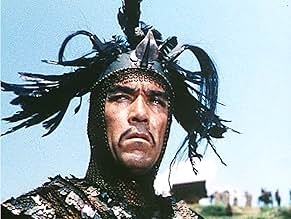
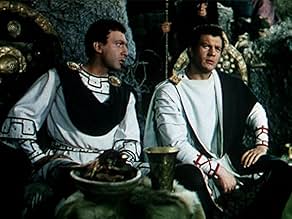
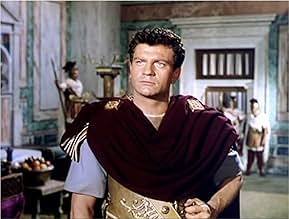
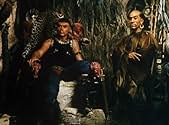
Attila, the leader of the barbarian Huns and called by the Romans "The Scourge of God", sweeps onto the Italian peninsula, defeating all of the armies of Rome, until he and his men reach the... Read allAttila, the leader of the barbarian Huns and called by the Romans "The Scourge of God", sweeps onto the Italian peninsula, defeating all of the armies of Rome, until he and his men reach the gates of the city itself.Attila, the leader of the barbarian Huns and called by the Romans "The Scourge of God", sweeps onto the Italian peninsula, defeating all of the armies of Rome, until he and his men reach the gates of the city itself.
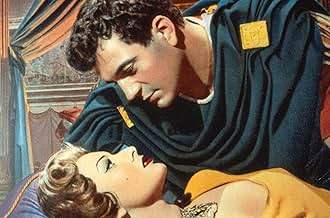
Anthony Quinn
- Attila
- (as Anthony Qvinn)
Eduardo Ciannelli
- Onegesius - Counselor to Attila
- (as Eduardo Cianelli)
5.4831
1
2
3
4
5
6
7
8
9
10
Featured reviews
"Today Rome. Tomorrow the World!"
Although not without its unintentionally funny moments, compared to most of the Sword and Sandal films that were churned out by Hollywood on the Tiber, this one is not at all bad.
Anthony Quinn's testosterone filled, Alpha male performance here certainly fits historian Edward Gibbon's description of Attila as 'a formidable barbarian' whilst the oestrogen of pneumatic Sophia Loren as Honoria practically leaps off the screen. Honoria was a tragic character who had the misfortune to be born the daughter of an emperor and to be treated miserably by her domineering mother but her one-dimensional portrayal here is par for the course in films of this type.
The year this film was released was notable for both Quinn and La Loren as he also appeared in a little opus entitled 'La Strada' and she was directed for the first time by Vittorio de Sica in the 'Pizza con credito' segment of 'L'Oro di Napoli' in which he brought out the Neapolitan earthiness and innate comedic ability that were to serve her so well through the years, not least in the amusing 'Peccato che sia una canaglia' from the same year which marked the first of her many films with a certain Marcello Mastroianni.
A good supporting cast, all of whom are adequately 'dubbed' comprises Colette Régis as the wilful Galla Placidia and Henri Vidal as Aetius. The emperor Valentinian III, described by Gibbon as 'feeble and dissolute', is convincingly played by Claude Laydu who will forever be associated with the title character of Bresson's 'Journal d'un curé de compagne'. Mention must be made of the wondrous Irene Papas in the minor role of one of Attila's many wives. She was to go from strength to strength, especially in classical Greek tragedy and utilised what one critic has called her 'elemental nobility' as the widow opposite Quinn's Zorba. For those interested in such things, neither Honoria nor Aetius met their ends in the manner depicted here.
Designed to warm the hearts of the Faithful, the final scene, complete with heavenly chorus and a crucifix in the sky, shows Attila being persuaded by Pope Leo not to attack Rome. It is not known what was said or indeed what inducements were offered but it is doubtful whether a heathen such as Attila would have been swayed by Leo's eloquence and sacerdotal robes alone and it is more likely that he turned back because of plague in his army, lack of food and the threat of Roman reinforcements from the East.
Oh well, as the man said, 'it's only a movie.'
Anthony Quinn's testosterone filled, Alpha male performance here certainly fits historian Edward Gibbon's description of Attila as 'a formidable barbarian' whilst the oestrogen of pneumatic Sophia Loren as Honoria practically leaps off the screen. Honoria was a tragic character who had the misfortune to be born the daughter of an emperor and to be treated miserably by her domineering mother but her one-dimensional portrayal here is par for the course in films of this type.
The year this film was released was notable for both Quinn and La Loren as he also appeared in a little opus entitled 'La Strada' and she was directed for the first time by Vittorio de Sica in the 'Pizza con credito' segment of 'L'Oro di Napoli' in which he brought out the Neapolitan earthiness and innate comedic ability that were to serve her so well through the years, not least in the amusing 'Peccato che sia una canaglia' from the same year which marked the first of her many films with a certain Marcello Mastroianni.
A good supporting cast, all of whom are adequately 'dubbed' comprises Colette Régis as the wilful Galla Placidia and Henri Vidal as Aetius. The emperor Valentinian III, described by Gibbon as 'feeble and dissolute', is convincingly played by Claude Laydu who will forever be associated with the title character of Bresson's 'Journal d'un curé de compagne'. Mention must be made of the wondrous Irene Papas in the minor role of one of Attila's many wives. She was to go from strength to strength, especially in classical Greek tragedy and utilised what one critic has called her 'elemental nobility' as the widow opposite Quinn's Zorba. For those interested in such things, neither Honoria nor Aetius met their ends in the manner depicted here.
Designed to warm the hearts of the Faithful, the final scene, complete with heavenly chorus and a crucifix in the sky, shows Attila being persuaded by Pope Leo not to attack Rome. It is not known what was said or indeed what inducements were offered but it is doubtful whether a heathen such as Attila would have been swayed by Leo's eloquence and sacerdotal robes alone and it is more likely that he turned back because of plague in his army, lack of food and the threat of Roman reinforcements from the East.
Oh well, as the man said, 'it's only a movie.'
Worth seeing!
The acting schools are extremely expensive. And what they teach you is how to control your breathing, how to scratch your balls or jump up. Anthony Quinn is a real acting school only by himself, just watching any of his movies, you have a lot to learn. Even in this film, the one born in Chihuahua, Mexico, makes us a great demonstration of huge talent, embodying "The Scourge of God". He is the most credible Attila of all the movies. Sophia Loren, very young, is good as Honoria. Henri Vidal is convincing too as Aetius. Same Claude Laydu as the idiot Emperor Valentiniano Caesar. Irene Papas, also very young, is OK as Grune. Christian Marquand, who was to become the director of the "Candy" masterpiece, is a Hun leader.
Hun, they shrunk the story
An early sword-and-sandal epic from Italy casts Anthony Quinn as Attila the Hun, with dialog that sounds as though it came from a kung fu movie. "Attila" is probably most noticeable as an early appearance of Sophia Loren (she plays Honoria, who marries the vicious warrior). Otherwise, it's the sort of movie that belongs on "Mystery Science Theater 3000". At this point, I have serious doubts as to whether its even possible to make a good movie about a historical figure from that long ago. Maybe they just work best as spoofs in the vein of "Life of Brian".
Anyway, this is certainly the sort of flick that should be of interest to bad movie buffs. Not terrible, but that year, Anthony Quinn starred in one of Italy's greatest films: "La strada".
Quinn tries his best with a bad and unreasonable script...
Destroying towns and cities across the Alp to Italy, the mounted hordes led by Attila, King of the Huns, reached the gates of Rome where they were stopped by the Cross and turned back by Pope Leo I...
Anthony Quinn is Attila, the infamous 5th Century barbarian in this Italian unworthy spectacular...
Sophia Loren offers a pretty presence as the ambitious tempting Honoria who accepts Attila as a husband just to save Rome... She loses her life and half of her kingdom...
Quinn tries his best in his portrayal of the infamous Attila, but the script is bad and unreasonable...
Anthony Quinn is Attila, the infamous 5th Century barbarian in this Italian unworthy spectacular...
Sophia Loren offers a pretty presence as the ambitious tempting Honoria who accepts Attila as a husband just to save Rome... She loses her life and half of her kingdom...
Quinn tries his best in his portrayal of the infamous Attila, but the script is bad and unreasonable...
The mighty Quinn
The script is admittedly very badly written but it follows roughly Attila 's biography.Of course ,as it is a 75 min movie,many moments are passed over in silence but all that concerns the main characters is accurate: the brother was slain by Attila and his German vassals ,Honoria tried to forge an alliance with him,(but her brother locked her into a convent),and yes,the pope found the right words to stop the conqueror.He had previously failed in front of Paris ,reportedly with a little help from Saint Genevieve ,a woman of God who urged the Parisians to resist.
The film suffers from an international ill-assorted cast:an American (Quinn) ideally cast as the bar bar,an Italian (Sophia Loren) which made sense,but also a Greek thespian (Irene Pappas) plus three French actors :Henri Vidal cast as the noble loyal hero- a character not unlike the legionnaire he played in "Fabiola"-,who was formerly Attila's good friend (?),Claude Laydu who gives a passable performance of an effeminate fearful emperor ,probably influenced by Peter Ustinov's masterful portrayal of Nero in Mervyn Le Roy's "Quo Vadis" ,Colette Régis,an obscure actress plays his mother ,an over possessive one of course.
Also handicapped by a last scene which verges on Christian propaganda -the last picture is revealing-,the film is to recommend only for Quinn's fans.
The film suffers from an international ill-assorted cast:an American (Quinn) ideally cast as the bar bar,an Italian (Sophia Loren) which made sense,but also a Greek thespian (Irene Pappas) plus three French actors :Henri Vidal cast as the noble loyal hero- a character not unlike the legionnaire he played in "Fabiola"-,who was formerly Attila's good friend (?),Claude Laydu who gives a passable performance of an effeminate fearful emperor ,probably influenced by Peter Ustinov's masterful portrayal of Nero in Mervyn Le Roy's "Quo Vadis" ,Colette Régis,an obscure actress plays his mother ,an over possessive one of course.
Also handicapped by a last scene which verges on Christian propaganda -the last picture is revealing-,the film is to recommend only for Quinn's fans.
Did you know
- TriviaAnthony Quinn worked on La Strada (1954) simultaneously with this movie. He remarked that it had a much smaller budget than the Attila epic, but considered it a much better film.
- Crazy creditsAlthough this was an Italian co-production shot in Italy, Eduardo Ciannelli's name is misspelled in the credit.
- ConnectionsFeatured in Soldiers: Cavalry (1985)
- How long is Attila?Powered by Alexa
Details
Box office
- Budget
- ITL 450,000,000 (estimated)
- Runtime
- 1h 20m(80 min)
- Aspect ratio
- 1.37 : 1
Contribute to this page
Suggest an edit or add missing content