
An Army doctor with no combat experience is forced to take command of a cavalry troop escorting a wagon train through hostile Indian country when the unit's commanding officer dies.An Army doctor with no combat experience is forced to take command of a cavalry troop escorting a wagon train through hostile Indian country when the unit's commanding officer dies.An Army doctor with no combat experience is forced to take command of a cavalry troop escorting a wagon train through hostile Indian country when the unit's commanding officer dies.
- Director
- Writers
- Stars


Robert Nichols
- 2nd Lt. O'Hirons
- (as Bob Nichols)
Carl Andre
- Trooper
- (uncredited)
Emile Avery
- Outrider
- (uncredited)


Jim Bannon
- Infantryman
- (uncredited)

Gregg Barton
- Capt. Forsythe
- (uncredited)

George Bell
- Webb
- (uncredited)

John Beradino
- Sergeant Major
- (uncredited)
Richard Boyer
- Infantry Sergeant
- (uncredited)

Larry Chance
- Indian Brave
- (uncredited)
Mack Chandler
- Infantry Lieutenant
- (uncredited)
- Director
- Writers
- All cast & crew
- Production, box office & more at IMDbPro
6.4741
1
2
3
4
5
6
7
8
9
10
Featured reviews
The Square Peg and the Round Hole.
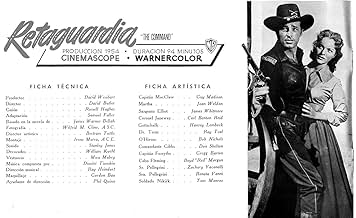
The Command is directed by David Butler and adapted by Samuel Fuller and Russell Hughes from the novel "Rear Guard" written by James Warner Bellah. It stars Guy Madison, James Whitmore, Joan Weldon, Carl Benton Reid and Harvey Lembeck. A CinemaScope production in Warnercolor, music is by Dimitri Tiomkin and cinematography by Wilfred M. Cline.
When the commanding officer of his Cavalry patrol is killed, the army doctor is tasked with taking the reins and leading the men.
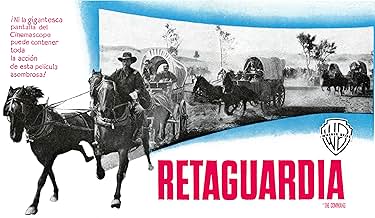
It deserves to be better known. Warner Brother's first CinemaScope release and the first Western to be filmed in that widescreen format, The Command is far better than what the routine synopsis suggests it is. For sure the Cavalry versus Indians theme is the steady heartbeat ticking away in the piece, but the writers have inserted other points of worth to expand the level of interest throughout the hour and half running time.
Madison is Captain MacClaw, the Cavalry doctor who is entrusted with command of the troop by his dying superior. The men aren't happy with this, more so when they find themselves involved in a deadly game of cat and mouse with the Indian hordes. Not only that but they are charged with escorting a civilian wagon train to safety, the residents of which may be transporting smallpox! When the troop are joined by an infantry regiment, this only complicates matters because there's no love lost between the two army forces. Where the Indians have a united front, the various tribes fighting as one force, the American military are at odds with each other on tactics and manoeuvres.
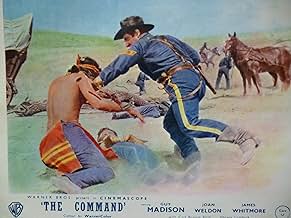
Tactics are a big issue in The Command, the story tosses up the argument about doing things by the book or breaking free of code restrictions and throwing caution to the wind. There's also opposing issues on the medical front, two doctors at odds with diagnoses which quite literally could be the end of them all if they can't get it right. Some critics have said Butler's direction is ponderous, but I'd argue strongly that that is not the case. It's true that the first hour involves a lot of talking, squabbling and sarcasm, but the director is juggling many thematic balls in readiness for the grand last third of the piece. Besides, he does insert action scenes along the way, including one blood and thunder sequence that is capped off by a surprising turn of events.
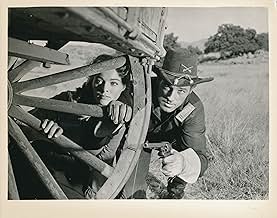
Then that last half hour comes, and it is superb. The tactics issue comes to a head, and everyone wonders if this is going to be another General Custer piece of history. Pic then explodes into all out action, with weaponry combat supplemented by hand to hand sequences. Chases are electrifying, the fires do rage and the wagons do hurtle and fall, the stunt work here is excellent, as is Butler's fluid camera work. We even have time for some fun in the mix, as one of the "special" tactics involves drag artistry. Tiomkin layers a boisterous score over proceedings, mixing marching beats with thunderclap percussion, and Cline in the Scope format brings the various California locations (pic is mostly set outdoors) bursting out of the screen. Cast are just dandy, with Whitmore the class act on show, but both Madison and Weldon make for a colourful and appealingly interesting pair.
It's guilty of being rooted in those Westerns of the era who just put the Indians up as a savage force whooping, hollering, firing arrows and flinging axes. Even though Whitmore's Sergeant Elliot is given some lines that recognise the Indians as not being dumb Howitzer fodder. So this obviously isn't in the league of those great psychological Westerns that afforded the Indians great respect. This is firmly in the realm of action for entertainments sake, with some other delicate thematics that garnish the spectacle on the cinematic plate. 8/10
When the commanding officer of his Cavalry patrol is killed, the army doctor is tasked with taking the reins and leading the men.
It deserves to be better known. Warner Brother's first CinemaScope release and the first Western to be filmed in that widescreen format, The Command is far better than what the routine synopsis suggests it is. For sure the Cavalry versus Indians theme is the steady heartbeat ticking away in the piece, but the writers have inserted other points of worth to expand the level of interest throughout the hour and half running time.
Madison is Captain MacClaw, the Cavalry doctor who is entrusted with command of the troop by his dying superior. The men aren't happy with this, more so when they find themselves involved in a deadly game of cat and mouse with the Indian hordes. Not only that but they are charged with escorting a civilian wagon train to safety, the residents of which may be transporting smallpox! When the troop are joined by an infantry regiment, this only complicates matters because there's no love lost between the two army forces. Where the Indians have a united front, the various tribes fighting as one force, the American military are at odds with each other on tactics and manoeuvres.
Tactics are a big issue in The Command, the story tosses up the argument about doing things by the book or breaking free of code restrictions and throwing caution to the wind. There's also opposing issues on the medical front, two doctors at odds with diagnoses which quite literally could be the end of them all if they can't get it right. Some critics have said Butler's direction is ponderous, but I'd argue strongly that that is not the case. It's true that the first hour involves a lot of talking, squabbling and sarcasm, but the director is juggling many thematic balls in readiness for the grand last third of the piece. Besides, he does insert action scenes along the way, including one blood and thunder sequence that is capped off by a surprising turn of events.
Then that last half hour comes, and it is superb. The tactics issue comes to a head, and everyone wonders if this is going to be another General Custer piece of history. Pic then explodes into all out action, with weaponry combat supplemented by hand to hand sequences. Chases are electrifying, the fires do rage and the wagons do hurtle and fall, the stunt work here is excellent, as is Butler's fluid camera work. We even have time for some fun in the mix, as one of the "special" tactics involves drag artistry. Tiomkin layers a boisterous score over proceedings, mixing marching beats with thunderclap percussion, and Cline in the Scope format brings the various California locations (pic is mostly set outdoors) bursting out of the screen. Cast are just dandy, with Whitmore the class act on show, but both Madison and Weldon make for a colourful and appealingly interesting pair.
It's guilty of being rooted in those Westerns of the era who just put the Indians up as a savage force whooping, hollering, firing arrows and flinging axes. Even though Whitmore's Sergeant Elliot is given some lines that recognise the Indians as not being dumb Howitzer fodder. So this obviously isn't in the league of those great psychological Westerns that afforded the Indians great respect. This is firmly in the realm of action for entertainments sake, with some other delicate thematics that garnish the spectacle on the cinematic plate. 8/10
Surprisingly fun western
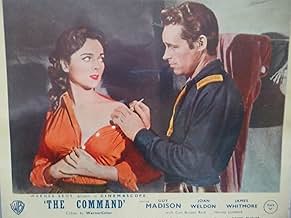
This surprisingly fun western stars Guy Madison as a Doctor Robert MacClaw who finds himself in charge of his cavalry troup as a result of his commanding officer's dying order. Needless to say, the men aren't thrilled, but he wins them over with his unorthodox, yet effective, tactics against the bands of hostile Indians who stand between them and safety. Along the way his command grows to include a wagon train of settlers and two units of inexperienced infantry. Naturally, there's a romantic subplot involving one of the settlers, and a breakout of smallpox that calls upon his medical skills. The romance seems tepid and formulaic, but MacClaw's relationship with his senior officer, Sgt Elliott, is believable and strong. Despite a disturbingly high body count of Indians, the good doctor doesn't show much remorse about the slaughter. Ironically, he seems much more worried that they'll be decimated by smallpox contracted from the wagon train. Don't look for any kind of message here, however, it's just good clean fun (if you can overlook the dead Indians), with an exciting high-speed wagon chase at the end!
Solid Western; Strong Situations; Has Fine Production Values
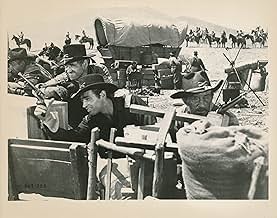
This is a very good story that was made into a very compelling western by director David Butler from James Warner Bellah's novel "rear guard". Samule Fuller and Russell S. Hughes get credit for the tau and only occasionally glossy screenplay. Star Guy Madion made several estimable and well-remembered westerns in the 1950s, in which decade he also starred in the "Wild Bill Hickick" TV series along with Andy Devine. The intriguing part of this standard story-line which concerns a ranking officer having to assume leadership of a cavalry outfit after the death of its senior officer is that this man happens to be a medical Captain, not a field commander. They fall in with a wagon train during Indian troubles, and end up meeting infantry as well, whom his second, powerfully played by James Whitmore, refers to as "stinkin' beetle crushers". Madson assumes command of both groups, romances lovely and talented Joan Weldon, and nurses the wagon train through sickness and danger; then, at the last, he gets the inspiration to mount cannon onto the wagons, form a hollow square, and draw the Indians into an ambush. Thus, he uses his imagination to defeat the Indian's long-delayed final attack. Madison gets Weldon, Whitmore's honor as a cavalrymen is served, and all ends well; but there are good dialogue confrontations and strong situations along the way, plenty of battle action and unusually strong character revelations. Music was supplied for this film by veteran Dimitri Tiomkin, costumes by Moss Mabry. The fine cinematography was the work of Wilfrid M. Cline. In the professional cast along with Madison, Whitmore and Weldon were Carl Benton Reid, Harvey Lembeck, Ray Teal, Robert Nichols, Gregg Barton, Renata Vanni, Zacharias Yaconelli, Jim Bannon and others. This is a quality production and a very strong story line which has to do with being true to values as its general themes. It is exceptionally well- carried-out, I suggest and thoughtful, not just for a western but for any genre of film.
color western from 1954
Some medium sized names in this later, color western from 1954. When their captain gets shot, the doc is made leader of the unit. And unfortunately he reports to a stubborn old man who refuses to take suggestions from anyone. And the indians keep attacking. Lots of horses galloping. Lots of time spent on how embarrassed the soldiers are that the doctor is the leader of the outfit. But when smallpox shows up, that doc becomes pretty important! He talks about "the vaccine"... was the smallpox vaccine that available back then in the old west?? And there's a pretty young gal in the group who seems to be distracting the doc. It's pretty good. James whitmore and ray teal were familiar faces in so many westerns. Directed by david butler. I had seen a bunch of his films, and most of them are pretty good! Based on the novel by james bellah. Whitmore was nominated for two oscars... for other projects.
Well made Western
This is one of those old Cowboy versus Indian westerns. As a kid growing up the cowboys were the good guys and the Indians the bad guys. Obviously as you grow up you realise that this wasn't the case. As a result the sight of Native Americans being mown down, leaves me slightly peeved. However I did watch the film in the context of the time it was made.
Although it does drag in parts towards the middle, in the main this is a very well made western with some great action scenes as the cavalry do battle with the Indians. The final battle scenes were excellently done. Guy Madison does a good job as the charismatic doctor finding himself in charge of a troop when the commanding officer is killed. There is a bit of humour thrown in now and again and of course the the obligatory romance with the love interest being played by the beautiful Joan Weldon.
Although not a truly great Western it's certainly an above average one and well worth watching for fans of this genre.
Although it does drag in parts towards the middle, in the main this is a very well made western with some great action scenes as the cavalry do battle with the Indians. The final battle scenes were excellently done. Guy Madison does a good job as the charismatic doctor finding himself in charge of a troop when the commanding officer is killed. There is a bit of humour thrown in now and again and of course the the obligatory romance with the love interest being played by the beautiful Joan Weldon.
Although not a truly great Western it's certainly an above average one and well worth watching for fans of this genre.


Did you know
- TriviaAt about 79 minutes, in a scene of Indians attacking the wagons full of soldiers, one Indian gets shot off his horse, then is run over by a wagon drawn by four horses . That wasn't a planned stunt--he was supposed to be "shot" and fall off the side of his horse, but the horse unexpectedly reared back and dumped him into the path of the wagon, which ran over him. He suffered numerous broken bones and ribs, but the scene was left in.
- GoofsIn 1876 the single-shot Springfield Model 45-70 1873 rifle was the standard US Army infantry rifle, as identified by Captain MacClaw when he picks up an abandoned one. The cavalry used a single-shot carbine version of the Springfield 1873. Yet the final battle sequences show both the infantry and the cavalry troopers exclusively using Winchester or Henry style lever action repeating rifles, even though these weapons were never Army issue.
- Quotes
Sgt. Elliott: Never say an Injun is dumb. He just waits for the chance to use his one good cavalry tactic: ring around and close in.
- ConnectionsReferenced in Lucky Me (1954)
- How long is The Command?Powered by Alexa
Details
Box office
- Gross US & Canada
- $2,500,000
- Runtime
- 1h 34m(94 min)
Contribute to this page
Suggest an edit or add missing content