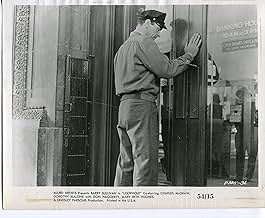
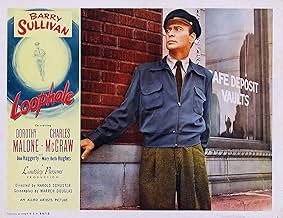
A bank teller attempts to clear his name and rebuild his career after he is wrongly accused of theft.A bank teller attempts to clear his name and rebuild his career after he is wrongly accused of theft.A bank teller attempts to clear his name and rebuild his career after he is wrongly accused of theft.
- Director
- Writers
- Stars
John Close
- FBI Agent
- (uncredited)
Tom Coleman
- Bank Examiner
- (uncredited)
Hal K. Dawson
- Mr. Johnson - Bank Examiner
- (uncredited)
Sayre Dearing
- Bank Employee
- (uncredited)
George Eldredge
- Policeman
- (uncredited)
Charles Ferguson
- Bank Examiner
- (uncredited)
Sam Flint
- Sam - Bank Guard
- (uncredited)
Don C. Harvey
- Police Detective
- (uncredited)
- …
- Director
- Writers
- All cast & crew
- Production, box office & more at IMDbPro
6.7501
1
2
3
4
5
6
7
8
9
10
Featured reviews
IMPLAUSIBLE
Very implausible plot. What bank is ever inspected by a team of auditors in this way who just suddenly turn up to count the money in each teller's drawer? And wouldn't the teller be casting a careful eye over what the "inspector" was doing, no matter how busy he was? Very odd.
Loophole (1954)
A bank teller comes up $50,000 short and an investigator is determined to nail him for theft. The film is something of a mixed bag. The cinematography is pedestrian, the narration is hokey, and the ending is too neat to be satisfying. However, a story about someone being wrongfully accused always makes my blood boil in a way that holds my attention. Barry Sullivan is great as usual, but more interesting is Charles McGraw. McGraw usually plays a righteous character, but here he's such a relentless, contemptible bastard that you can't wait to see him get what's coming to him. The film could have paid off a little better in this respect, but it's an engaging performance. Dorothy Malone is unfortunately saddled with a dull good girl role that doesn't exploit her talents, but there is a small but delightful femme fatale part for Mary Beth Hughes. Ultimately the positives outweigh the negatives and it's a fun watch.
Barry Sullivan has a shortage in his cash drawer
Mike Donovan (Barry Sullivan) is a teller with a problem - a $49,900 shortage (the equivalent of $466,000 in today's money) in his cash for one day. Gus Slavin (Charles McGraw) from the bonding company is sent to investigate. Slavin is sure Mike stole the money, so he's arrested. The cops believe he had a female accomplice.
Everyone believes Mike except Slavin, so the bond company revokes his bond, and he is fired. Slavin also keeps him from keeping other jobs by telling the bosses they've hired a thief.
Slavin figures if he can keep Mike broke, he'll go for the money. Meanwhile Mike and his wife (Dorothy Malone) sell their house and move into a cheaper place.
Mike meanwhile gets a job as a cab driver, and the boss tells Slavin that until Mike is in prison, he's working there. It's in his cab that Mike hears a familiar voice and the wheels start turning. He and his wife devise a plan.
Charles McGraw is fantastic as a relentless investigator who doesn't have a nice bone in his body. He has the strongest role. The revelation is sweet '30s and '40s ingenue Mary Beth Hughes as a hardboiled blonde - she was terrific! Sullivan and Malone are sympathetic characters and play their parts well.
Great seeing all those old '50s cars.
Everyone believes Mike except Slavin, so the bond company revokes his bond, and he is fired. Slavin also keeps him from keeping other jobs by telling the bosses they've hired a thief.
Slavin figures if he can keep Mike broke, he'll go for the money. Meanwhile Mike and his wife (Dorothy Malone) sell their house and move into a cheaper place.
Mike meanwhile gets a job as a cab driver, and the boss tells Slavin that until Mike is in prison, he's working there. It's in his cab that Mike hears a familiar voice and the wheels start turning. He and his wife devise a plan.
Charles McGraw is fantastic as a relentless investigator who doesn't have a nice bone in his body. He has the strongest role. The revelation is sweet '30s and '40s ingenue Mary Beth Hughes as a hardboiled blonde - she was terrific! Sullivan and Malone are sympathetic characters and play their parts well.
Great seeing all those old '50s cars.
MacGraw and Hughes SIZZLE
This is a pretty interesting tale of an average Joe bank teller who is wrongly accused of masterminding a robbery at his bank. The story moves along, the acting is good, and the direction is adept. The movie really ignites flames when CHARLES MACGRAW, as a vengeful bail bondsman, and MARY BETH HUGHES, as a platinum blond femme fatale, are on screen. They both light up the screen with their world-wary, jaded, magnetism. I wish the film had been about them instead of rather dull BARRY SULLIVAN. And DOROTHY MALONE is wasted as the dutiful, loyal wife. In one particularly cringe-worthy scene, Sullivan's boss, Jim Starling (DAYTON LUMMIS), physically hold up his hand up to shush Malone when she tries to make a suggestion, and barks, "I'll handle this, Ruthie." That about sums up how Malone's character was written. Don Beddoe is great as the mild-mannered bank teller in over his head with Hughes, and Richard Reeves is a scene-stealer as Sullivan's new boss who has no time for MacGraw!
The FIlm is Predictable as Sunshine in California - Loophole Still Good
You know in five minutes how this film will end. But it is the journey, not reaching the destination that is the best part of this low-budget film noir piece. Barry Sullivan is miscast as a banker who has a bad day at the office. But Mcgraw is letter perfect in his Edward G imitation of "Double Indemnity". He plays the hard-nosed bond detective to a tee. The females do well in this film, also. I love the bank robber's moll, who was as evil as they get, and the good girl was predictably played well by good girl Dorothy Malone, who always suffered during love scenes (she could never convince the audience she was overtly sexy). She is fine in this role, however. Sullivan, who was famous for uttering one of the most famous lines that ever slipped through the censors in Hollywood with Barbara Stanwyck in "Forty Guns", when he tells Stanwyck that "she better not play with his gun or it might go off in her face". How the hell did that get through? Anyway, the direction is interesting and the production values are wretched, but somehow, the film works anyway. The idea is quite clever at the beginning. A watchable noir.
Did you know
- TriviaThe house on Westward Beach Rd., Westward Beach, Malibu (CA), in the final scenes also appears in the final scenes of Kiss Me Deadly (1955) and What Ever Happened to Baby Jane? (1962).
- GoofsWhen Donovan drives away from the telephone booth on the road to the Malibu beach-house the camera and cameraman are reflected in the window of his cab.
Details
- Runtime
- 1h 20m(80 min)
- Color
Contribute to this page
Suggest an edit or add missing content