IMDb RATING
5.6/10
1.1K
YOUR RATING


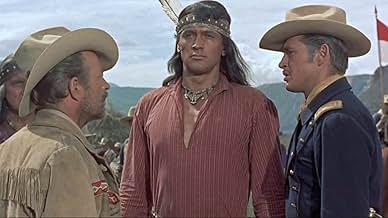
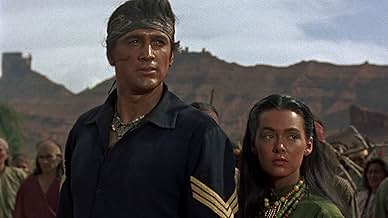
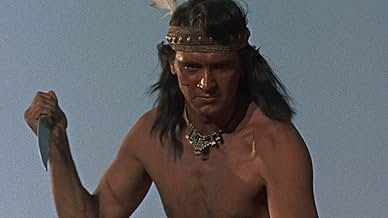
When peacemaking Apache chief Cochise dies, the Chiricahua Apaches are torn between following Cochise's peace loving son Taza and following the warlike renegade Apache warrior Geronimo.When peacemaking Apache chief Cochise dies, the Chiricahua Apaches are torn between following Cochise's peace loving son Taza and following the warlike renegade Apache warrior Geronimo.When peacemaking Apache chief Cochise dies, the Chiricahua Apaches are torn between following Cochise's peace loving son Taza and following the warlike renegade Apache warrior Geronimo.
- Director
- Writers
- Stars





Rex Reason
- Naiche
- (as Bart Roberts)


Eugene Iglesias
- Chato
- (as Gene Iglesias)

Richard H. Cutting
- Cy Hegan
- (as Richard Cutting)


Bradford Jackson
- Lt. Richards
- (as Brad Jackson)


Seth Bigman
- Indian Man
- (uncredited)
- Director
- Writers
- All cast & crew
- Production, box office & more at IMDbPro
5.61.1K
1
2
3
4
5
6
7
8
9
10
Featured reviews
Decent cavalry-Indian western
Universal joined the parade of film studios that wanted to cash in on the popularity of Indian chiefs during the 1950s. This western followed the familiar formula of war and peace, reservation vs. warpath story lines, trigger happy soldiers and renegade Indians. Rock Hudson stars as the obedient, peace-loving son of Cochise in this Arizona saga but his brother opposes the chief's death-bed wish and schemes with other Indians to break free to raid and plunder. That is essentially the plot here, with nothing new to offer fans of this genre. The movie has enough action and scenic vistas to maintain interest but also looks like it was filmed on a shoestring budget. Hudson and Barbara Rush make a fetching couple and the supporting cast is good but the film lacks the polish of other Universal westerns of this period.
The reactionary side of Douglas Sirk
Don't get me wrong.I've always been a big fan of Deltlef Sierck (Douglas Sirk in America)and most of his melodramas are among my all time favorites : "A time to live and a time to die ","All that Heaven allows" "Magnificent obsession" " Tarnished angels" "Written on the wind" plus those with Zarah Leander in Germany not to forget his final effort ,the remake of "imitation of life".
THis remake was drastically different from Stahl's version:the black servant Delilah became Annie and the only thing she could expect in life was a beautiful funeral.In Stahl's version (and in Fannie Hurst's novel) she was a businesswoman's associate ,in Sirk's screenplay she stayed the good servant -not very far away from GWTW's Mamma-who knew her place.
Still with me?I do think that,in spite of Sirk's storyteller qualities and good scenes (the discovery of the bruises on Barbara Rush's back),"Taza" is also a reactionary work .Taza (who in real life died of pneumonia two years after his dad)predates Annie in "Imitation" :he is the good Indian,who knows his place ,who (this is amazing) dresses like them ,who rebels against his people's customs and even fights them;on the other hand ,Geronimo (and his allies) plays the role of the villain : "we were hunters, warriors,we won't be breeders ".After all ,the white men are taking their land and sending them to reservations:his rebellion makes sense.
Rock Hudson,who was Sirk's favorite actor (his best parts were certainly "All that Heaven allows" and "Magnificent Obsession" -another remake of a Stahl's work-) ,is not well cast as an Indian.And what about Barbara Rush as a squaw?Debra Paget was acceptable ("Broken Arrow"),she is not.
THis remake was drastically different from Stahl's version:the black servant Delilah became Annie and the only thing she could expect in life was a beautiful funeral.In Stahl's version (and in Fannie Hurst's novel) she was a businesswoman's associate ,in Sirk's screenplay she stayed the good servant -not very far away from GWTW's Mamma-who knew her place.
Still with me?I do think that,in spite of Sirk's storyteller qualities and good scenes (the discovery of the bruises on Barbara Rush's back),"Taza" is also a reactionary work .Taza (who in real life died of pneumonia two years after his dad)predates Annie in "Imitation" :he is the good Indian,who knows his place ,who (this is amazing) dresses like them ,who rebels against his people's customs and even fights them;on the other hand ,Geronimo (and his allies) plays the role of the villain : "we were hunters, warriors,we won't be breeders ".After all ,the white men are taking their land and sending them to reservations:his rebellion makes sense.
Rock Hudson,who was Sirk's favorite actor (his best parts were certainly "All that Heaven allows" and "Magnificent Obsession" -another remake of a Stahl's work-) ,is not well cast as an Indian.And what about Barbara Rush as a squaw?Debra Paget was acceptable ("Broken Arrow"),she is not.
Better to break a promise than your heart.
Taza, Son of Cochise is directed by Douglas Sirk and written by Gerald Drayson Adams and George Zuckerman. It stars Rock Hudson, Barbara Rush, Gregg Palmer, Rex Reason and Morris Ankrum. A Technicolor production with the Music scored by Frank Skinner and cinematography by Russell Metty.
In 1872 the long bitter war fought between the United States Cavalry troops and Apache bands led by Cochise came to an end. The peace treaty signed by Cochise and General Howard brought peace to the Arizona Territory. But three years later the mighty leader of the Chiricahua Apaches grew ill and come to the end of his days....
....the torch was passed to his first born son, Taza, who wants to follows his father's ideals and peace brokering ways. His second born son, Naiche, however, has different ideas, as does the mighty Geronimo.....
Douglas Sirk's only venture into the Western realm was originally shot in 3D around the gorgeous Arches National Monument Park. Following the pro-Indian theme that was becoming a feature of 1950s Westerns, it's a film that suffers primarily because of the casting of none Native Americans in the important character roles. Which is a shame because it's a gorgeous production that features action scenes full of vim and vigour. Story isn't out of the ordinary and the dialogue is often clunky as the Indian chatter is of the Hollywoodisation kind. Yet picture is never dull, the interest is always held as Taza attempts to hold on to peace for his people, whilst simultaneously he's trying to court the hand of Oona (Rush) against the wishes of her father, the war mongering Grey Eagle (Ankrum).
Hudson, badly cast as he is, can't be faulted for commitment in the title role. He clearly feels at ease working for Sirk (it was a coupling that would work together on a total of 9 movies), and at least he has the physicality for such a character. Unlike Ian MacDonald as Geronimo, who looks too old, is too staid and sticks out like a sore thumb. Russell Metty's photography is top draw, both in capturing gorgeous frames of the locale and in choice of colour lenses. Skinner provides a breezy, if standard Indian tinted Western musical score, and Sirk's direction is simple and effective with only minimal 3D moments part of the action. It's hardly an essential picture in the pantheon of pro-Indian Westerns, but it's better than it has a right to be, and with Pegasus' DVD release providing a lovely print, this is worth seeking out if only for Russell Metty's fine work. 6.5/10
In 1872 the long bitter war fought between the United States Cavalry troops and Apache bands led by Cochise came to an end. The peace treaty signed by Cochise and General Howard brought peace to the Arizona Territory. But three years later the mighty leader of the Chiricahua Apaches grew ill and come to the end of his days....
....the torch was passed to his first born son, Taza, who wants to follows his father's ideals and peace brokering ways. His second born son, Naiche, however, has different ideas, as does the mighty Geronimo.....
Douglas Sirk's only venture into the Western realm was originally shot in 3D around the gorgeous Arches National Monument Park. Following the pro-Indian theme that was becoming a feature of 1950s Westerns, it's a film that suffers primarily because of the casting of none Native Americans in the important character roles. Which is a shame because it's a gorgeous production that features action scenes full of vim and vigour. Story isn't out of the ordinary and the dialogue is often clunky as the Indian chatter is of the Hollywoodisation kind. Yet picture is never dull, the interest is always held as Taza attempts to hold on to peace for his people, whilst simultaneously he's trying to court the hand of Oona (Rush) against the wishes of her father, the war mongering Grey Eagle (Ankrum).
Hudson, badly cast as he is, can't be faulted for commitment in the title role. He clearly feels at ease working for Sirk (it was a coupling that would work together on a total of 9 movies), and at least he has the physicality for such a character. Unlike Ian MacDonald as Geronimo, who looks too old, is too staid and sticks out like a sore thumb. Russell Metty's photography is top draw, both in capturing gorgeous frames of the locale and in choice of colour lenses. Skinner provides a breezy, if standard Indian tinted Western musical score, and Sirk's direction is simple and effective with only minimal 3D moments part of the action. It's hardly an essential picture in the pantheon of pro-Indian Westerns, but it's better than it has a right to be, and with Pegasus' DVD release providing a lovely print, this is worth seeking out if only for Russell Metty's fine work. 6.5/10
Terrific in 3d
Not all 3d movies are filmed having in mind that 3d technique requires specific camera movements and well adjusted settings to shine. But Douglas Sirk, a consumated director did not make that mistake. Just watch the opening sequence with an indian on a horse standing in front of the deep immensity of the canyon at Arches National Monument Park in 3d and glorious technicolor. Breathtaking.
The story -almost totally fictionized- turns pale before it but still is a nice entertainment. Jeff Chandler, who played Cochise in Broken Arrow and The battle at apache pass reprise the role uncredited at the beginning of the film, passing the leadership to his older son Taza. The story runs along to explain how indians are put aside in a reservation with many discontent trying to sublevate and others -guided by Taza- trying to preserve a peace difficult to mantain due to white man's rigid mentality. Imperative to watch it in 3d to enjoy the visual values of this film.
Ambitious But Flawed
When Cochise (played briefly by an uncredited Jeff Chandler) dies, his son Taza (played by Rock Hudson) takes over as chief of the Chiricahua Apaches and tries to maintain the peace. Followers of Geronimo wish to start fighting again.
It's a thoughtful script, and director Douglas Sirk claimed it was his favorite of his movies; he had always wanted to make a western. There are some issues with the movie, some caused by technical issues, and most by Rock Hudson's rather wooden acting. He's got two settings, thoughtful and angry, and that performance makes him, as the central character, seem rather stupid, especially given the more nuanced performances afforded the men playing cavalrymen.
The technical issues can be understood by knowing this was originally shot for 3-D, but released in a flat version. The compositions meant to showcase the depth of shot stick out like a sore thumb, lending a peculiarly film noir look to them. While Russel Metty's camerawork is exemplary in the big-screen shots of Utah, many of the more intimate scenes show up in a peculiarly dark and grey light.
The script by George Zuckerman keeps things moving along, but the problems of performance and camerawork lay heavily on this movie. Sirk and producer Ross Hunter abandoned the western for a series of glossy soap operas.
It's a thoughtful script, and director Douglas Sirk claimed it was his favorite of his movies; he had always wanted to make a western. There are some issues with the movie, some caused by technical issues, and most by Rock Hudson's rather wooden acting. He's got two settings, thoughtful and angry, and that performance makes him, as the central character, seem rather stupid, especially given the more nuanced performances afforded the men playing cavalrymen.
The technical issues can be understood by knowing this was originally shot for 3-D, but released in a flat version. The compositions meant to showcase the depth of shot stick out like a sore thumb, lending a peculiarly film noir look to them. While Russel Metty's camerawork is exemplary in the big-screen shots of Utah, many of the more intimate scenes show up in a peculiarly dark and grey light.
The script by George Zuckerman keeps things moving along, but the problems of performance and camerawork lay heavily on this movie. Sirk and producer Ross Hunter abandoned the western for a series of glossy soap operas.


Did you know
- TriviaDouglas Sirk often cited this film as the favorite of his own films since he always wanted to make a Western.
- GoofsThe official U.S. flag of 1872, the year the story takes place, did have 37 stars in five rows, however it consisted of a top and bottom row of eight stars with three rows of seven stars in between (8-7-7-7-8), not alternating rows of seven and eight (7-8-7-8-7) as the one in the film has.
- ConnectionsFeatured in Rock Hudson's Home Movies (1992)
- How long is Taza, Son of Cochise?Powered by Alexa
Details
- Release date
- Country of origin
- Languages
- Also known as
- Son of Cochise
- Filming locations
- Devils Garden, Arches National Park, Utah, USA(cavalry ambush scene)
- Production company
- See more company credits at IMDbPro
- Runtime
- 1h 19m(79 min)
- Color
- Aspect ratio
- 2.00 : 1
Contribute to this page
Suggest an edit or add missing content