IMDb RATING
7.3/10
1.4K
YOUR RATING
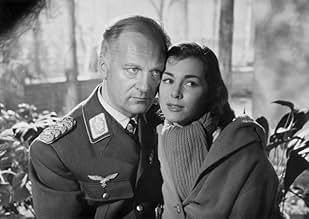
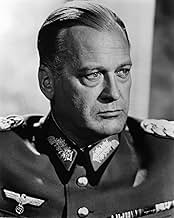
During WW2, German general Harry Harras is a test pilot and chief engineer for the Luftwaffe but his contempt for the Nazis and sabotage at the aircraft plant land him in hot water with the ... Read allDuring WW2, German general Harry Harras is a test pilot and chief engineer for the Luftwaffe but his contempt for the Nazis and sabotage at the aircraft plant land him in hot water with the Gestapo.During WW2, German general Harry Harras is a test pilot and chief engineer for the Luftwaffe but his contempt for the Nazis and sabotage at the aircraft plant land him in hot water with the Gestapo.
- Director
- Writers
- Stars
- Awards
- 2 wins & 3 nominations total
Eva Ingeborg Scholz
- Waltraut 'Pützchen' Mohrungen
- (as Eva-Ingeborg Scholz)
Karl Ludwig Diehl
- Generaldirektor Hugo Mohrungen
- (as Carl Ludwig Diehl)
Joseph Offenbach
- Kriminalrat Zernick
- (as Josef Offenbach)
Wolfrid Lier
- Kellner Detlev
- (as Wolfried Lier)
- Director
- Writers
- All cast & crew
- Production, box office & more at IMDbPro
7.31.4K
1
2
3
4
5
6
7
8
9
10
Featured reviews
Film for Thought!
A movie that I saw for the first time decades ago and numerous times since! Every time I watch it, I discover new facets in Harras'personality. On one hand he is the tough guy, the party animal, the womanizer; however, he shows his softer, almost romantic side when he meets Diddo Geiss. I think that the movie could be a wonderful teaching tool, because it illustrates how "non-political", even rebellious Germans were drawn into the Nazi ideology and paid the ultimate price! Udo Jürgens and Marianne Koch were fabulous together! I would recommend this film for upper level German classes in the US. It is a good addition to "Die weisse Rose" or "Sophie Scholl".
"I have to clear my debts at last. My guilt."
German audiences in the 1930's thrilled to see the astonishing aerial acrobatics of Ernst Udet in the mountain films of Arnold Fanck. The highest-ranking air ace to survive WWI, he was to become Colonel-General of the Luftwaffe but the unbearable pressures of the job, his sense of being betrayed by Goering and his despair at Hitler's invasion of Russia led to his taking his own life.
It is generally accepted that the character of General Harras in Carl Zuckmayer's hugely successful post war play is loosely based on Udets and is a fictionalised account of his final days.
The title role in this excellent film adaptation made an international star of the charismatic Curd Juergens and deservedly won him a Best Actor award at Cannes. It is undeniably his finest role and arguably his best performance.
The cast is uniformly excellent and the characters well drawn, not least Eva-Ingerborg-Scholz as the loathsome Putzchen and Viktor de Kowa as rabid Nazi Schmidt-Lausen. The career of de Kowa, despite his being on Goebbel's 'Important Artists exempt list' and his membership of the Nazi party, continued unabated after the war and his marvellously menacing portrayal is riveting. Marianne Koch plays Harras' young love and their mutual attraction is convincing despite the age gap.
This piece cannot but betray its theatrical roots but under Helmut Kautner's customarily expert direction and with Klaus Dudenhofer's editing it never drags and builds to a stupendous climax.
The intelligent and artistic Helmut Kautner not only navigated the shark infested waters of the Third Reich but also gave us one of its greatest films, 'Romanze in Moll' and managed to rise above the crass commercialism of 1950's German cinema.
It is generally accepted that the character of General Harras in Carl Zuckmayer's hugely successful post war play is loosely based on Udets and is a fictionalised account of his final days.
The title role in this excellent film adaptation made an international star of the charismatic Curd Juergens and deservedly won him a Best Actor award at Cannes. It is undeniably his finest role and arguably his best performance.
The cast is uniformly excellent and the characters well drawn, not least Eva-Ingerborg-Scholz as the loathsome Putzchen and Viktor de Kowa as rabid Nazi Schmidt-Lausen. The career of de Kowa, despite his being on Goebbel's 'Important Artists exempt list' and his membership of the Nazi party, continued unabated after the war and his marvellously menacing portrayal is riveting. Marianne Koch plays Harras' young love and their mutual attraction is convincing despite the age gap.
This piece cannot but betray its theatrical roots but under Helmut Kautner's customarily expert direction and with Klaus Dudenhofer's editing it never drags and builds to a stupendous climax.
The intelligent and artistic Helmut Kautner not only navigated the shark infested waters of the Third Reich but also gave us one of its greatest films, 'Romanze in Moll' and managed to rise above the crass commercialism of 1950's German cinema.
good film about Nazi Germany from a quite German point of view
This is a tranquil but disturbing film about a disputatious general trying to get along with the Nazi system. And even though the film does not live on action but on good dialogues, its appeal is quite different to that of the theatrical play. The movie is a classic.
Well done, but not great
"The devil's general" is about a war hero from the First World War who is still in the army when the Second World War breaks out, but who is secretly opposed to the Nazi's. Of course this general has to operate very carefully in order not to get unmasked. The film portrays the actions of this general, sometimes not without humour.
Helmut Käutner was one of the few post war German directors who remained in Germany during the Nazi regime but managed not to compromise himself by participating in Nazi propaganda. In fact his only respected colleague was Wolfgang Staudte. For years these two directors were the only two making quality cinema in Germany.
Helmut Käunter is mainly known for "Unter den Brucken" (1946), in the style of "L'Atalante" (1934, Jean Vigo).
The opening scene of "The devil's general" reminded me vaguely of "The damned" (1969, Luchino Visconti). There is a party of high ranked Nazi's. On the surface evrything is cheerful, but below there is a lot of mistrust and complot thinking.
After the opening scene the film remains well done but it does not equal the quality of "The damned". For this "The devil's general" lacks the perversity and cynicism that makes "The damned"such a great movie.
Helmut Käutner was one of the few post war German directors who remained in Germany during the Nazi regime but managed not to compromise himself by participating in Nazi propaganda. In fact his only respected colleague was Wolfgang Staudte. For years these two directors were the only two making quality cinema in Germany.
Helmut Käunter is mainly known for "Unter den Brucken" (1946), in the style of "L'Atalante" (1934, Jean Vigo).
The opening scene of "The devil's general" reminded me vaguely of "The damned" (1969, Luchino Visconti). There is a party of high ranked Nazi's. On the surface evrything is cheerful, but below there is a lot of mistrust and complot thinking.
After the opening scene the film remains well done but it does not equal the quality of "The damned". For this "The devil's general" lacks the perversity and cynicism that makes "The damned"such a great movie.
A great movie with one great actor.
Curd Juergens, Germany´s famous actor of the fifties and sixties, here playing a part that made him a star: The Devil´s General is an airforce general with extraordinary success in building new warplanes for the luftwaffe in ww2. At the same time, he is definitely not a nazi, not a bureaucrat but a party animal and a human being with a certain sense that everybody should be treated as human beings. This makes him an enemy to the high ranks of the SS and at the same a potential partner for people of the german resistance. In the end, he pays the bill for being part of a system, he never really said "no" to. A great movie with one great actor.
Did you know
- TriviaThe main character, Gen. Harras, is based on Ernst Udet. Udet was a top-scoring German fighter ace during World War I and became a national hero. In the interwar era he lived the life of a celebrity; womanizing, performing at airshows and playing in movies. After Hitler's National Socialist Party came to power, he was appointed Generalluftzeugmeister of the Luftwaffe, responsible for development and procurement of new aircraft for the German Air Force. Unable to cope with the stress of the job and aware of worsening war situation for Germany, he committed suicide in Autumn 1941.
- GoofsAround 1:40, when the MO-168 bomber prototype is being test-dived, a high-pitched siren-like noise is heard. In reality this sound, called "Stuka-siren", was made only by the Junkers Ju 87 "Stuka" dive bombers by special noise-generating devices mounted on the aircraft landing gear. However, due to ubiquity of WWII German propaganda newsreels portraying Stukas during their attack runs, the sound became associated in the popular knowledge with any aircraft during any kind of diving maneuver, and thus often the movies portray other military aircraft, civilian airplanes and even passenger airliners making this siren-like noise when diving.
- Alternate versionsAn English dubbed version was released to American television.
- ConnectionsReferences The German Weekly Review (1940)
- How long is The Devil's General?Powered by Alexa
Details
- Release date
- Country of origin
- Languages
- Also known as
- Des Teufels General
- Filming locations
- Production company
- See more company credits at IMDbPro
- Runtime
- 1h 57m(117 min)
- Color
- Sound mix
- Aspect ratio
- 1.33 : 1
Contribute to this page
Suggest an edit or add missing content