Devdas
- 1955
- 2h 39m
IMDb RATING
7.7/10
2.1K
YOUR RATING

The scion of a wealthy landowner family turns to alcohol and self-pity and slowly self-destructs after class differences force him to break off his relationship with his childhood sweetheart... Read allThe scion of a wealthy landowner family turns to alcohol and self-pity and slowly self-destructs after class differences force him to break off his relationship with his childhood sweetheart.The scion of a wealthy landowner family turns to alcohol and self-pity and slowly self-destructs after class differences force him to break off his relationship with his childhood sweetheart.
- Director
- Writers
- Stars
- Awards
- 4 wins total


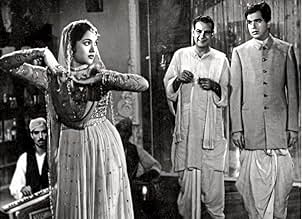

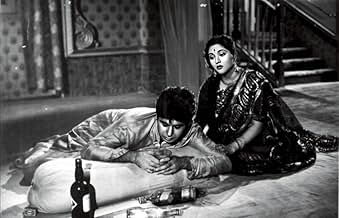


Vyjayanthimala
- Chandramukhi
- (as Vyjayanti Mala)


Kanhaiyalal Chaturvedi
- Teacher
- (as Kanhaiyalal)


Kumari Naaz
- Young Parvati
- (as Baby Naaz)
- Director
- Writers
- All cast & crew
- Production, box office & more at IMDbPro
7.72.1K
1
2
3
4
5
6
7
8
9
10
Featured reviews
10gabs-10
Realistic, moving and tragic...
This is another film by the great Bimal Roy. Based on Sarat Chandra's famous Bengali novel "Debdas", "Devdas" (1955) is one of Bimal Roy's handful of films that are adaptations of Bengali novels and short stories; others include "Parineeta" (1953) and "Kabuliwallah" (1960). In comparison with its successor "Devdas" (2002), Bimal Roy's "Devdas" (1955) provides a more realistic backdrop. The buildings, such as Devdas' and Paro's houses as well as the brothel in which Chandramukhi dances are relatively simple, unlike their over-extravagant replicas in the recent adaptation by Sanjay Leela Bhansali. Also, the costumes are simple and reflect the lifestyles of rural Bengalis in the past, much unlike Sanjay Leela Bhansali's adaptation that features too much jewellery, gold embroidery, rich brocades and fabulous fabrics. In addition to that, this film has great and subliminal histrionic performances by Dilip Kumar, Suchitra Sen and Vyjayanthi Mala. I was captivated by Dilip Kumar's perfect picturisation of a drunk, lovesick Devdas. His dialogues are simple and easier to understand, in comparison with Shahrukh Khan's role, who speaks lots of flowery language. Apart from that, Dilip Kumar's blurred glint in his eyes while playing the drunk Devdas scene with Vyjayanthi Mala is simply natural. Leading Bengali-film tragedy queen Suchitra Sen played Paro in this film, and her performance was the greatest. In my opinion, Paro's (Aishwarya Rai) reaching out to a dying Devdas (Shahrukh Khan) towards the story's end in Sanjay Leela Bhansali's adaptation was merely a copy of Suchitra Sen's act in this film: the saris featured in the same scene from both films were exactly the same, too! I strongly feel that Suchitra Sen's performance was at its strongest during this scene, and no other actress can possibly duplicate it. Last but not least, the round of applause should also go to Bollywood's legendary Dancing Queen, Vyjayanthi Mala. She was handpicked by Bimal Roy for her flawless dancing skills. Nevertheless, she not only spiced the film with her fluid Kathak; she also gave the audience a never-seen-before melodramatic side of herself when she played the converted Chandramukhi. Madhuri Dixit's role was simply out of the question whereby she even met up with Paro! Moreover, one ought to note that Chandramukhi is just a courtesan, not a diva, as portrayed by Madhuri Dixit. In short, Vyjayanthi Mala has successfully proved her versatility through Chandramukhi in this film. On top of that, "Devdas" (1955) has a beautiful original musical score. The biggest credit should go to Lataji, who was, at that time, enjoying early success. Her melodious voice made the mujras "Aa Gayi Teri Marzi" and "O Jaane Wale" as well as the touching "Jisse Tu Kabool Kar Le Voh" all-time best-loved nostalgic hits. In a nutshell, Bimal Roy's "Devdas" (1955) will always rank as an evergreen classic in the charts of Bollywood, thanks to the unforgettable acting by Dilip Kumar, Suchitra Sen and Vyjayanthi Mala, Lataji, Talat Mehmood, Mubarak Begum, Asha Bhosle and Usha Mangeshkar's melodious voices as well as the memorable direction of the great film-maker Bimal Roy.
10burman
Based on Sharatchandra's literary classic of the same name, it is a landmark in the history of Indian Cinema.
This film was just excellent on all counts, be it direction, cinematography, acting or music. A classic produced and directed by Bimal Roy. And what performances ! Motilal, Dilip Kumar, Vyjayanthimala and Suchitra Sen, all excelled. And what a musical score ! Talat Mahmood's "Mitwa, lagi re yeh kaisi" and "Kisko khabar thi, kisko yakeen tha, aise bhi din aayenge" are among his best numbers. So are Lata Mangeshkar's "Jise tu qabool karle", "O' jaane wale, ruk ja koi dam" and "Ab aage teri marzi" are excellent numbers. Two other songs, "Woh na aayenge palat kar, chahe lakh ham bulaayen", sung by Mubarak Begum and "Manzil ki chaah mein" are haunting songs.
A Classic Indian Story...
I'm writing - and viewed, this, as an English non-Indian, who simply loves film and is venturing from more obvious World Cinema, into the more obscure and possibly more rewarding.
So, I'm more concerned with the story than who's playing whom and such. I came across the story, Devdas, via the 2002, very colourful and (at the time, may still be the case) most expensive Indian film, which is a feast to both eye and ear. I'll review that one, once I've re-watched my new DVD of it, having only seen on TV.
The universal and accessible story, written as early as 1917 is of two childhood sweethearts - Parvati and the titular Devdas, who grow up but go their separate ways. Devdas flees to Calcutta and seeking the high- life, frequents a brothel and starts drinking; to the extent that he comes alcoholic. She marries a wealthy husband. They both regret their parting and long for what could have been. Devdas befriends a pretty prostitute - Chandramukhi - who desperately wants to love the Devdas that she inwardly sees, but cannot reach. His loves are for his childhood sweetheart - and the alcohol, only. Add family issues and you've got a nice pot-boiler of emotion, drama and pathos throughout the 160 minute run-time.
Many think, wrongly, that Indian cinema is nothing but Bollywood - lightweight singing and dancing and that serious issues on Life are either treated in a dismissive way, or not at all. In many ways, this story could be Shakespearian, or made for the Golden era of Hollywood. What makes it endlessly fascinating is of course the different culture, from marriage and fidelity to the simple poetic beauty in the landscape and costume.
There is some singing and dancing in this 1955 black & white version, but little compared to a Bollywood production and much of what there is are the rituals of the working ladies that venture into Devdas' sordid existence.
Naturally, this monochrome - and much earlier film than the 2002 one, is poorer in picture and sound quality. Mine (cover exactly as shown) had a varying faint green/olive colour cast, had quite a few blemishes picked up through time and was slightly soft. The sound is OK, if you're not fussy. However, I know that this quality is typical, for Indian film of this period. However, one gets used to it and almost comforted by it, being more intense, somehow. At least is doesn't look like a video- transfer, thankfully.
From what I gather, many agree that Bimal Roy's film, here, is the definitive adaptation, though it was made earlier, the first of which was in 1928! For popularists and lovers of colour and spectacle, go for the 2002 glossy version. If the story and the acting and a purer form of beauty is what you're after, then this one will have you enthralled. Though the film itself is a four and half starrer, I've not rounded it up, due to transfer quality issue.
So, I'm more concerned with the story than who's playing whom and such. I came across the story, Devdas, via the 2002, very colourful and (at the time, may still be the case) most expensive Indian film, which is a feast to both eye and ear. I'll review that one, once I've re-watched my new DVD of it, having only seen on TV.
The universal and accessible story, written as early as 1917 is of two childhood sweethearts - Parvati and the titular Devdas, who grow up but go their separate ways. Devdas flees to Calcutta and seeking the high- life, frequents a brothel and starts drinking; to the extent that he comes alcoholic. She marries a wealthy husband. They both regret their parting and long for what could have been. Devdas befriends a pretty prostitute - Chandramukhi - who desperately wants to love the Devdas that she inwardly sees, but cannot reach. His loves are for his childhood sweetheart - and the alcohol, only. Add family issues and you've got a nice pot-boiler of emotion, drama and pathos throughout the 160 minute run-time.
Many think, wrongly, that Indian cinema is nothing but Bollywood - lightweight singing and dancing and that serious issues on Life are either treated in a dismissive way, or not at all. In many ways, this story could be Shakespearian, or made for the Golden era of Hollywood. What makes it endlessly fascinating is of course the different culture, from marriage and fidelity to the simple poetic beauty in the landscape and costume.
There is some singing and dancing in this 1955 black & white version, but little compared to a Bollywood production and much of what there is are the rituals of the working ladies that venture into Devdas' sordid existence.
Naturally, this monochrome - and much earlier film than the 2002 one, is poorer in picture and sound quality. Mine (cover exactly as shown) had a varying faint green/olive colour cast, had quite a few blemishes picked up through time and was slightly soft. The sound is OK, if you're not fussy. However, I know that this quality is typical, for Indian film of this period. However, one gets used to it and almost comforted by it, being more intense, somehow. At least is doesn't look like a video- transfer, thankfully.
From what I gather, many agree that Bimal Roy's film, here, is the definitive adaptation, though it was made earlier, the first of which was in 1928! For popularists and lovers of colour and spectacle, go for the 2002 glossy version. If the story and the acting and a purer form of beauty is what you're after, then this one will have you enthralled. Though the film itself is a four and half starrer, I've not rounded it up, due to transfer quality issue.
Tragic Masterpiece of a Forlorn Love Affair !
The simple, austere, penetrating, candid and passionately electrifying depiction of subtle human values and sentiments is the hallmark of Bimal Roy's DEVDAS.
Dilip Kumar's demeanor in this heartrending movie happens to be the culmination of his acting prowess which is all praise and nothing else. He was no Dilip Kumar in the film but exact imitation of the role. He outperformed in perfectly getting under the skin of a prodigal Devdas in the first hour of the movie and a profligate Devdas in the last hour. Besides, the very real to life and original performance of Dilip, Suchitra Sen's weighted speech quality and simple dialog delivery adds resonance to an already touching storyline that goes to the heart of every viewer.
The direction of Bimal Roy is superbly excellent and all the more imaginative and original, i.e, no artificial, tawdry and superfluous love scenes and no vulgarity, as well. He believed in ruling over the hearts of the audience through the sheer force of evocative and poignant dialogs, songs and cinematography. That is a quality, in sharp contrast with the latest version of Bhansali's Devdas. Roy's Devdas should be regarded as an intellectually perfect cinematic sequence in the history of Indian film making.
This black and white, old cinematic rendition of Chatterjee's novel is definitely head and shoulders above Bhansali's flamboyant and extravagant version of 2002, starring Shahrukh Khan.
Dilip Kumar's demeanor in this heartrending movie happens to be the culmination of his acting prowess which is all praise and nothing else. He was no Dilip Kumar in the film but exact imitation of the role. He outperformed in perfectly getting under the skin of a prodigal Devdas in the first hour of the movie and a profligate Devdas in the last hour. Besides, the very real to life and original performance of Dilip, Suchitra Sen's weighted speech quality and simple dialog delivery adds resonance to an already touching storyline that goes to the heart of every viewer.
The direction of Bimal Roy is superbly excellent and all the more imaginative and original, i.e, no artificial, tawdry and superfluous love scenes and no vulgarity, as well. He believed in ruling over the hearts of the audience through the sheer force of evocative and poignant dialogs, songs and cinematography. That is a quality, in sharp contrast with the latest version of Bhansali's Devdas. Roy's Devdas should be regarded as an intellectually perfect cinematic sequence in the history of Indian film making.
This black and white, old cinematic rendition of Chatterjee's novel is definitely head and shoulders above Bhansali's flamboyant and extravagant version of 2002, starring Shahrukh Khan.
Devdas(1955)
I first saw this movie in 1970 and have to this day never forgotten the haunting and beautifully tuned climax.Many years later the recent Shah Rukh blockbuster came to view which to my mind defamed the essence and spirit of the tale.Bimal Roy's dignified classic took one to the root of the matter.It is hard to imagine a film with so much realism.I have never seen an actor so deeply immersed in the character he's playing like Dilip Kumar and to bring that piece of fiction to life.Suchitra Sen embodies her role beautifully but Vyjantimala is simply superb.The other parts are skillfully played; an attribute to sound casting.The photography and music like in all Bimal Roy films are an accolade to nature.Forget about the lavish Khan extravaganza and see Devdas as it really should be : a man who gives up all even his life for his bitterment but still evokes admiration from the world.I had seen the Bengali Uttam Kumar in some films and it is my regret he never played this role but Dilip Kumar will never be bettered.I felt he was totally lost in the character!!!


Did you know
- TriviaRanks on Number 2 on University of Iowa's List of Top 10 Bollywood Films by Corey K. Creekmur.
- ConnectionsFeatured in Celluloid Man (2012)
- SoundtracksJise tu kabool kar le woh
Sung by Lata Mangeshkar
- How long is Devdas?Powered by Alexa
Details
- Runtime
- 2h 39m(159 min)
- Color
- Sound mix
- Aspect ratio
- 1.37 : 1
Contribute to this page
Suggest an edit or add missing content