
In Mexico, at the dawn of the automobile, modern bandit Santiago burglarizes train freight cars and falls in love with a poor farmer's wife.In Mexico, at the dawn of the automobile, modern bandit Santiago burglarizes train freight cars and falls in love with a poor farmer's wife.In Mexico, at the dawn of the automobile, modern bandit Santiago burglarizes train freight cars and falls in love with a poor farmer's wife.
- Awards
- 1 nomination total




Eumenio Blanco
- Bartender
- (uncredited)

Edward Colmans
- Police Officer
- (uncredited)

Bert LeBaron
- Brawler
- (uncredited)
Jose Portugal
- Hood
- (uncredited)
Armando Rodriguez
- Bar Patron
- (uncredited)

Rosa Turich
- Vendor
- (uncredited)
- Director
- Writer
- All cast & crew
- Production, box office & more at IMDbPro
6.6762
1
2
3
4
5
6
7
8
9
10
Featured reviews
Likable, different
There is something very likable about this low budget, "poetic" story of an aging outlaw who comes upon the small farm of an ambitious peon and his willful wife. The atmosphere is a bit thick perhaps, constant philosophizing in a "poetic" Spanish accent, with a guitar playing in the background. But Kennedy is particularly good as the outlaw, worldly-wise and mellow with flashes of toughness, anger and cynicism. The other players carry their weight well enough, though Iglesias sometimes goes a bit overboard with his characterization of the naive, greedy young man. There's not much to the story, but it's well told. Here, certainly, is a film that, whatever its ultimate virtues, is unique. Though the subject makes it a Western, the style (as well as the Mexican setting and the apparent thirties time-frame) makes it something completely different. This is the sort of film one expects from Ulmer's reputation; small but personal. I really did like it, but I don't know if I would go as far as Francois Truffaut: "Poetic and violent, tender and droll, moving and subtle, joyously energetic and wholesome... reminds us inevitably of Renoir and Ophuls."
Some Depth Despite Tacky Title
The movie's not a western in the usual sense. Instead, it's more like a pondering of character and life-styles set in modern Mexico. Manuel and Maria are in an arranged marriage, she being passed along like a piece of property, he being a budding farm entrepreneur. They are above all "respectable", and the feeling is that this is what holds the marriage together.
Then, into their settled life arrives escaping train robber Santiago. But he's not a typical robber. We know that from his buddy's moving death scene. There Santiago shows something of a poetic sensitivity, proving he's not without his own sense of values. In fact, he's more a free spirit than a criminal type, even giving away much of his loot to deserving strangers. Ironically, however, he appears unfree to be anything but free!
It's Santiago's free-wheeling effect on the young couple's brittle marriage that makes up the storyline. Kennedy, of course, was one of that era's premier actors. Here, his bravura performance effectively dramatizes Santiago's free spirit gusto. On the other hand, as the young couple, Iglesias and St. John appear over-the-top at times. Perhaps that can be rationalized by their emotional release from repressed lives. Nevertheless, the emoting does at times distract from story advancement.
The notion of respectability is also pondered here. What the screenplay seems to be saying is that conforming lives are okay as long as one's humanity is not sacrificed in the process. In his own eccentric way, this appears the lesson Santiago imparts to the young couple. At the same time, religion gets much the same treatment, while criminal Santiago acts poetically as a kind of secular priest in easing his dying confederate into the great unknown.
All in all, the movie's distinctive features come more from blacklisted writer Zimet's offbeat screenplay than from cult director Ulmer who's required to film in Technicolor instead of his b&w forte. Nonetheless, the movie's fully deserving of the Ulmer brand-- an offbeat 80-minutes that manages some depth over and above its tacky 50's title.
Then, into their settled life arrives escaping train robber Santiago. But he's not a typical robber. We know that from his buddy's moving death scene. There Santiago shows something of a poetic sensitivity, proving he's not without his own sense of values. In fact, he's more a free spirit than a criminal type, even giving away much of his loot to deserving strangers. Ironically, however, he appears unfree to be anything but free!
It's Santiago's free-wheeling effect on the young couple's brittle marriage that makes up the storyline. Kennedy, of course, was one of that era's premier actors. Here, his bravura performance effectively dramatizes Santiago's free spirit gusto. On the other hand, as the young couple, Iglesias and St. John appear over-the-top at times. Perhaps that can be rationalized by their emotional release from repressed lives. Nevertheless, the emoting does at times distract from story advancement.
The notion of respectability is also pondered here. What the screenplay seems to be saying is that conforming lives are okay as long as one's humanity is not sacrificed in the process. In his own eccentric way, this appears the lesson Santiago imparts to the young couple. At the same time, religion gets much the same treatment, while criminal Santiago acts poetically as a kind of secular priest in easing his dying confederate into the great unknown.
All in all, the movie's distinctive features come more from blacklisted writer Zimet's offbeat screenplay than from cult director Ulmer who's required to film in Technicolor instead of his b&w forte. Nonetheless, the movie's fully deserving of the Ulmer brand-- an offbeat 80-minutes that manages some depth over and above its tacky 50's title.
An extremely talented actor finally scores a starring role.
This movie provides the viewer with an opportunity to see a truly gifted,if unsung actor, in a role that he owns. Arthur Kennedy played many supporting roles in the 40's and 50's and was nominated five times for an Oscar as Best Supporting Actor. During that time he acted for most of the outstanding directors of the period and with actors like Mitchum,Sinatra,Douglas,to name a few. Long overdue for a memorable starring role, he finally has the lead in this movie. As Santiago he demonstrates how callousness and gentleness of spirit can reside believably in the same person. His contact with th peasant couple ultimately changes forever their views of the future as well as his own and final redemption. This is a movie one can see only on TV late shows. A pity, but if you're lucky enough to catch it, you'll be rewarded. Guaranteed.
A small but excellent, atmospheric western - an allegory on greed.
An excellent little western that shows what can be done with a good story, little money, character actors and inspired direction(i.e. with no studio interference). The story unfolds in a slow but well-controlled tempo and proceeds to show how greed changes a kind-hearted man and his family into vicious money-hungry people. Edgar Ulmer, a much underrated but top-grade director, knows how to bring out the deepest and most secret feelings of his characters, through the excellent direction of his actors (Arthur Kennedy gives the best performance of his career) and create tension and the right atmosphere. On the level of John Ford's "Wagonmaster"! Should be seen and enjoyed more often. Makes you want to see more of Ulmer's works. Andreas-27
A romantic life style
King of the cheapies Edgar Ullmer directed this modern west saga set in Mexico with something he normally didn't have at his disposal, technicolor. Even with that it's certainly one parsimonious production, but not bad.
Although why he cast Arthur Kennedy replete with dyed black hair and a greasy beard as a Mexican bandit who knows. This was a role so right for Gilbert Roland. I guess he wasn't available.
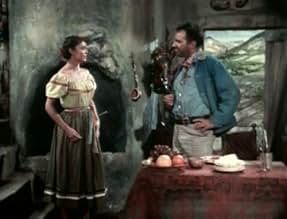
Nevertheless Kennedy gives it his best as the charismatic bandit who after losing one partner doing a job is ready for another. He takes refuge in the house of farmer Eugene Iglesias and wife Betta St.John. In one way or another he seduces both of them with what they see as a romantic life style. Both want to go off with him and leave the other.
The Naked Dawn is a curious little film, deep in character rather than plot. But I think it would have been a classic with a Gilbert Roland or a Fernando Lamas in the lead.
Although why he cast Arthur Kennedy replete with dyed black hair and a greasy beard as a Mexican bandit who knows. This was a role so right for Gilbert Roland. I guess he wasn't available.
Nevertheless Kennedy gives it his best as the charismatic bandit who after losing one partner doing a job is ready for another. He takes refuge in the house of farmer Eugene Iglesias and wife Betta St.John. In one way or another he seduces both of them with what they see as a romantic life style. Both want to go off with him and leave the other.
The Naked Dawn is a curious little film, deep in character rather than plot. But I think it would have been a classic with a Gilbert Roland or a Fernando Lamas in the lead.


Did you know
- TriviaFrançois Truffaut cited this film as an inspiration for Jules and Jim. In fact, he even mentions Jules and Jim in his review of this film. Truffaut's film came out six years later.
- ConnectionsFeatured in Edgar G. Ulmer: The Man Off-Screen (2004)
Details
- Release date
- Country of origin
- Language
- Also known as
- The Bandit
- Filming locations
- Production company
- See more company credits at IMDbPro
- Runtime
- 1h 22m(82 min)
Contribute to this page
Suggest an edit or add missing content