IMDb RATING
6.4/10
2.2K
YOUR RATING
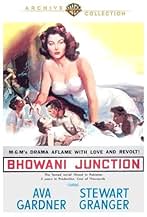
Anglo-Indian Victoria Jones seeks her true identity amid the chaos of the British withdrawal from India.Anglo-Indian Victoria Jones seeks her true identity amid the chaos of the British withdrawal from India.Anglo-Indian Victoria Jones seeks her true identity amid the chaos of the British withdrawal from India.
- Director
- Writers
- Stars
- Nominated for 1 BAFTA Award
- 2 nominations total
Ronald Adam
- General Ackerby
- (uncredited)
Anthony Bushell
- Lanson
- (uncredited)
Eric Corrie
- Man-at-Arms
- (uncredited)
George Cukor
- Man on Train
- (uncredited)
Roger Delgado
- Train Driver
- (uncredited)
Dharma Emmanuel
- Sentry
- (uncredited)
Raymond Francis
- Captain Cumberly
- (uncredited)
- Director
- Writers
- All cast & crew
- Production, box office & more at IMDbPro
6.42.2K
1
2
3
4
5
6
7
8
9
10
Featured reviews
As an Anglo Banglo descendant.....
Well, I've always sort of identified myself as an AngloBanglo.
My dad was born in Lahore in 1929 and my grandparents left Karachi in 1965 almost 20 years after partition because the Muslims had made it impossible for my Nana to continue to run her private school.
The returned to England like so many AngloBanglos where they were too Indian for the white and not Indian enough for the Indians.
Just like they were back in what was then Pakistan and by some account, India itself.
You have to remember that at this point, as depicted in the film, 1947 was the cusp of partition and violence was everywhere. My grandfather told me graphic stories of entire trains of people slaughtered he had witnessed.
Ava Gardner's character has to choose which side she is on but for many AngloBanglos the struggle goes on. We are neither brown enough for the browns, nor white enough for the whites. I now live in Canada but I self identify as English.
The sub text in George Cukor's story has lost some of it's impact over time because few remember the upheaval of partition but for some of us, it bring it back into focus.
More interesting to me is that it was released the year I was born, in England, in 1956.
My dad was born in Lahore in 1929 and my grandparents left Karachi in 1965 almost 20 years after partition because the Muslims had made it impossible for my Nana to continue to run her private school.
The returned to England like so many AngloBanglos where they were too Indian for the white and not Indian enough for the Indians.
Just like they were back in what was then Pakistan and by some account, India itself.
You have to remember that at this point, as depicted in the film, 1947 was the cusp of partition and violence was everywhere. My grandfather told me graphic stories of entire trains of people slaughtered he had witnessed.
Ava Gardner's character has to choose which side she is on but for many AngloBanglos the struggle goes on. We are neither brown enough for the browns, nor white enough for the whites. I now live in Canada but I self identify as English.
The sub text in George Cukor's story has lost some of it's impact over time because few remember the upheaval of partition but for some of us, it bring it back into focus.
More interesting to me is that it was released the year I was born, in England, in 1956.
Ambitious, uneven
Produced barely a handful of years after the tumultuous period in question, the film delves further into events and attitudes that would have been comparatively unfamiliar to North American audiences - perhaps explaining, in part, its middling box office performance.
One can only speculate as to whether the project was part of a Cold War ploy to woo India away from its affection for Russia; however, dialogue early on does make specific reference to worries about Russian influence. If there's any validity to that speculation, then its ambitions extended beyond the box office (and might have been realized..?).
I agree with those commending director Cukor for his handling of the wide screen spectacle and action. I suspect that Richard Attenborough took notes from Cukor's visual approach in pre-planning his "Gandhi." Yes, other directors (e.g., Victor Fleming, Gone With the Wind, to mention but one) achieved more memorable tableaux; but this was an honourable entry in a still-evolving format at the time.
I'll yield to others' opinions on the performances - with the exception that I found Bill Travers's character and his portrayal were a one-note annoyance throughout. I mean, at least get a dialogue coach and find a credible accent, already!
It would be interesting to recover Cukor's original cut of the film, notwithstanding the apparently negative audience reactions at the time. The voice over post-facto narrative technique the studio imposed was hackneyed even then.
One can only speculate as to whether the project was part of a Cold War ploy to woo India away from its affection for Russia; however, dialogue early on does make specific reference to worries about Russian influence. If there's any validity to that speculation, then its ambitions extended beyond the box office (and might have been realized..?).
I agree with those commending director Cukor for his handling of the wide screen spectacle and action. I suspect that Richard Attenborough took notes from Cukor's visual approach in pre-planning his "Gandhi." Yes, other directors (e.g., Victor Fleming, Gone With the Wind, to mention but one) achieved more memorable tableaux; but this was an honourable entry in a still-evolving format at the time.
I'll yield to others' opinions on the performances - with the exception that I found Bill Travers's character and his portrayal were a one-note annoyance throughout. I mean, at least get a dialogue coach and find a credible accent, already!
It would be interesting to recover Cukor's original cut of the film, notwithstanding the apparently negative audience reactions at the time. The voice over post-facto narrative technique the studio imposed was hackneyed even then.
Ava in fine form
'Bhowani Junction' was one of the few movies where Ava Gardner was allowed to be more than just a beautiful, but inanimate statue. As Victoria Jones, she emotes in ways that one rarely sees her do. Like her character Julie in 'Showboat' Victoria is bi-racial, which is the main theme of the movie. The Pakistani backdrop is gorgeously photographed and it's certainly a testament to location shooting as opposed to studio backdrops. Unsurprisingly, it was well directed by Cukor, especially the interior, dramatic scenes that he is so famous for. The final sequence is a break from that, however, with darkly lit chases and murder. An entertaining diversion; certainly one that fans of Gardner would want to catch.
A beautiful movie
This is a beautifully shot, and well acted movie. It is almost faithful to the book and a good portrait of the chaos at the end of the second world war. Ava Gardner is luminous as always, and Stewart Granger a good foil for her.
An Anglo-Indian woman (Ava Gardner) is caught between India and England
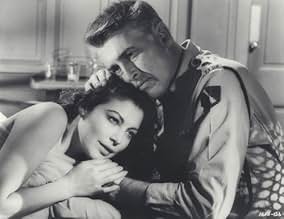
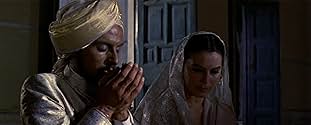
During the chaotic final days of British rule in northwest India in 1947, the beautiful daughter (Gardner) of an English train engineer and an Indian mother struggles to find her identity while pursued by three men: a rail-traffic superintendent (Bill Travers), his Sikh subordinate (Francis Matthews) and a British colonel (Stewart Granger). Meanwhile Indian supporters of Mahatma Gandhi campaign for independence while Communists, led by a revolutionary called Davay (Peter Illing), fuel unrest.
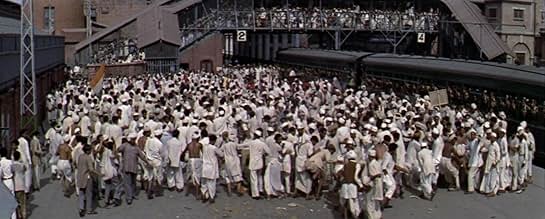
"Bhowani Junction" (1956) is an exotic drama with adventure elements similar to the future "A Passage to India" (1985), although not as good as that one. It features most of the elements you'd think of when India comes to mind - never-ending throngs of people in (usually) white garb, trains, street commotion, etc.
Ava is beautiful, Granger makes for a stalwart male protagonist, the locations are authentic and the historical setting is interesting. But I rolled my eyes at the subplot regarding a certain person feeling guilty about something, which didn't make sense since what that person did was in self-defense and the perpetrator was an ignoble scumbag.
The movie runs 1 hour, 50 minutes, and was shot in Lahore, Pakistan, which is just across the border from northwestern India; the train wreck sequence was done 35 miles outside London to the southwest; another sequence was shot at Tram Tunnel, Kingsway, London, while studio stuff was done at the MGM British Studios just north of the city.
GRADE: B-/C+
"Bhowani Junction" (1956) is an exotic drama with adventure elements similar to the future "A Passage to India" (1985), although not as good as that one. It features most of the elements you'd think of when India comes to mind - never-ending throngs of people in (usually) white garb, trains, street commotion, etc.
Ava is beautiful, Granger makes for a stalwart male protagonist, the locations are authentic and the historical setting is interesting. But I rolled my eyes at the subplot regarding a certain person feeling guilty about something, which didn't make sense since what that person did was in self-defense and the perpetrator was an ignoble scumbag.
The movie runs 1 hour, 50 minutes, and was shot in Lahore, Pakistan, which is just across the border from northwestern India; the train wreck sequence was done 35 miles outside London to the southwest; another sequence was shot at Tram Tunnel, Kingsway, London, while studio stuff was done at the MGM British Studios just north of the city.
GRADE: B-/C+
Did you know
- TriviaMGM originally planned to film Bhowani Junction on location in India. That is, until the Indian government started making demands seeking script approval and a big tax payment of 12% of the film's worldwide net profit. MGM changed their plans and decided to film instead in Pakistan - whose government was more accommodating and less demanding of the studio. And this made the picture the first Hollywood film produced in that country.
- GoofsWhen Savage is first in Taylor's office giving him orders about the trains, he says, "One of you will have to be in close touch with me at all times so that my trolley patrols do not run into unscheduled trains." He says the word "unscheduled" using the American "sk" pronunciation, but as an Englishman he would have pronounced it using the British "sh" sound.
- Quotes
Victoria Jones: Why should you stand by me? You're not an Anglo-Indian?
Col. Rodney Savage: You're an officer under my command.
Victoria Jones: Say, eh, I, all these weeks I've known you, this is the first time I've realized there's a human being inside you somewhere.
Col. Rodney Savage: Oh, he's still there, is he? Good. Then, there's hope for us all.
- ConnectionsEdited into Histoire(s) du cinéma: Une histoire seule (1989)
- How long is Bhowani Junction?Powered by Alexa
Details
Box office
- Budget
- $3,637,000 (estimated)
- Gross worldwide
- $3,657
- Runtime
- 1h 50m(110 min)
- Aspect ratio
- 2.35 : 1
Contribute to this page
Suggest an edit or add missing content