

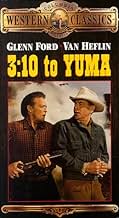
Broke small-time rancher Dan Evans is hired by the stagecoach line to put big-time captured outlaw leader Ben Wade on the 3:10 train to Yuma but Wade's gang tries to free him.Broke small-time rancher Dan Evans is hired by the stagecoach line to put big-time captured outlaw leader Ben Wade on the 3:10 train to Yuma but Wade's gang tries to free him.Broke small-time rancher Dan Evans is hired by the stagecoach line to put big-time captured outlaw leader Ben Wade on the 3:10 train to Yuma but Wade's gang tries to free him.
- Nominated for 1 BAFTA Award
- 1 win & 4 nominations total







Dorothy Adams
- Mrs. Potter
- (uncredited)
Jimmie Booth
- Wade Henchman
- (uncredited)
Danny Borzage
- Townsman
- (uncredited)

John Cason
- Wade Henchman
- (uncredited)

Woodrow Chambliss
- Blacksmith
- (uncredited)

Barry Curtis
- Mathew Evans
- (uncredited)

Richard Devon
- Wade Henchman
- (uncredited)
- Director
- Writers
- All cast & crew
- Production, box office & more at IMDbPro
7.623.4K
1
2
3
4
5
6
7
8
9
10
Featured reviews
Psychotic killer or gentleman thief?
I've liked this movie for a long time. Watching it last night, though, it finally occurred to me to wonder about the character played by Glenn Ford. I don't really understand what motivates him, or his gang.
Some people have commented that the closing scene is unbelievable, but I think that's only true because we never get a fix on Glenn Ford's character. Is he a psychotic killer, or is he a gentleman thief?
The psychotic killer label is supported by his actions in the opening scene of the stage coach robbery. He didn't even try to talk himself out of that situation, even though the driver was one against twelve and couldn't carry out his threat without being gunned down instantly. It's also supported by the fear that his name strikes into the hearts of all the townspeople. A man doesn't generate that kind of fear by simply robbing stage coaches. Obviously, he and his gang have done a lot of killing.
The gentleman thief label is supported by his complete lack of bullying characteristics. In every other situation of the movie except that opening scene, he uses his charm to try to get around people. He doesn't attempt to run roughshod over them. That completely contradicts the image of a guy who shoots first and asks questions later.
As for his gang, they show an extraordinary amount of loyalty to him and each other, which makes the shooting during the stage coach robbery that much more unconvincing. Why would they be loyal to a leader who didn't even try to save one of his own? Maybe that was just an anomaly. Ford tells us later in the movie that his gang will always go to extraordinary lengths to save one of their own, and they do just that to try to free him. Yet, at the end, he chooses to save the life of Van Heflin rather than go with his gang. Okay, so he decided that Van Heflin was a good guy worth saving, even if it did get his second in command killed. I don't mind that. What bothers me is, why is he so confident that, having turned his back on his gang, they are going to try to rescue him again in Yuma??? If I'm in that gang, he's made his choice and he can swing for it.
Some people have commented that the closing scene is unbelievable, but I think that's only true because we never get a fix on Glenn Ford's character. Is he a psychotic killer, or is he a gentleman thief?
The psychotic killer label is supported by his actions in the opening scene of the stage coach robbery. He didn't even try to talk himself out of that situation, even though the driver was one against twelve and couldn't carry out his threat without being gunned down instantly. It's also supported by the fear that his name strikes into the hearts of all the townspeople. A man doesn't generate that kind of fear by simply robbing stage coaches. Obviously, he and his gang have done a lot of killing.
The gentleman thief label is supported by his complete lack of bullying characteristics. In every other situation of the movie except that opening scene, he uses his charm to try to get around people. He doesn't attempt to run roughshod over them. That completely contradicts the image of a guy who shoots first and asks questions later.
As for his gang, they show an extraordinary amount of loyalty to him and each other, which makes the shooting during the stage coach robbery that much more unconvincing. Why would they be loyal to a leader who didn't even try to save one of his own? Maybe that was just an anomaly. Ford tells us later in the movie that his gang will always go to extraordinary lengths to save one of their own, and they do just that to try to free him. Yet, at the end, he chooses to save the life of Van Heflin rather than go with his gang. Okay, so he decided that Van Heflin was a good guy worth saving, even if it did get his second in command killed. I don't mind that. What bothers me is, why is he so confident that, having turned his back on his gang, they are going to try to rescue him again in Yuma??? If I'm in that gang, he's made his choice and he can swing for it.
Nearly a classic
I was accidentally given this movie instead of the 2007 re-make! And I am grateful. For modern students of cinematography the 1950s Western genre may initially seem somewhat arcane, but movies like this demonstrate how movies of that era reach for a higher plane, not just in terms of the craft, but philosophy as well. This effort is almost perfectly constructed, and worthy of a student's close analysis. It could have been 10 minutes longer, to develop the characters of Ford and Heflin, emphasise some of the sexual tension, and to develop the relationship between protagonist and antagonist. Perhaps some back story should have been implied, too, between the gang and its leader (civil war loyalty ?) And incidentally, I was amazed and pleased how briefly, intensely and satisfying was the connection between Ford and the barmaid.An amazing scene, of just a few minutes - which surely must have shocked adult audiences of 1957 (and passed over the head of children).
Room 207 and the 3:10 To Yuma.
Van Heflin plays rancher Dan Evans whose family and livelihood is at breaking point due to a devastating drought. Needing money fast, Evans gets thrown a financial lifeline when a reward is offered to escort a recently captured outlaw, Ben Wade (Glenn Ford), on to the 3:10 train to Yuma prison. But as Wade's gang closes in to free the shackled outlaw, and the clock starts to tick down, Evans finds himself torn between a sense of social duty and an easy option courtesy of Wade's mind game offer.
Based on a story by Elmore Leonard, this is a tight and tense Western that harks to the wonderful High Noon five years earlier. Directed by Delmer Daves, 3:10 to Yuma sees two of the Western genre's most undervalued performers come together in perfect contrast. Heflin's Evans is honest, almost saintly; but ultimately filling out his life with dullness and too much of a safe approach. Ford's Wade is the other side of the coin, ruthless (the opening sequence sets it up), handsome and very self-confident. This coupling makes for an interesting story-one that thankfully delivers royally on its set-up. As Wade's gang closes in, led by a sleek and mean Richard Jaeckel, Wade toys with Evans, offering him financial gain and gnawing away at him about his abilities as a husband, the tension is palpable in the extreme. Nothing is ever certain until the credits role, and that is something that is never to be sniffed at in the Western genre.
The comparison with High Noon is a fair one because 3:10 to Yuma also deals with the man alone scenario. A man left alone to deal with his adversaries and his own conscience; money or pride indeed. Daves' direction is gritty and suitably claustrophobic, with close ups either being erotically charged {watch out for Felicia Farr's scenes with Ford in the saloon} or tightly wound in room 207 of the hotel; where Heflin & Ford positively excel. His outdoor work, aided by Charles Lawton Jr's photography, also hits the spot, particularly the barren land desperate for water to invigorate it. While the piece also has a tremendous George Duning theme song warbled (and whistled by Ford in the film) by Frankie Laine. Great acting, great direction and a great involving story; essential for fans of character driven Westerns. 8.5/10
Footnote: The film was very well remade in 2007 with two of the modern era's finest leading men, Russell Crowe & Christian Bale, in the dual roles of Ben & Dan respectively. One hopes, and likes to think, that they remade it purely because it was such a great premise to work from. Because Daves' film didn't need improving, it was, and still is, a great film showcasing how great this often maligned genre can sometimes be.
Based on a story by Elmore Leonard, this is a tight and tense Western that harks to the wonderful High Noon five years earlier. Directed by Delmer Daves, 3:10 to Yuma sees two of the Western genre's most undervalued performers come together in perfect contrast. Heflin's Evans is honest, almost saintly; but ultimately filling out his life with dullness and too much of a safe approach. Ford's Wade is the other side of the coin, ruthless (the opening sequence sets it up), handsome and very self-confident. This coupling makes for an interesting story-one that thankfully delivers royally on its set-up. As Wade's gang closes in, led by a sleek and mean Richard Jaeckel, Wade toys with Evans, offering him financial gain and gnawing away at him about his abilities as a husband, the tension is palpable in the extreme. Nothing is ever certain until the credits role, and that is something that is never to be sniffed at in the Western genre.
The comparison with High Noon is a fair one because 3:10 to Yuma also deals with the man alone scenario. A man left alone to deal with his adversaries and his own conscience; money or pride indeed. Daves' direction is gritty and suitably claustrophobic, with close ups either being erotically charged {watch out for Felicia Farr's scenes with Ford in the saloon} or tightly wound in room 207 of the hotel; where Heflin & Ford positively excel. His outdoor work, aided by Charles Lawton Jr's photography, also hits the spot, particularly the barren land desperate for water to invigorate it. While the piece also has a tremendous George Duning theme song warbled (and whistled by Ford in the film) by Frankie Laine. Great acting, great direction and a great involving story; essential for fans of character driven Westerns. 8.5/10
Footnote: The film was very well remade in 2007 with two of the modern era's finest leading men, Russell Crowe & Christian Bale, in the dual roles of Ben & Dan respectively. One hopes, and likes to think, that they remade it purely because it was such a great premise to work from. Because Daves' film didn't need improving, it was, and still is, a great film showcasing how great this often maligned genre can sometimes be.
"I guess they figure a storm is blowin' up, huh, Dan?"
Wherever possible, I like to see the original version of a film before I see its remake. Set to attend a screening for James Mangold's '3:10 to Yuma (2007)' the following night, I quickly decided to rent Delmer Daves' 1957 original, which was adapted from a short story by Elmore Leonard. Unsurprisingly, given its source, the film's plot is extremely simple, unconcerned with the need for a large cast of characters and complicated story lines. After a fatal gold robbery, infamous outlaw Ben Wade (Glenn Ford) is captured in a small town, and a group of honest volunteers agree to transport him to Contention to board the 3:10 train to Yuma Prison. One of these volunteers is Dan Evans (Van Heflin), a poverty-stricken small-time rancher with a thirst to proves his worth to both his wife and two sons. Meanwhile, Wade's loyal gang ride in hot pursuit of their leader, intent on rescuing him and avenging his capture. As the tension mounts, and loading Wade onto the 3:10 train begins to seem impossible, the other volunteers rationally retreat from their task, with only Evans staying true to his word.
It's only recently that I've begun to concern myself with the Western genre, but '3:10 to Yuma' seems an ideal example. The story's brilliance lies in its own inherent simplicity; the interactions between the two main characters form the picture's emotional core, and it's the incredible depth of these interactions that allow the film to rise above its B-movie foundations. In one case, at least, the minimalism of the film's production allows for the perfect atmosphere in the story's climax, as Wade's bandits begin to surround the hotel room in which their leader is being held. Even before the gang rides into town, the streets have become almost completely vacant; Contention has become a ghost town. It seems likely that this was partly a result of the film's low production budget money spent on extras was probably considered money wasted but the escalating sense of foreboding created by the chillingly empty streets is perfect, as though, indeed, everybody in town figures that "a storm is blowin' up."
Both Glenn Ford and Van Heflin do a very good job considering the film's straightforward plot, and it is their believable characterisations that prove the picture's greatest asset. At first glance, Ben Wade appears obnoxious, sarcastic and detestable, but reveals more likable trait and even a streak of nobility as the film progresses. Likewise, Dan Evans is portrayed as a conservative man {whose logical unwillingness to take risks might easily be misattributed to cowardice}, one who only agrees to escort Wade in order to claim the much-needed $200 reward. However, as the situation continually progresses towards guaranteed disaster, and all the other volunteers back down regretfully, Evans refuses to surrender. In his captor's inflexible perseverance, and unflinching integrity, Wade discovers a man that he himself respects and admires, and the mutual understanding however tentative that the two men develop proves crucial in the picture's final moments.
It's only recently that I've begun to concern myself with the Western genre, but '3:10 to Yuma' seems an ideal example. The story's brilliance lies in its own inherent simplicity; the interactions between the two main characters form the picture's emotional core, and it's the incredible depth of these interactions that allow the film to rise above its B-movie foundations. In one case, at least, the minimalism of the film's production allows for the perfect atmosphere in the story's climax, as Wade's bandits begin to surround the hotel room in which their leader is being held. Even before the gang rides into town, the streets have become almost completely vacant; Contention has become a ghost town. It seems likely that this was partly a result of the film's low production budget money spent on extras was probably considered money wasted but the escalating sense of foreboding created by the chillingly empty streets is perfect, as though, indeed, everybody in town figures that "a storm is blowin' up."
Both Glenn Ford and Van Heflin do a very good job considering the film's straightforward plot, and it is their believable characterisations that prove the picture's greatest asset. At first glance, Ben Wade appears obnoxious, sarcastic and detestable, but reveals more likable trait and even a streak of nobility as the film progresses. Likewise, Dan Evans is portrayed as a conservative man {whose logical unwillingness to take risks might easily be misattributed to cowardice}, one who only agrees to escort Wade in order to claim the much-needed $200 reward. However, as the situation continually progresses towards guaranteed disaster, and all the other volunteers back down regretfully, Evans refuses to surrender. In his captor's inflexible perseverance, and unflinching integrity, Wade discovers a man that he himself respects and admires, and the mutual understanding however tentative that the two men develop proves crucial in the picture's final moments.
A tough act to follow
Christian Bale and Russell Crowe are going to have to perform feats of magic to beat this film. There is no doubt that they have picked one of the toughest westerns to beat in their remake.
There is shooting, but this is not a shoot-'em-up western. It is a thoughtful game of chess between a ruthless outlaw (Glenn Ford) and a farmer (Van Heflin). To see Ford, who we lost last year, try to buy Helflin (Johnny Eager, Shane), and see Heflin grow in courage was magnificent.
Every one else fades as these two play their game. The ending was terrific. I am anxious to see if they change it.
There is shooting, but this is not a shoot-'em-up western. It is a thoughtful game of chess between a ruthless outlaw (Glenn Ford) and a farmer (Van Heflin). To see Ford, who we lost last year, try to buy Helflin (Johnny Eager, Shane), and see Heflin grow in courage was magnificent.
Every one else fades as these two play their game. The ending was terrific. I am anxious to see if they change it.


Did you know
- TriviaAlthough most Westerns by this time were being produced in color, Delmer Daves and Charles Lawton Jr. opted to shoot this one in black and white. Lawton used red filters on his lenses, however, to give the landscape an even more starkly parched look, befitting the story's setting amid a lengthy drought.
- GoofsWhen all the characters are shown in the street just after the clock shows just after 11:00, all of their shadows are extremely long, because the scene was shot probably in very early morning after sunrise.
- ConnectionsFeatured in Siskel & Ebert Holiday Gift Guide (1991)
- Soundtracks3:10 to Yuma
by Ned Washington and George Duning
Sung by Frankie Laine
A Columbia Recording Artist
also performed by Norma Zimmer (uncredited)
- How long is 3:10 to Yuma?Powered by Alexa
Details
- Release date
- Country of origin
- Language
- Also known as
- El tren de las 3:10 a Yuma
- Filming locations
- Old Tucson - 201 S. Kinney Road, Tucson, Arizona, USA(Contention City backdrop)
- Production company
- See more company credits at IMDbPro
Box office
- Gross US & Canada
- $4,033,000
- Runtime
- 1h 32m(92 min)
- Color
- Aspect ratio
- 1.85 : 1
- 1.75 : 1
Contribute to this page
Suggest an edit or add missing content