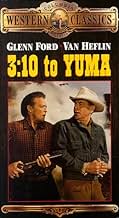
Broke small-time rancher Dan Evans is hired by the stagecoach line to put big-time captured outlaw leader Ben Wade on the 3:10 train to Yuma but Wade's gang tries to free him.Broke small-time rancher Dan Evans is hired by the stagecoach line to put big-time captured outlaw leader Ben Wade on the 3:10 train to Yuma but Wade's gang tries to free him.Broke small-time rancher Dan Evans is hired by the stagecoach line to put big-time captured outlaw leader Ben Wade on the 3:10 train to Yuma but Wade's gang tries to free him.
- Nominated for 1 BAFTA Award
- 1 win & 4 nominations total
Dorothy Adams
- Mrs. Potter
- (uncredited)
Jimmie Booth
- Wade Henchman
- (uncredited)
Danny Borzage
- Townsman
- (uncredited)
John Cason
- Wade Henchman
- (uncredited)
Woodrow Chambliss
- Blacksmith
- (uncredited)
Barry Curtis
- Mathew Evans
- (uncredited)
Richard Devon
- Wade Henchman
- (uncredited)
- Director
- Writers
- All cast & crew
- Production, box office & more at IMDbPro
7.623.4K
1
2
3
4
5
6
7
8
9
10
Featured reviews
Psychotic killer or gentleman thief?
I've liked this movie for a long time. Watching it last night, though, it finally occurred to me to wonder about the character played by Glenn Ford. I don't really understand what motivates him, or his gang.
Some people have commented that the closing scene is unbelievable, but I think that's only true because we never get a fix on Glenn Ford's character. Is he a psychotic killer, or is he a gentleman thief?
The psychotic killer label is supported by his actions in the opening scene of the stage coach robbery. He didn't even try to talk himself out of that situation, even though the driver was one against twelve and couldn't carry out his threat without being gunned down instantly. It's also supported by the fear that his name strikes into the hearts of all the townspeople. A man doesn't generate that kind of fear by simply robbing stage coaches. Obviously, he and his gang have done a lot of killing.
The gentleman thief label is supported by his complete lack of bullying characteristics. In every other situation of the movie except that opening scene, he uses his charm to try to get around people. He doesn't attempt to run roughshod over them. That completely contradicts the image of a guy who shoots first and asks questions later.
As for his gang, they show an extraordinary amount of loyalty to him and each other, which makes the shooting during the stage coach robbery that much more unconvincing. Why would they be loyal to a leader who didn't even try to save one of his own? Maybe that was just an anomaly. Ford tells us later in the movie that his gang will always go to extraordinary lengths to save one of their own, and they do just that to try to free him. Yet, at the end, he chooses to save the life of Van Heflin rather than go with his gang. Okay, so he decided that Van Heflin was a good guy worth saving, even if it did get his second in command killed. I don't mind that. What bothers me is, why is he so confident that, having turned his back on his gang, they are going to try to rescue him again in Yuma??? If I'm in that gang, he's made his choice and he can swing for it.
Some people have commented that the closing scene is unbelievable, but I think that's only true because we never get a fix on Glenn Ford's character. Is he a psychotic killer, or is he a gentleman thief?
The psychotic killer label is supported by his actions in the opening scene of the stage coach robbery. He didn't even try to talk himself out of that situation, even though the driver was one against twelve and couldn't carry out his threat without being gunned down instantly. It's also supported by the fear that his name strikes into the hearts of all the townspeople. A man doesn't generate that kind of fear by simply robbing stage coaches. Obviously, he and his gang have done a lot of killing.
The gentleman thief label is supported by his complete lack of bullying characteristics. In every other situation of the movie except that opening scene, he uses his charm to try to get around people. He doesn't attempt to run roughshod over them. That completely contradicts the image of a guy who shoots first and asks questions later.
As for his gang, they show an extraordinary amount of loyalty to him and each other, which makes the shooting during the stage coach robbery that much more unconvincing. Why would they be loyal to a leader who didn't even try to save one of his own? Maybe that was just an anomaly. Ford tells us later in the movie that his gang will always go to extraordinary lengths to save one of their own, and they do just that to try to free him. Yet, at the end, he chooses to save the life of Van Heflin rather than go with his gang. Okay, so he decided that Van Heflin was a good guy worth saving, even if it did get his second in command killed. I don't mind that. What bothers me is, why is he so confident that, having turned his back on his gang, they are going to try to rescue him again in Yuma??? If I'm in that gang, he's made his choice and he can swing for it.
Original Still The Greatest
Long before it was re-made, I treasured this modest gem of a western.
From the first notes of its mournful, affecting theme to to the poignant finale it draws you in and keeps you riveted as the tension mounts. It accomplishes this by keeping to the Aristotelian unities: a single theme about a single protagonist on a single day. Yes, there is an obvious parallel to **High Noon**.
Though cast as a villain for the only time in his career, Glen Ford's natural likability shines through in the role of gang boss Ben Wade. Van Heflin's Dan Evans is Everyman--no hero but spurred to heroism by desperate circumstances and devotion to family. In contrast to Heflin's homeliness is the godlike physical perfection of the young Richard Jaeckel as the outlaw gang's second-in-command, smart, dangerous, utterly amoral yet loyal unto death to his boss.
There is not a bad performance anywhere. But I must single out Felicia Farr as the lonely barmaid who gives Ford a last, quick good time, and craggy-faced Ford Rainey as a town Marshal with a plan.
With its mix of deep focus shots and closeups of the actors' faces, the cinematography was the obvious inspiration to Sergio Leone in his spaghetti western series.
From the first notes of its mournful, affecting theme to to the poignant finale it draws you in and keeps you riveted as the tension mounts. It accomplishes this by keeping to the Aristotelian unities: a single theme about a single protagonist on a single day. Yes, there is an obvious parallel to **High Noon**.
Though cast as a villain for the only time in his career, Glen Ford's natural likability shines through in the role of gang boss Ben Wade. Van Heflin's Dan Evans is Everyman--no hero but spurred to heroism by desperate circumstances and devotion to family. In contrast to Heflin's homeliness is the godlike physical perfection of the young Richard Jaeckel as the outlaw gang's second-in-command, smart, dangerous, utterly amoral yet loyal unto death to his boss.
There is not a bad performance anywhere. But I must single out Felicia Farr as the lonely barmaid who gives Ford a last, quick good time, and craggy-faced Ford Rainey as a town Marshal with a plan.
With its mix of deep focus shots and closeups of the actors' faces, the cinematography was the obvious inspiration to Sergio Leone in his spaghetti western series.
A Classic Western
When the charming outlaw Ben Wade (Glenn Ford) is captured after the heist of a stagecoach, the stage line owner Mr. Butterfield (Robert Emhardt) offers US$ 200,00 to the man that escorts the bandit to the city of Contention to take the 3:10 PM train to Yuma to be sent to trial. The rancher Dan Evans (Van Heflin) is broken and needs the money to save his cattle and support his family and accepts the assignment. During their journey, Dan saves the life of Ben when a vigilante tries to execute the criminal. Meanwhile Ben's gang split to find where Ben is and then rescues their boss. When they find that Ben is trapped in a hotel room, they put the place under siege and Dan can not find any man to help him.
"3:10 to Yuma" is a classic western from a wonderful time when honor was an important value in a film and even outlaws could have a code of honor. In the present days, it would be hard to believe why Dan Evans is incorruptible and does not accept Ben's bribe. Glenn Ford performs a charismatic outlaw and the moral duel with Van Heflin's character is fantastic. My vote is eight.
Title (Brazil): "Galante e Sanguinário" ("Gallant and Bloodthirsty")
"3:10 to Yuma" is a classic western from a wonderful time when honor was an important value in a film and even outlaws could have a code of honor. In the present days, it would be hard to believe why Dan Evans is incorruptible and does not accept Ben's bribe. Glenn Ford performs a charismatic outlaw and the moral duel with Van Heflin's character is fantastic. My vote is eight.
Title (Brazil): "Galante e Sanguinário" ("Gallant and Bloodthirsty")
photography by charles lawton is amazing
I normally don't comment on movies others have already commented on, but this one's been really bother me because no one really noted just how outstanding the cinematic compositions are. They're eye-poppingly gorgeous and remind me of a western Citizen Kane. In some scenes the Deep Focus technique (lots of hot light so that the background is in sharp focus) is outstanding. The artistry is almost out of place in this exciting but preposterously noirish western. There doesn't seem to be anything else in Lawton's repertoire (maybe parts of Two Rode Together?) as good, but director Daves' respect for good pictorials is evident in most of his efforts. It's a great collaboration, and a pretty good picture that's not as great as the sum of its parts. *** Most of the other comments rightly comment on Glenn Ford's cool acting. Isn't it time for him to get a Lifetime from AFI?
Tense little thriller that stands out for it's simplicity and it's strong characterisation
Farmer Evans looks to avoid conflict and work his farm in peace, when he witnesses a stage coach being held up he doesn't get involved. However due to drought and debt threatening his farm, he takes the job of escorting the leader of the gang to Yuma and prison when he is caught. The sheriffs fool the gang into thinking that Wade has been taken by coach and Evans and Wade stay in a hotel room until the train to Yuma. However with Wade's gang getting closer, the clock ticking and Evans' posse deserting him man by man the stakes rise.
It's a western but it could easily have been in any setting if it was done this well. The story is clever but really picks up once Wade is captured in both Evans' home and in the hotel room, the dialogue becomes clever and meaningful. The story is kept tense (with Evans getting increasingly sweaty) despite being very talky. Wade works Evans in a Machiavellian flow of dialogue that visually gets to him throughout. However once it is clear that honour is important over money the countdown to the tense walk to the train station is on.
Heflin is great as the farmer who takes a stand only to see pride swell up in his family, in a way he respects the criminal for taking risk and being brave in contrast to his middle road lifestyle. Ford is effortlessly brilliant as the criminal blessed with charisma and charm with a dangerous streak underneath in one key scene he sets out Heflin's character when he easily casts a spell charming Heflin's wife and sons. However beneath the dialogue he is slightly jealous of the farmer's settled life and this adds spice to the relationship between the two.
Overall this is a fantastic western, but if it was set in the modern day it would be a brilliant cop thriller, or in space, a brilliant sci-fi. The key is the central relationship between the two men here it is perfect and the tension that builds towards the fateful walk to the station is gripping.
It's a western but it could easily have been in any setting if it was done this well. The story is clever but really picks up once Wade is captured in both Evans' home and in the hotel room, the dialogue becomes clever and meaningful. The story is kept tense (with Evans getting increasingly sweaty) despite being very talky. Wade works Evans in a Machiavellian flow of dialogue that visually gets to him throughout. However once it is clear that honour is important over money the countdown to the tense walk to the train station is on.
Heflin is great as the farmer who takes a stand only to see pride swell up in his family, in a way he respects the criminal for taking risk and being brave in contrast to his middle road lifestyle. Ford is effortlessly brilliant as the criminal blessed with charisma and charm with a dangerous streak underneath in one key scene he sets out Heflin's character when he easily casts a spell charming Heflin's wife and sons. However beneath the dialogue he is slightly jealous of the farmer's settled life and this adds spice to the relationship between the two.
Overall this is a fantastic western, but if it was set in the modern day it would be a brilliant cop thriller, or in space, a brilliant sci-fi. The key is the central relationship between the two men here it is perfect and the tension that builds towards the fateful walk to the station is gripping.
Did you know
- TriviaAlthough most Westerns by this time were being produced in color, Delmer Daves and Charles Lawton Jr. opted to shoot this one in black and white. Lawton used red filters on his lenses, however, to give the landscape an even more starkly parched look, befitting the story's setting amid a lengthy drought.
- GoofsWhen all the characters are shown in the street just after the clock shows just after 11:00, all of their shadows are extremely long, because the scene was shot probably in very early morning after sunrise.
- ConnectionsFeatured in Siskel & Ebert Holiday Gift Guide (1991)
- Soundtracks3:10 to Yuma
by Ned Washington and George Duning
Sung by Frankie Laine
A Columbia Recording Artist
also performed by Norma Zimmer (uncredited)
- How long is 3:10 to Yuma?Powered by Alexa
Details
- Release date
- Country of origin
- Language
- Also known as
- El tren de las 3:10 a Yuma
- Filming locations
- Old Tucson - 201 S. Kinney Road, Tucson, Arizona, USA(Contention City backdrop)
- Production company
- See more company credits at IMDbPro
Box office
- Gross US & Canada
- $4,033,000
- Runtime
- 1h 32m(92 min)
- Color
- Aspect ratio
- 1.85 : 1
- 1.75 : 1
Contribute to this page
Suggest an edit or add missing content