
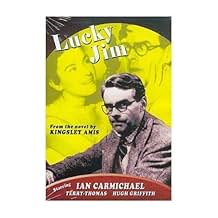
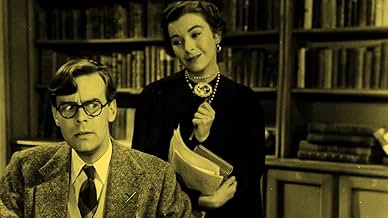
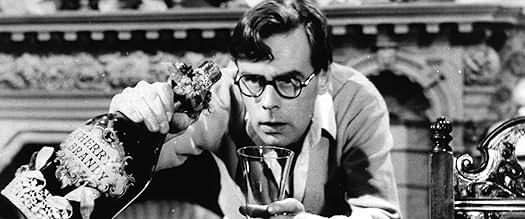
Jim Dixon struggles with university work, Professor Welch's boring behavior, and his neurotic friend Margaret Peel. His misery is further complicated by his son Bertrand and companion Christ... Read allJim Dixon struggles with university work, Professor Welch's boring behavior, and his neurotic friend Margaret Peel. His misery is further complicated by his son Bertrand and companion Christine Callaghan.Jim Dixon struggles with university work, Professor Welch's boring behavior, and his neurotic friend Margaret Peel. His misery is further complicated by his son Bertrand and companion Christine Callaghan.
- Director
- Writers
- Stars


John Welsh
- The Principal
- (as John Welch)


Henry B. Longhurst
- Professor Hutchinson
- (as Henry Longhurst)
- Director
- Writers
- All cast & crew
- Production, box office & more at IMDbPro
6.0805
1
2
3
4
5
6
7
8
9
10
Featured reviews
Flawed but fun.
Fans of Kingsley Amis's brilliant novel might with justification hate this adaptation, but taken on its own terms, it is an enjoyable slice of 'fifties British comedy. While the novel's bite may have been lost, the movie's troubled production history (a few weeks into the filming, the original director, Ealing's Charles Crichton, was replaced) fails to show on the finished film.
Ian Charmichael is at his best in this movie. The combination of a (realistic) Northern accent, plus a slightly harder edged characterisation, helps distance him from his usual 'silly ass' image. Perhaps he isn't the Dixon of the book, but it is a fair attempt. A first rate cast adds to the fun, in particular a small but perfectly formed cameo by Terry-Thomas steals the movie.
The final chase is, as been noted, the movie's weakest link (it seems to come out of nowhere and does not fit in with the rest of the film) and is it fair from being the best Amiss adaptation (that honour belongs to the wonderful 'Only Two Can Play'). But despite these flaws, it remains a watch able enough movie.
Ian Charmichael is at his best in this movie. The combination of a (realistic) Northern accent, plus a slightly harder edged characterisation, helps distance him from his usual 'silly ass' image. Perhaps he isn't the Dixon of the book, but it is a fair attempt. A first rate cast adds to the fun, in particular a small but perfectly formed cameo by Terry-Thomas steals the movie.
The final chase is, as been noted, the movie's weakest link (it seems to come out of nowhere and does not fit in with the rest of the film) and is it fair from being the best Amiss adaptation (that honour belongs to the wonderful 'Only Two Can Play'). But despite these flaws, it remains a watch able enough movie.
Hilarious satire, notably sharp-edged for its time
This is an outstanding movie whose meticulously-crafted set pieces frequently had me in stitches. Superbly cast, Ian Carmichael, Hugh Griffiths and Terry-Thomas were in exceptional form, and the luminous beauty of Sharon Acker lights up the film. If you don't find this funny, charming and uplifting, all I can say is that I feel sorry for you!
The pompous, stiff and class-deferential era of the 1950s is marvellously evoked in this movie. Always the sign of a classic, even the minor characters - Mrs Welch, the taxi driver, the waiter and the university porter, for instance - all hold their own and come across as real people. The appalling persona of Bertrand Welch (Terry-Thomas) with his self-obsessed sense of his own importance is excellently drawn. One to see and quite possibly one to keep.
The pompous, stiff and class-deferential era of the 1950s is marvellously evoked in this movie. Always the sign of a classic, even the minor characters - Mrs Welch, the taxi driver, the waiter and the university porter, for instance - all hold their own and come across as real people. The appalling persona of Bertrand Welch (Terry-Thomas) with his self-obsessed sense of his own importance is excellently drawn. One to see and quite possibly one to keep.
Academia and stuffiness comes under the Boulting's microscope.
Lucky Jim is directed by John Boulting and adapted from the Kingsley Amis novel of the same name. It stars Ian Carmichael, Terry-Thomas, Hugh Griffith, Sharon Acker and Jean Anderson.
A Redbrick university In Britain's New Elizabethan Age: Here Are Moulded The Intellectual Drakes And Raleighs Of Tomorrow-Fearless, Independent- -
And State Supported!
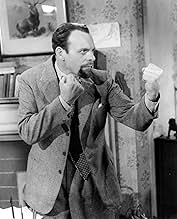
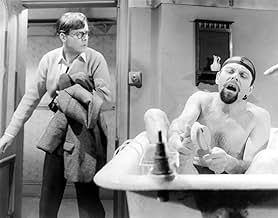
Enter Carmichael's accident prone Jim Dixon, who in order to keep his job at the University has to do the bidding for Griffith's dull Professor Welch. Worse still, maybe, is having to spend time with his boorish family, especially the Son, pompous show off Bertrand (Thomas). Salvation may come in the form of Bertrand's companion, though, Christine Callaghan (Acker)?
I haven't read the Amis novel this is based on, so can't have frame of reference there. By all accounts it's very different, and staunch Amis supporters are very dismissive of the Boulting movie. The film itself is hardly prime Boullting Brothers, who would produce British classics such as Brighton Rock and I'm All Right Jack, but it has a number of funny scenes whilst also being nicely flecked with satirical flavouring. Carmichael attacks the lead role with gusto and comic affability, while "scary eyebrows" Griffith and Terry-Thomas provide good comedy footings for Carmichael to work from. The ladies are pretty and effective enough, without really doing anything any other British actress of the time couldn't have done, but all told it's a well acted and genial time filler for the undemanding. 6.5/10
A Redbrick university In Britain's New Elizabethan Age: Here Are Moulded The Intellectual Drakes And Raleighs Of Tomorrow-Fearless, Independent- -
And State Supported!
Enter Carmichael's accident prone Jim Dixon, who in order to keep his job at the University has to do the bidding for Griffith's dull Professor Welch. Worse still, maybe, is having to spend time with his boorish family, especially the Son, pompous show off Bertrand (Thomas). Salvation may come in the form of Bertrand's companion, though, Christine Callaghan (Acker)?
I haven't read the Amis novel this is based on, so can't have frame of reference there. By all accounts it's very different, and staunch Amis supporters are very dismissive of the Boulting movie. The film itself is hardly prime Boullting Brothers, who would produce British classics such as Brighton Rock and I'm All Right Jack, but it has a number of funny scenes whilst also being nicely flecked with satirical flavouring. Carmichael attacks the lead role with gusto and comic affability, while "scary eyebrows" Griffith and Terry-Thomas provide good comedy footings for Carmichael to work from. The ladies are pretty and effective enough, without really doing anything any other British actress of the time couldn't have done, but all told it's a well acted and genial time filler for the undemanding. 6.5/10
Mildly Funny but Somewhat Broad Version of the Amis Classic
Planned as a follow-up to PRIVATE'S PROGRESS (1956), the Boulting Brothers' version of the Kingsley Amis classic substitutes physical comedy for much of the novel's satire. Ian Carmichael plays Jim Dixon as an amiable dolt, well-meaning but hopelessly lost in a faculty world of would-be Oxbridge dons. Professor Welch (Hugh Griffith) comes across as forgetful yet obsessive; his wife (Jean Anderson) as an incorrigible snob; and their son Bertram (Terry-Thomas) as a pretentious layabout. They inhabit a world of the past, dominated by images of 'Merrie England' - an idealized version of history that in Dixon's view never existed. By contrast Dixon tries to inspire his learners by encouraging them to speculate on alternative versions of the past. The film's enduring theme ("Oh, Lucky Jim!") by John Addison offers an ironic counterpoint to many of the protagonists' misadventures; he is clearly NOT lucky in many of the things he does - for example, bringing a bulldog into the Welches' front room to disrupt their evening concert, or creating total anarchy in the middle of a procession dedicated to the new Chancellor's (Clive Morton's) inauguration. Carmichael possesses a certain degree of comic talent as the innocent lost in a world of pseudo-sophisticates, but the Boultings' attempt to turn him into a Keatonesque figure, complete with a repertoire of India-rubber facial expressions, falls rather flat. The film ends happily with Dixon getting the girl (Sharon Acker), but only after a chase-sequence involving a series of unconvincing studio shots that seems out of place in terms of the film as a whole. It's nice to see him get the better of the Welch family, but we don't get the sense that he is in any proud of his grammar school education which (in terms of the novel at least) is particularly important at the time of the film's original release, when redbrick universities were offering greater opportunities to people from all social backgrounds to advance themselves. The Welch family might not like these social upstarts invading their intellectual space but, in terms of British history as a whole, they were the future while the Welches represented the past.
The dull thud of pulled punches
Kingsley Amis's first and best novel drew much satirical thrust from its evocation of the late 1940s, when British idealism about the socialist government elected in the first flush of World War Two victory was petering out. The ex-communist university lecturer Amis's ambiguity about putting The People in charge- later expressed in a vehement rejection of educational egalitarianism- is already implicit in this campus chronicle.
The Boulting Brothers, themselves on the left, worked "Lucky Jim" into the mildly satirical cycle of movies which made them the main successors to Ealing in the 1950s and early 1960s. But by updating it to the present and filling it with their rep company of character actors, they lost the plot.
Written by the newspaper humorist Patrick Campbell, this picturisation skates over the hypocrisy of Professor Welch and his clan as moneyed leftists-- an early depiction of limousine liberalism-- and concentrates on slapstick. Ian Carmichael, whose northern accent comes and goes, is too posh to play a grammar school lad who has blundered into the wrong profession. Terry-Thomas is too old and too T-T ("extra-ordinary fellah!") for Bertrand Welch, the spoilt son-- and why make him a novelist rather than a painter, when visual fun could have been had with his awful daubs to make up for the absence of Amis's authorial voice?
Most of the novel's heft comes from the gap between Jim Dixon's forced toadying and his secret derision, expressed in making faces and fantasising elaborate practical jokes. Little of this can get through in a script which majors on pratfalls and all-too-Britishly endorses Jim as the good guy by having the Welch's dog adopt him. And the provincial campus is too grand for the era of austerity and demobbed students Amis imagined, as though the Boultings secretly hankered to relocate the tale to Oxbridge.
All that said, there are incidental pleasures. Hugh Griffiths is spot-on as "Neddy" Welch, as is his namesake Kenneth as the creepy Evan Johns. Unexpectedly, given the initial compromises, the denouement (which was slapstick in the book too) gets closer to Amis's acrid eloquence, although drunks on screen become tiresome faster than directors realise. Interestingly in view of Amis's later problems with American publishers, the Boultings tone down the novel's misogyny. Margaret Peel is less neurotic, predatory and manipulative in the film. Jim's love object Christine, alas, is a tittering cipher on both page and screen. The British cinema wasn't doing sex in the Fifties unless it was "exposing" tarts in Soho.
The Boulting Brothers, themselves on the left, worked "Lucky Jim" into the mildly satirical cycle of movies which made them the main successors to Ealing in the 1950s and early 1960s. But by updating it to the present and filling it with their rep company of character actors, they lost the plot.
Written by the newspaper humorist Patrick Campbell, this picturisation skates over the hypocrisy of Professor Welch and his clan as moneyed leftists-- an early depiction of limousine liberalism-- and concentrates on slapstick. Ian Carmichael, whose northern accent comes and goes, is too posh to play a grammar school lad who has blundered into the wrong profession. Terry-Thomas is too old and too T-T ("extra-ordinary fellah!") for Bertrand Welch, the spoilt son-- and why make him a novelist rather than a painter, when visual fun could have been had with his awful daubs to make up for the absence of Amis's authorial voice?
Most of the novel's heft comes from the gap between Jim Dixon's forced toadying and his secret derision, expressed in making faces and fantasising elaborate practical jokes. Little of this can get through in a script which majors on pratfalls and all-too-Britishly endorses Jim as the good guy by having the Welch's dog adopt him. And the provincial campus is too grand for the era of austerity and demobbed students Amis imagined, as though the Boultings secretly hankered to relocate the tale to Oxbridge.
All that said, there are incidental pleasures. Hugh Griffiths is spot-on as "Neddy" Welch, as is his namesake Kenneth as the creepy Evan Johns. Unexpectedly, given the initial compromises, the denouement (which was slapstick in the book too) gets closer to Amis's acrid eloquence, although drunks on screen become tiresome faster than directors realise. Interestingly in view of Amis's later problems with American publishers, the Boultings tone down the novel's misogyny. Margaret Peel is less neurotic, predatory and manipulative in the film. Jim's love object Christine, alas, is a tittering cipher on both page and screen. The British cinema wasn't doing sex in the Fifties unless it was "exposing" tarts in Soho.


Did you know
- TriviaAt 46 Terry-Thomas was a year older than Hugh Griffith, who played his father. Jean Anderson, playing his mother, was only 4 years older than Thomas.
- GoofsThe taxi used by Jim and Christine when leaving the ball has 'Taxi' on a paper sign in the windscreen which is not there in long shot.
- Crazy creditsOpening credits prologue: A Redbrick University in Britain's new Elizabethan age: here are moulded the intellectual Drakes and Raleighs of tomorrow - fearless, independent - and state supported
- ConnectionsReferenced in The Bill: Lucky Jim (1999)
- How long is Lucky Jim?Powered by Alexa
Details
- Release date
- Country of origin
- Language
- Also known as
- Volltreffer ins Glück
- Filming locations
- The Royal Masonic School, Bushey, Hertfordshire, England, UK(red-brick university where Jim works)
- Production companies
- See more company credits at IMDbPro
- Runtime
- 1h 35m(95 min)
- Color
Contribute to this page
Suggest an edit or add missing content