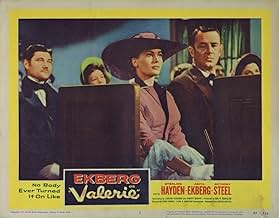
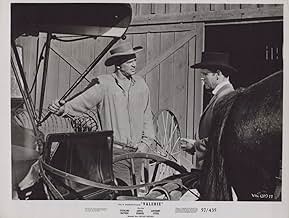
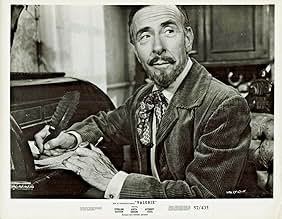
After the American Civil War, former Union Major John Garth marries pretty settler Valerie but tragedy strikes and the two spouses end up in court where they give conflicting accounts of the... Read allAfter the American Civil War, former Union Major John Garth marries pretty settler Valerie but tragedy strikes and the two spouses end up in court where they give conflicting accounts of their marriage.After the American Civil War, former Union Major John Garth marries pretty settler Valerie but tragedy strikes and the two spouses end up in court where they give conflicting accounts of their marriage.
Jered Barclay
- Jim Mingo
- (as Jerry Barclay)
Robert Adler
- Lundy
- (as Bob Adler)
Chet Brandenburg
- Trial Spectator
- (uncredited)
- Director
- Writers
- All cast & crew
- Production, box office & more at IMDbPro
5.9496
1
2
3
4
5
6
7
8
9
10
Featured reviews
The Rashomon Bit
Sterling Hayden is the biggest rancher around. He's also on trial for killing his in-laws and critically wounding his wife, Anita Ekberg. On the witness stand he tells a tale of betrayal by Miss Ekberg with handsome pastor Anthony Steel and unremitting carping by the older people. But when his wife gives testimony on her sickbed, a different version may emerge.
There's a bit of RASHOMON impulse her,e an attempt to use a subjective camera from several several viewpoints. It ultimately gives way to the objective standard; there can be only one truth. It is, however, the playing around with that uncertainty that lends this movie its initial interest. In the end, alas, it becomes a peculiarly squeamish piece of brutality, with scars from burns neatly blackened circles of smooth skin. It was the odd screen persona that Hayden cultivated in the 1950s: low-affect anger that Huston used so effectively in THE ASPHALT JUNGLE became his stock in trade, a character who couldn't feel like a human being. Unfortunately it hangs too apparently over this movie, removing all ambiguity.
He says, she says, he shoots
If not for Ernest Laszlo's competent photography, "Valerie" would be a complete fiasco, exploiting the points-of-view concept of "Rashomon" minus any humanistic insights. In the first scene, a Civil War veteran, 40-year-old rancher John Garth (Sterling Hayden), is arrested for shooting his 26-year-old wife Valerie (Anita Ekberg) and her parents. She survives; they don't.
The trial commences with testimony which is shown in flashbacks. We start with Garth's point of view, in which Valerie is a wine-swilling gold-digger who, once she finds out he is still paying off his father's debts, shuns him in favor of playing footsie with his brother Herb (Peter Walker) and seducing the local padre, Reverend Blake (Anthony Steel), whose child she is carrying when Garth shoots her.
Testifying from a bed in the infirmary, Valerie claims to be an innocent victim. Her parents, recent immigrants, persuaded her to marry Garth, who mistreated her, pouring liquor down her throat before taking her to bed, and striking her. In her distress, she sought only rapport with her brother-in-law and only counsel from the handsome Rev. Blake, who eventually rescued her and returned her to her parents' homestead, where Garth found and shot them.
Who's telling the truth? Who cares.
Lurid marketing focused on Ekberg's upper assets, including whorls of blond hair, and I was rather amazed none of the buttons popped off her taut blouses and bodices, which are typical of the total lack of subtlety in the entire melodrama. Ekberg plays her part and displays her parts well enough, but Sterling Hayden breaks his own personal record for stiff acting.
The whole debacle was cheaply filmed at the Iverson Ranch in California, the location of a raft of TV westerns from "The Lone Ranger" to solid fare like "Gunsmoke" and "Bonanza," any episode of which is better than "Valerie."
The trial commences with testimony which is shown in flashbacks. We start with Garth's point of view, in which Valerie is a wine-swilling gold-digger who, once she finds out he is still paying off his father's debts, shuns him in favor of playing footsie with his brother Herb (Peter Walker) and seducing the local padre, Reverend Blake (Anthony Steel), whose child she is carrying when Garth shoots her.
Testifying from a bed in the infirmary, Valerie claims to be an innocent victim. Her parents, recent immigrants, persuaded her to marry Garth, who mistreated her, pouring liquor down her throat before taking her to bed, and striking her. In her distress, she sought only rapport with her brother-in-law and only counsel from the handsome Rev. Blake, who eventually rescued her and returned her to her parents' homestead, where Garth found and shot them.
Who's telling the truth? Who cares.
Lurid marketing focused on Ekberg's upper assets, including whorls of blond hair, and I was rather amazed none of the buttons popped off her taut blouses and bodices, which are typical of the total lack of subtlety in the entire melodrama. Ekberg plays her part and displays her parts well enough, but Sterling Hayden breaks his own personal record for stiff acting.
The whole debacle was cheaply filmed at the Iverson Ranch in California, the location of a raft of TV westerns from "The Lone Ranger" to solid fare like "Gunsmoke" and "Bonanza," any episode of which is better than "Valerie."
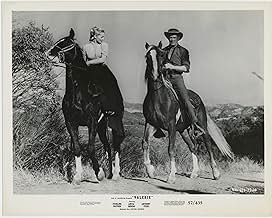
Angel or demon?
Like in "the iron sheriff" ,which also features Hayden as the lead,the movie begins when many important events happened .
In this whodunit disguised as western, the hero wanted to piece together the past ,meeting several suspects ,during his son' s trial .We watched the story through different eyes .
The same goes for "Valerie" which is nothing but a long flashback;whereas the scenes are told by the hero or his lawyer or by the showdown's victim,the story takes an entirely new meaning .The main inspiration is not the traditional western,but rather Japanese Kurosawa's "Rashomon"(1950) -which was remade by Martin Ritt as ""the outrage" (1964) The story sustains interest throughout ,except for the final scenes which are botched.Anita Ekberg possesses enough ambiguity to pass for an angel or a demon.Sterling Hayden is ,as usual,an imposing individual,even in the scenes of his trial when he is supposed to keep a low profile.
In this whodunit disguised as western, the hero wanted to piece together the past ,meeting several suspects ,during his son' s trial .We watched the story through different eyes .
The same goes for "Valerie" which is nothing but a long flashback;whereas the scenes are told by the hero or his lawyer or by the showdown's victim,the story takes an entirely new meaning .The main inspiration is not the traditional western,but rather Japanese Kurosawa's "Rashomon"(1950) -which was remade by Martin Ritt as ""the outrage" (1964) The story sustains interest throughout ,except for the final scenes which are botched.Anita Ekberg possesses enough ambiguity to pass for an angel or a demon.Sterling Hayden is ,as usual,an imposing individual,even in the scenes of his trial when he is supposed to keep a low profile.
challenging western
After the Civil War, Union Major John Garth (Sterling Hayden) marries immigrant Valerie Horvat (Anita Ekberg). Somehow it ends in murder. John is surprised that Valerie is still alive, barely. Most see that she got what she deserves. He goes to trial as different people testify.
I like the idea of the Rashomon structure although different witnesses describe different incidents. It can be a bit of a grind with the differing accounts. I do question a few things. I would think that her injuries would be very obvious and that the sheriff would figure it out before going to trial. He should have questioned the doctor who would know the situation. It was probably done to be absolutely clear to the audience of its time. As for the acting, Ekberg's shortcomings can be attributed to her injured character's limitations. I like this movie challenging a 50's audience although it may not be completely successful.
Quite Similar to another
I've seen another movie entitled "Valerie" but it was a bit different from movie I saw last with same actors, and actress! The story was similar in that the husband thought his wife was cheating on him with his brother and with their church pastor. I remember events being different how Sterling Hayden told Valerie that he paid her parents for her hand, not they paid him. Her parents didn't have a lot of money. True that she didn't love him cause she was courting both his brother outright, and the pastor on the sneak. I'm NOT understanding why if he had lots of valuable land then why would he accept money from her parents selling Valerie to him?!? He wasn't a poor man! I know this is weird but I know I watched two different versions of this movie at different times. The first time I watched movie I DIDN'T catch it from the beginning but saw enough to remember movie. The second one I saw last night was a bit different. The same storyline and characters but the details were a but different.😒🤔
Did you know
- TriviaAnita Ekberg and Anthony Steel were married about six months before production began, and this is the only film they made together during their marriage. They divorced in 1959.
- GoofsAt 53 minutes in when Valerie and John are out riding, John gets off his horse to open the gate; as he moves toward it, the shadows of the camera and cameraman are visible on the ground.
- Quotes
John Garth: Valerie is alive?
Details
- Runtime
- 1h 22m(82 min)
- Color
- Sound mix
Contribute to this page
Suggest an edit or add missing content