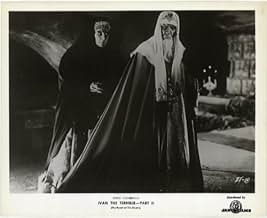
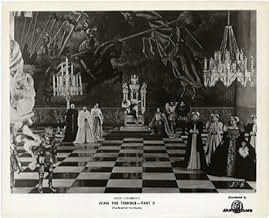
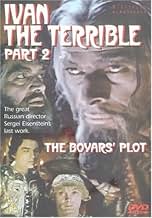
Ivan the Terrible, Part II: The Boyars' Plot
Original title: Ivan Groznyy. Skaz vtoroy: Boyarskiy zagovor
IMDb RATING
7.7/10
8.6K
YOUR RATING
As Ivan the Terrible attempts to consolidate his power by establishing a personal army, his political rivals, the Russian boyars, plot to assassinate their Tsar.As Ivan the Terrible attempts to consolidate his power by establishing a personal army, his political rivals, the Russian boyars, plot to assassinate their Tsar.As Ivan the Terrible attempts to consolidate his power by establishing a personal army, his political rivals, the Russian boyars, plot to assassinate their Tsar.
- Director
- Writer
- Stars
- Awards
- 1 nomination total
Vsevolod Pudovkin
- Nikolay the Fanatic
- (as V.I. Pudovkin)
Ada Voytsik
- Elena Glinskaya, Ivan's Mother
- (as Ada Vojtsik)
Aleksandr Rumnev
- The Stranger
- (uncredited)
- Director
- Writer
- All cast & crew
- Production, box office & more at IMDbPro
7.78.5K
1
2
3
4
5
6
7
8
9
10
Featured reviews
10zetes
Eisenstein's Ivan the Terrible films are two hugely underrated masterpieces
There is not a single criticism I could make for either Ivan the Terrible Film. They are perfect films, original, effective, and affecting. Perhaps the two best films ever made. If not, they're to be included on my list of totally invaluable films, with not a doubt in my mind.
II begins exactly where I ends. Ivan has consolidated his power in Moscow, at least with the people (though not with the nobles, or "boyars"). In fact, what power he has inspires jealousy and fear in the boyars.
Ivan I builds Ivan up as a noble character. We despise the boyars for their flagrant wealth and greed, and we like Ivan for supporting the people. His closest comrades seem like Homeric heroes.
Ivan II develops Ivan's character even further. He may have power, but he still feels alone on the throne. His two greatest friends have left him, one gone to religion and one to the enemy. His immediate underlings, perceived as heroes in Ivan I, have grown paranoid and powerful. They convince Ivan to execute left and right. The only route for the boyars is to conspire Ivan's death.
Ivan II leads up to one of the single greatest climax I can think of. To heighten the effect, for the first time, Eisenstein opted to shoot in color. And as masterful as he was with black and white, he is also with color. The juxtaposition of color with black and white is absolutely amazing.
The only problem with the film is no one's fault. Part II ends, open for the third installment. Alas, Sergei Eisenstein would die before its completion. We're lucky enough to have Ivan the Terrible Part II, for Stalin demanded that it not be released theatrically, believing Ivan to be a portrait of himself. Eisenstein, in fact, never had the chance to see it released theatrically, was never to hear the lavish praise from critics the world round. Here I praise it, hoping that in the next world possibly Eisenstein can know what masterworks he made.
II begins exactly where I ends. Ivan has consolidated his power in Moscow, at least with the people (though not with the nobles, or "boyars"). In fact, what power he has inspires jealousy and fear in the boyars.
Ivan I builds Ivan up as a noble character. We despise the boyars for their flagrant wealth and greed, and we like Ivan for supporting the people. His closest comrades seem like Homeric heroes.
Ivan II develops Ivan's character even further. He may have power, but he still feels alone on the throne. His two greatest friends have left him, one gone to religion and one to the enemy. His immediate underlings, perceived as heroes in Ivan I, have grown paranoid and powerful. They convince Ivan to execute left and right. The only route for the boyars is to conspire Ivan's death.
Ivan II leads up to one of the single greatest climax I can think of. To heighten the effect, for the first time, Eisenstein opted to shoot in color. And as masterful as he was with black and white, he is also with color. The juxtaposition of color with black and white is absolutely amazing.
The only problem with the film is no one's fault. Part II ends, open for the third installment. Alas, Sergei Eisenstein would die before its completion. We're lucky enough to have Ivan the Terrible Part II, for Stalin demanded that it not be released theatrically, believing Ivan to be a portrait of himself. Eisenstein, in fact, never had the chance to see it released theatrically, was never to hear the lavish praise from critics the world round. Here I praise it, hoping that in the next world possibly Eisenstein can know what masterworks he made.
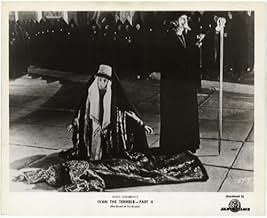
It should be in a museum.
It's great art.Eisenstein can be compared to Michelangelo,no less.Needless to say,you've got to see part one -slightly inferior to this one,but what does it mean,when you' re watching the seventh art at the height of its terrible powers?-.This part focuses on the feud between Ivan and his aunt who tries to replace him by an effeminate imposter of her choice.Prokofiev music gives the feeling of watching an opera,the scenes in the cathedral recreate a mystery as it was in the Middle Ages as faithfully as you can wish.The peak of the movie remains the banquet,shot in color,thanks to spoils of war film.So stunning is Eisenstein's mastery of the picture that you can hardly exactly tell when the color returns to black and white (which for the final becomes a color in itself)Ivan's last soliloquy might seem aggressive and chauvinistic.But you've got to remember that the USSR were at war at the time ."Ivan" is timeless ,a monument that's as awesome today as it was for its -deleted,because of Stalin- 1958 release.
10rnair
One of the true masterpieces of the cinema...
This space can't afford me the kind of gargantuan platform needed to speak on Eisenstein's masterwork (both parts) with the sort of attention to detail and passion that the director brings to the story of the Russian tsar. This is the rarest of films that stands as a testament to how cinema can extend beyond an entertainment and exist as a singular work of art and a document that works to expand our knowledge of the human condition. Every frame is rich, every scene speaks far more than any written line or action. The production is a phenomenal achievement in the absolute totality of the collaborative effort; the actors, the set, the cinematography, the soundtrack - every facet of the film-making process has worked to create a seamless connection. While the approach of the actors, the lighting and the choices of camera angles frustrate our standard ideas of what a movie should look and feel like, there is a design here; it is precise and it is brilliant. This is a film for those viewers who, as Eisenstein famously said, read (not just watched) the images on the screen. One of the two or three true masterworks in the history of movies.
This is the movie of my life
Ivan Grosnyy, Part II is the movie of my life; the Part I is also a very good film. It is the masterpiece of Sergei Eisenstein. Unfortunately we can never see the Part III of this meant to be trilogy. The performances (especially Nikolai Cherkasov), the photography, the wardrobe, the scenarios and the shots are the most beautiful I have ever seen in the history of film-making. However, it is necessary to watch the Part I first to understand the history. I suggest to all the people who like this genre of film to see another very good film of Sergey Eisenstein: Alexander Nevsky once again with Nikolai Cherkasov in the main role. I recommend to all the people who want to see these movies to by the Criterion DVD box set, which contains also first part and, Alexander Nevsky. Don't die without seeing these masterpieces.
Brilliant
Ivan the Terrible Part II, the culmination of Eisenstein's career, is easily one of the most brilliant films of all time.
Nothing - repeat absolutely nothing - in this film is sub-par. The acting, especially the inhuman physical contortions of Nikolai Cherkasov as the Tsar himself, is uniformly excellent. As is to be expected from Eisenstein, the direction is perfect. Eisenstein's compositions create painterly tableaux that can be watched endlessly on pause (especially now that Criterion has issued both Ivans on DVD), allowing the audience to take in the full breadth of this man's genius. Additionally, unlike, for example, Alexander Nevsky or Strike, Ivan the Terrible Part II (and part I) benefits from a smoother pace and better editing, putting Eisenstein's theory of montage to its best use since Potemkin.
For me, however, what two key components of this film set it apart from its prequel and Eisenstein's earlier Potemkin and October.
Those components, as you can imagine, are its more pronounce political allegory and its color sequence towards the end.
Certainly October and Potemkin were highly politicized affairs, both celebrating the Communist victory in Russia. In Ivan the Terrible Part II (and to a lesser extent Part I), the audience bears witness to a moment of challenge wherein Eisenstein becomes critical of the course his country and its post-Lenin leaders have taken. As such, Ivan the Terrible becomes one of the bravest moments in film history and, for that alone, should be commended.
Brilliant as a political critique, the film also represents a dazzling demonstration of how color could be used in cinema. The colorized dance at the end of the film rivals and prefigures the technicolor explosion in Douglas Sirk's 1950s melodramas; furthermore, it reveals that color can be used to achieve specific effects. It does not have to mimic reality; rather it can be used artistically to enhance the mood and atmosphere of the film.
Taken as a whole, the two-part Ivan the Terrible is a masterpiece of Russian Cinema and should be required viewing for anyone with the slightest bit of interest in film. My preference lies with the second part, but both are fantastic moments in film history.
Nothing - repeat absolutely nothing - in this film is sub-par. The acting, especially the inhuman physical contortions of Nikolai Cherkasov as the Tsar himself, is uniformly excellent. As is to be expected from Eisenstein, the direction is perfect. Eisenstein's compositions create painterly tableaux that can be watched endlessly on pause (especially now that Criterion has issued both Ivans on DVD), allowing the audience to take in the full breadth of this man's genius. Additionally, unlike, for example, Alexander Nevsky or Strike, Ivan the Terrible Part II (and part I) benefits from a smoother pace and better editing, putting Eisenstein's theory of montage to its best use since Potemkin.
For me, however, what two key components of this film set it apart from its prequel and Eisenstein's earlier Potemkin and October.
Those components, as you can imagine, are its more pronounce political allegory and its color sequence towards the end.
Certainly October and Potemkin were highly politicized affairs, both celebrating the Communist victory in Russia. In Ivan the Terrible Part II (and to a lesser extent Part I), the audience bears witness to a moment of challenge wherein Eisenstein becomes critical of the course his country and its post-Lenin leaders have taken. As such, Ivan the Terrible becomes one of the bravest moments in film history and, for that alone, should be commended.
Brilliant as a political critique, the film also represents a dazzling demonstration of how color could be used in cinema. The colorized dance at the end of the film rivals and prefigures the technicolor explosion in Douglas Sirk's 1950s melodramas; furthermore, it reveals that color can be used to achieve specific effects. It does not have to mimic reality; rather it can be used artistically to enhance the mood and atmosphere of the film.
Taken as a whole, the two-part Ivan the Terrible is a masterpiece of Russian Cinema and should be required viewing for anyone with the slightest bit of interest in film. My preference lies with the second part, but both are fantastic moments in film history.
Did you know
- TriviaThis film was withheld by Soviet authorities by order of Joseph Stalin, since this film, dealing with Ivan's slide into madness and the tyranny of the Oprichnina, did not properly mythologize Ivan IV Grozny to Stalin's satisfaction. It was not finally released until 10 years after the deaths of director Sergei Eisenstein and Stalin.
- GoofsIn the movie young Ivan IV is making a contract with the Livonian Brothers of the Sword. However it didn't exist since the 7th June 1238, almost 300 years before Ivan was born.
- Quotes
Czar Ivan IV: From now on I will become the one you call me. I will become terrible.
- Crazy creditsThe main cast and their roles is read by the narrator with accompanied footage.
- ConnectionsFeatured in The Secret Life of Sergei Eisenstein (1987)
Details
Box office
- Gross worldwide
- $1,655
- Runtime
- 1h 28m(88 min)
- Color
- Sound mix
- Aspect ratio
- 1.37 : 1
Contribute to this page
Suggest an edit or add missing content