
A vicar falsely accused of assaulting a youth attempts to prove his innocence and save his reputation.A vicar falsely accused of assaulting a youth attempts to prove his innocence and save his reputation.A vicar falsely accused of assaulting a youth attempts to prove his innocence and save his reputation.
- Director
- Writers
- Stars


Jess Conrad
- Dancer
- (uncredited)
Marie Devereux
- Sexy Girl in Coffee Bar
- (uncredited)
Carol Dourof
- Dancer
- (uncredited)
- Director
- Writers
- All cast & crew
- Production, box office & more at IMDbPro
6.4300
1
2
3
4
5
6
7
8
9
10
Featured reviews
Good Performances Help A Story That Has Grown Problematic
Vicar Anthony Quayle has a small parish, and a self-appointed charge to help out youngsters. He runs a youth center, and is always ready to speak to the authorities to keep a lad from going to a borstal. Sarah Churchill has her eye on him, and he turns her down as well as he can. When Leigh Madison comes to him in despair at being in a family way, she lets slip that the boy responsible is Andrew Ray. Then she kills herself, and Quayle calls in Ray, and tells him he should let her family know he was responsible. His reaction is to start smashing things, ripping his clothes, and when Miss Churchill comes in, claiming Quayle was "interfering" with him. Now the whole parish is up in arms, and charges are preferred against him.
It's an interesting story, but as an American with what went on in the Catholic Church in the 1990s, and even the Boy Scouts, it's hard to take this particular story seriously, despite Quayle's fine performance: particularly when his mother, Irene Browne, takes a hand in setting things aright. Still, it's a good story from a novel by Philip King, with some good acting jobs and an "introducing" credit for Cliff Richard.
It's an interesting story, but as an American with what went on in the Catholic Church in the 1990s, and even the Boy Scouts, it's hard to take this particular story seriously, despite Quayle's fine performance: particularly when his mother, Irene Browne, takes a hand in setting things aright. Still, it's a good story from a novel by Philip King, with some good acting jobs and an "introducing" credit for Cliff Richard.
Absurd fun if you are in the mood
This was the first film to deal with homosexuality in British cinema, and it is absurd as there is not one homosexual character in it. I say this, and without spoilers, that the Vicar might be, well, repressed but it is all such a muddle I ended up not caring. But disregarding this the acting is not bad and Anthony Quayle, Sarah Churchill and especially Irene Browne are excellent. Irene Browne, the Vicar's mother has the best lines in the film, and her voice alone commands attention. I will just say that the vicar falls into troubled waters and there is an attempt at showing homophobia and the human havoc it can cause. Andrew Ray attempts being convincing as a juvenile delinquent ( very attractive to 1950's audiences ) but of course to be disapproved of. Cliff Richard improbably plays another delinquent and ridiculously stops the film by singing ' Living Doll ' which was a hit at the time. All this sounds as if I do not like watching it, and that is not true. When I feel low I watch it just for the acting, and its enjoyable absurdity. And even Sarah Churchill transforms herself from being prudish, sexually repressed and drab into one of the best ( elegant ) seducers on film. I like watching her in anything. See it and smile and remember that this really is an imitation of life. I give it just 5 because the actors save the film from poor direction and an awful musical soundtrack.
Surprisingly Frank
An unmarried vicar in a new parish (Quayle) accuses a local 19 year old of being partially responsible for the death of a teenage girl. In defiance, the young man claims the vicar molested him. Out of spite, his story is backed up by a local woman (Churchill) still furious that the vicar rejected her advances. Unfortunately for the vicar, the woman is a highly respected member of the community - her father is the previous clergyman.
Given that this film was released in 1959, its subject matter is pretty ground-breaking, especially for a British film. Yes, the depiction of disaffected youth hanging around coffee bars, breaking into swimming pools and grooving to Cliff Richard's Livin' Doll is a little clumsy (Richard is asked to do little in a secondary role other than sulk or croon), but in an era when folks weren't supposed to know about homosexuality (at least in the movies), this is quite a daring story, and occasionally quite subversive. We the audience are ever so slightly encouraged to wonder about Quayle's sexuality as he spurns the advances of a good churchy woman, seems oblivious to his sexy young French maid (!) and looks up to his strident mother (a wonderfully knowing performance by Irene Browne). Judith Furse's probation officer is also deliciously ambiguous...
So quite a grown up film then - a shame that these days it's probably only known for being Cliff's debut film.
Given that this film was released in 1959, its subject matter is pretty ground-breaking, especially for a British film. Yes, the depiction of disaffected youth hanging around coffee bars, breaking into swimming pools and grooving to Cliff Richard's Livin' Doll is a little clumsy (Richard is asked to do little in a secondary role other than sulk or croon), but in an era when folks weren't supposed to know about homosexuality (at least in the movies), this is quite a daring story, and occasionally quite subversive. We the audience are ever so slightly encouraged to wonder about Quayle's sexuality as he spurns the advances of a good churchy woman, seems oblivious to his sexy young French maid (!) and looks up to his strident mother (a wonderfully knowing performance by Irene Browne). Judith Furse's probation officer is also deliciously ambiguous...
So quite a grown up film then - a shame that these days it's probably only known for being Cliff's debut film.
Reflects attitudes of the era.
Anthony Quayle plays a vicar who somehow manages to combine the role of vicar of a parish and professional footballer.He never seems to be doing any training.The fact that he is not married concerns his mother.She encourages a rather past it Sarah Churchill to make a pass at him.Meantime Quayle seems to have his hands full trying to run a youth club for which he really seems to have no aptitude or empathy whatsoever.He seems to make more enemies than friends.His troubles only begin when he rebuffs the advances made to him by Churchill.From thereon it is all downhill for him.Interesting film which preserves the attitudes of the time.Also little is directly said about the sexuality of Quayle' s character.
Charge Of The Right Brigade
For about the first hour this low-budget movie had definite aspirations of being added to the pantheon of significant films of the British New Wave, otherwise known as "kitchen-sink" dramas. Unfortunately it tails off tamely in the final half-hour as it retreats from the boldness of its narrative as just desserts are meted out and worse, love looks like it might conquer all.
Notable for being an early outing for later Bond director Terence Young as well as the feature debut for veteran British pop star, Cliff Richard, its plot is heavily derived from Arthur Miller's "The Crucible" as a respectable pillar of a small town community is accused of a scandalising, career-threatening crime by a grudge-bearing teenager, indeed, it's no surprise to learn that the film is itself an adaptation of a recent play. While there's no sub-text here of the Hollywood witch-hunt, the film does at least commendably approach the taboo subjects of pre-marital sex and homosexuality, remembering in particular that there was no Pill and that the latter was still a criminal offence in the U. K. until 1967.
The venerable Anthony Quayle plays a venerable parish priest looking in particular to have some positive interaction with the local youths. Of course being the 50's, some of these include the English version of the world phenomenon of teenage delinquency, who openly rebel against their elders, usually carrying concealed weapons like knuckle-dusters and chains and with a penchant for rock and roll music. Leader of this particular band is the tearaway Larry Thompson, played by Andrew Ray, who in addition to the above, has also abandoned a young girl he's got pregnant. He has a kid brother halfway to following him into minor crime, played by the debuting Cliff, who Quayle tries to rescue and a violent, brutish father who you wouldn't want turning up at your door with a grievance late at night. Lucky then that Quayle also trains the kids at boxing.
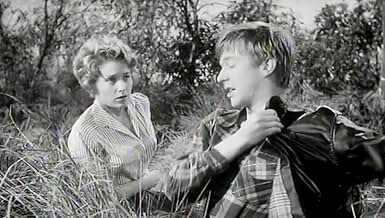
At the vicarage, passions are overheating, firstly in the form of the vicar's new, pretty young French maid who gets herself involved with Larry but secondly and more significantly with Sarah Churchill's man-hunting Hester, another vicar's respectable daughter, who makes a bee-line for Quayle. Hell hath no fury as we all know and when she's spurned by Quayle, she finds a way to revenge herself on him by supporting a false claim of molestation brought against the vicar by Larry, this after the poor pregnant girl has been accidentally knocked down and killed after she sees him making out with the maid in a bus-shelter and Quayle has summoned Larry to the vicarage to confront him about his treatment of the dead girl.
So far so good as the film confronts its contentious subject of alleged homosexuality with refreshing candour as the town turns against the heretofore admired vicar who now faces the ruination of his career. Unfortunately just as events edge towards a dramatic peak, the film draws back with a Damascene conversion, a ludicrously staged exposé scene and even worse, a final reconciliation with a romantic undertone which undoes much of the realism which has gone before.
Never mind, possibly the narrative was necessarily bowing to the censorship laws of the time, it's just a pity that having put its head above the parapet towards modernity, it felt it had to withdraw it again for a diluted happy ending.
Quayle is very good as the conscientious preacher, likewise Ray and Churchill in slightly more cliched roles. Cliff doesn't get to do much other than look pretty and sing a rocking version of his hit ballad "Living Doll". There's strong support from recognisably stalwart British character actors, the best of whom I thought was Irene Browne as Quayle's supportive and perceptive mother.
While the film is a little dated by its treatment of its hep-catting rock and roll juveniles, and ultimately cops out from fully confronting societal attitudes of the time, it at least openly raises the subjects of teenage pregnancy and homosexual behaviour and still feels like a further step along the road to challenging the norms of the day and is to be commended for that.
Notable for being an early outing for later Bond director Terence Young as well as the feature debut for veteran British pop star, Cliff Richard, its plot is heavily derived from Arthur Miller's "The Crucible" as a respectable pillar of a small town community is accused of a scandalising, career-threatening crime by a grudge-bearing teenager, indeed, it's no surprise to learn that the film is itself an adaptation of a recent play. While there's no sub-text here of the Hollywood witch-hunt, the film does at least commendably approach the taboo subjects of pre-marital sex and homosexuality, remembering in particular that there was no Pill and that the latter was still a criminal offence in the U. K. until 1967.
The venerable Anthony Quayle plays a venerable parish priest looking in particular to have some positive interaction with the local youths. Of course being the 50's, some of these include the English version of the world phenomenon of teenage delinquency, who openly rebel against their elders, usually carrying concealed weapons like knuckle-dusters and chains and with a penchant for rock and roll music. Leader of this particular band is the tearaway Larry Thompson, played by Andrew Ray, who in addition to the above, has also abandoned a young girl he's got pregnant. He has a kid brother halfway to following him into minor crime, played by the debuting Cliff, who Quayle tries to rescue and a violent, brutish father who you wouldn't want turning up at your door with a grievance late at night. Lucky then that Quayle also trains the kids at boxing.
At the vicarage, passions are overheating, firstly in the form of the vicar's new, pretty young French maid who gets herself involved with Larry but secondly and more significantly with Sarah Churchill's man-hunting Hester, another vicar's respectable daughter, who makes a bee-line for Quayle. Hell hath no fury as we all know and when she's spurned by Quayle, she finds a way to revenge herself on him by supporting a false claim of molestation brought against the vicar by Larry, this after the poor pregnant girl has been accidentally knocked down and killed after she sees him making out with the maid in a bus-shelter and Quayle has summoned Larry to the vicarage to confront him about his treatment of the dead girl.
So far so good as the film confronts its contentious subject of alleged homosexuality with refreshing candour as the town turns against the heretofore admired vicar who now faces the ruination of his career. Unfortunately just as events edge towards a dramatic peak, the film draws back with a Damascene conversion, a ludicrously staged exposé scene and even worse, a final reconciliation with a romantic undertone which undoes much of the realism which has gone before.
Never mind, possibly the narrative was necessarily bowing to the censorship laws of the time, it's just a pity that having put its head above the parapet towards modernity, it felt it had to withdraw it again for a diluted happy ending.
Quayle is very good as the conscientious preacher, likewise Ray and Churchill in slightly more cliched roles. Cliff doesn't get to do much other than look pretty and sing a rocking version of his hit ballad "Living Doll". There's strong support from recognisably stalwart British character actors, the best of whom I thought was Irene Browne as Quayle's supportive and perceptive mother.
While the film is a little dated by its treatment of its hep-catting rock and roll juveniles, and ultimately cops out from fully confronting societal attitudes of the time, it at least openly raises the subjects of teenage pregnancy and homosexual behaviour and still feels like a further step along the road to challenging the norms of the day and is to be commended for that.


Did you know
- TriviaThe song, "Living Doll" by Cliff Richard and The Shadows (as The Drifters) was released as a single (in a different arrangement) as a spin off from this film. It was a British #1, and was the top-selling song of 1959.
- Quotes
Mrs. Phillips: Now, do let's sit down, Hester. You're taking to another woman, not one of those helpless males who can't discuss anything important or private without staring out of a window or looking confused.
Hester Peters: I don't wish to be rude...
Mrs. Phillips: You can, my dear, because I'm going to be extremely rude to you.
- ConnectionsFeatured in A Bit of Scarlet (1997)
- SoundtracksLiving Doll
by Lionel Bart
Cliff Richard song
Accompanied by The Shadows (as The Drifters) (uncredited)
Details
- Runtime
- 1h 39m(99 min)
- Color
- Aspect ratio
- 1.37 : 1
Contribute to this page
Suggest an edit or add missing content