IMDb RATING
5.3/10
2.4K
YOUR RATING


In 1960, a military test pilot is caught in a time warp that propels him to year 2024 where he finds a plague has sterilized the world's population.In 1960, a military test pilot is caught in a time warp that propels him to year 2024 where he finds a plague has sterilized the world's population.In 1960, a military test pilot is caught in a time warp that propels him to year 2024 where he finds a plague has sterilized the world's population.



Arianne Ulmer
- Capt. Markova
- (as Arianne Arden)


John Van Dreelen
- Dr. Bourman
- (as John van Dreelen)
Boyd 'Red' Morgan
- Captain
- (as Red Morgan)
William Shephard
- Gen. York
- (as William Shapard)
James 'Ike' Altgens
- Secretary Lloyd Patterson
- (as James Altgens)
Russ Marker
- Col. Curtis
- (as Russell Marker)
Arthur C. Pierce
- Mutant Escaping from Jail
- (uncredited)
Malcolm Thompson
- Guard
- (uncredited)
- Director
- Writer
- All cast & crew
- Production, box office & more at IMDbPro
5.32.4K
1
2
3
4
5
6
7
8
9
10
Featured reviews
2024 ... so far in to the future
What a great little waste of time. The second time I have seen this little movie. Time travel brings so many conundrums and contradictions.
So far in to the future and still the ladies dress in heels and short skirts, not that I am complaining and both lead females are easy on the eye.
The acting is wooden, the sets are wooden, the special effects are anything but and the escaped mutants seem to have just one thing on their minds and the ladies in heels just can't run fast enough.
Having spent a lifetime in aviation I love to see the old aeroplanes.
So far in to the future and still the ladies dress in heels and short skirts, not that I am complaining and both lead females are easy on the eye.
The acting is wooden, the sets are wooden, the special effects are anything but and the escaped mutants seem to have just one thing on their minds and the ladies in heels just can't run fast enough.
Having spent a lifetime in aviation I love to see the old aeroplanes.
For Sci-Fi Buffs Only
Beyond the Time Barrier (1960)
** (out of 4)
Sci-fi has a military test pilot (Robert Clarke) goes into flight during 1960 and moments later he lands his spaceship in a strange land. After walking around for a bit he's finally taken captive by a group of people who don't make much sense to him but before long he realizes that his little trip actually sent him through a time barrier and he landed sixty-four years after taking off. The world has been destroyed due to a plague so he tries to get back in time to prevent it. This is an ultra low-budget movie that has a few ideas going for it but unfortunately there's not too much that can be done in regards to the science fiction because the budget didn't allow for it. The "future" city looks just like any abandoned city of 1960 and there special effects just aren't all that convincing. Fans of Edgar G. Ulmer will probably say that his keen eye manages to take the low budget and do more with it than most would. I'll buy that to a certain level but there's still no question that the majority of the film is dialogue scenes that really just talk about stuff instead of us ever actually getting to see it. I thought Clarke was good in his leading role as the pilot turned hero. Clarke is always fun to see in these low-budget movies and he does a nice job with the part. Darlene Tompkins plays the love interest, a princess in the future and she too is good. Vladimir Sokoloff plays "The Supreme" and isn't too bad. Universal horror fans will be happy to see Jack Pearce's name pop up in the credits for the special effects. There's talk of mutants in the film but sadly those hoping to see the make-up legends work on them will be disappointed because they're just normal people in bald caps. Pearce does get to do a little make-up at the end but I won't reveal with what as it will give away a major plot twist. This twist is actually pretty good and I think the final five-minutes are actually quite effective.
** (out of 4)
Sci-fi has a military test pilot (Robert Clarke) goes into flight during 1960 and moments later he lands his spaceship in a strange land. After walking around for a bit he's finally taken captive by a group of people who don't make much sense to him but before long he realizes that his little trip actually sent him through a time barrier and he landed sixty-four years after taking off. The world has been destroyed due to a plague so he tries to get back in time to prevent it. This is an ultra low-budget movie that has a few ideas going for it but unfortunately there's not too much that can be done in regards to the science fiction because the budget didn't allow for it. The "future" city looks just like any abandoned city of 1960 and there special effects just aren't all that convincing. Fans of Edgar G. Ulmer will probably say that his keen eye manages to take the low budget and do more with it than most would. I'll buy that to a certain level but there's still no question that the majority of the film is dialogue scenes that really just talk about stuff instead of us ever actually getting to see it. I thought Clarke was good in his leading role as the pilot turned hero. Clarke is always fun to see in these low-budget movies and he does a nice job with the part. Darlene Tompkins plays the love interest, a princess in the future and she too is good. Vladimir Sokoloff plays "The Supreme" and isn't too bad. Universal horror fans will be happy to see Jack Pearce's name pop up in the credits for the special effects. There's talk of mutants in the film but sadly those hoping to see the make-up legends work on them will be disappointed because they're just normal people in bald caps. Pearce does get to do a little make-up at the end but I won't reveal with what as it will give away a major plot twist. This twist is actually pretty good and I think the final five-minutes are actually quite effective.
Interesting SF Despite Low Budget
I have always been fascinated by the philosophical aspects of space and time, for example, such as the possibility of time dilation. That is why movies such as "The Time Machine", "World Without End" (especially, "World Without End" being one of my all-time favorite SF films), and this one, "Beyond the Time Barrier" have a great deal of appeal.
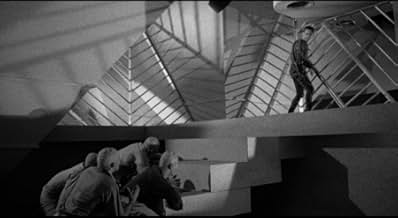
The highlights of the film and worth far more than the price of admission are the scenes in which Robert Clarke first breaks the time barrier up in space (in physics, this sounds like what is currently referred to as a "wormhole" in contrast to the older concept of time dilation) and the scenes after he touches back down to earth. The scene in which Robert Clarke observes the exterior of the futuristic city along with the pulsating solar energy tower is fascinating. (I first saw this when I was ten years old and never forgot it.) Also the scenes of Darlene Tomkins are also a delight for the eyes (especially the swimming pool scene - I never forgot this either). I also liked the triangular designs. They looked almost out of Die Blaue Reiter (The Blue Rider) Gruppe - the Munich Art School that specialized in abstract expressionism (producing such greats such as Klee, Marc, Kandinsky, others) or, perhaps out of the Bauhaus School of Architecture which produced such greats such as Ludwig Mies van der Rohe and others who pioneered modern futuristic design. For this, the art designer for the movie, Ernst Fegte should take a bow.
However, the overall plot is somewhat disappointing after Robert Clarke is captured. The idea that the human race can bring the earth to such a state in which it is perilous to walk the actual surface of the earth due to excessive radiation because the protective atmospheric screens had been decimated (the ozone layer in the stratosphere, for example) seems very dreary indeed (The scientist played by Istvan Bekassy mentions the ionosphere being contaminated by nuclear particles). Furthermore, what happened to the various animal and plant species ? Were they decimated, too ? Perhaps the writers could have planned a less dismal story. As the story progresses, the plot becomes even more pessimistic with the sterility of the population, the evil scientists, the barbarity of the mutants, the almost complete resignation to the eventual extinction of the human race as voiced by the Supreme, Vladimir Sokoloff, and the murder in the final reel of Trirene, his daughter, played by Darlene Tomkins. In general, the writers could have done a lot better, in terms of plot, theme, and characters.
Not the best, not the worst.
Worth watching for the art design and certain aspects of the story which make a person think.
6/10
Dan Basinger
The highlights of the film and worth far more than the price of admission are the scenes in which Robert Clarke first breaks the time barrier up in space (in physics, this sounds like what is currently referred to as a "wormhole" in contrast to the older concept of time dilation) and the scenes after he touches back down to earth. The scene in which Robert Clarke observes the exterior of the futuristic city along with the pulsating solar energy tower is fascinating. (I first saw this when I was ten years old and never forgot it.) Also the scenes of Darlene Tomkins are also a delight for the eyes (especially the swimming pool scene - I never forgot this either). I also liked the triangular designs. They looked almost out of Die Blaue Reiter (The Blue Rider) Gruppe - the Munich Art School that specialized in abstract expressionism (producing such greats such as Klee, Marc, Kandinsky, others) or, perhaps out of the Bauhaus School of Architecture which produced such greats such as Ludwig Mies van der Rohe and others who pioneered modern futuristic design. For this, the art designer for the movie, Ernst Fegte should take a bow.
However, the overall plot is somewhat disappointing after Robert Clarke is captured. The idea that the human race can bring the earth to such a state in which it is perilous to walk the actual surface of the earth due to excessive radiation because the protective atmospheric screens had been decimated (the ozone layer in the stratosphere, for example) seems very dreary indeed (The scientist played by Istvan Bekassy mentions the ionosphere being contaminated by nuclear particles). Furthermore, what happened to the various animal and plant species ? Were they decimated, too ? Perhaps the writers could have planned a less dismal story. As the story progresses, the plot becomes even more pessimistic with the sterility of the population, the evil scientists, the barbarity of the mutants, the almost complete resignation to the eventual extinction of the human race as voiced by the Supreme, Vladimir Sokoloff, and the murder in the final reel of Trirene, his daughter, played by Darlene Tomkins. In general, the writers could have done a lot better, in terms of plot, theme, and characters.
Not the best, not the worst.
Worth watching for the art design and certain aspects of the story which make a person think.
6/10
Dan Basinger
Low Budget but a Good Watch
The acting is suspect, the special effects very average and the general feel of the movie is very low budget, but its a surprisingly entertaining watch. The end is a bit muddled, but effective nonetheless. I think it was trying to copy the invasion of the body snatchers end and it did a good job.
A cautionary tale for the future.
This Monday morning I spoke into my Xfinity remote "Free this week" and one that came up is this movie from 1960 depicting a test pilot accidentally traveling to our current year, 2024. I am always curious how older movies (I was a teenager in 1960) depict the future and compare it to how 2024 actually is.
Unfortunately it is not exactly that type of movie, we only see what represents people living in an underground society. They use lots of triangle and pyramids with sliding triangular doors as their futuristic set design.
Robert Clarke is top test pilot Maj. William Allison and on this day in 1960 is taking a test plane with secondary rocket assist up to 500,000 feet. Something happens, when he lands back at the base everything is old, dilapidated, and deserted. He manages to walk to a place where he is observed and captured, treated as an enemy.
It takes until about the half-way point for him (and us) to figure out he has time-traveled to the future. And things are bad because of a plague during the 1970s caused by radiation from various atomic bomb tests destroying the Earth's atmospheric protective layer. About half the world's population has died and most survivors are deaf-mutes. The bigger problem might be the widespread sterility which makes keeping the world's population up.
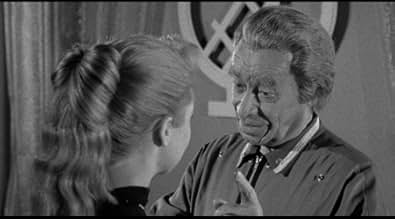
The main female character and one that becomes a love interest is Darlene Tompkins, about 19 during filming, as Princess Trirene. She is fertile but also a deaf-mute, however has developed ESP and can read the Major's thoughts.
So the story takes on two options, the Major can stay in 2024 and help propagate future generations or he can try to return to 1960 by doing a similar test flight in the opposite direction, warn people so that the future catastrophe can be avoided. Sadly, the climax in 2024 is a big fight with fists and guns and many key characters get killed.
Did I enjoy this short movie? Yes, I did, as it is a good representation of this type of movie made in the 1950s and 1960s. It DID take the time for 2024 scientist characters to give a good, thorough explanation for how time-travel happened, using the speed of the Earth's rotation, the Earth's orbit, and the whole solar system traveling through space, even though it is bad science it makes sense within the context of this story.
Streaming on Prime.
Unfortunately it is not exactly that type of movie, we only see what represents people living in an underground society. They use lots of triangle and pyramids with sliding triangular doors as their futuristic set design.
Robert Clarke is top test pilot Maj. William Allison and on this day in 1960 is taking a test plane with secondary rocket assist up to 500,000 feet. Something happens, when he lands back at the base everything is old, dilapidated, and deserted. He manages to walk to a place where he is observed and captured, treated as an enemy.
It takes until about the half-way point for him (and us) to figure out he has time-traveled to the future. And things are bad because of a plague during the 1970s caused by radiation from various atomic bomb tests destroying the Earth's atmospheric protective layer. About half the world's population has died and most survivors are deaf-mutes. The bigger problem might be the widespread sterility which makes keeping the world's population up.
The main female character and one that becomes a love interest is Darlene Tompkins, about 19 during filming, as Princess Trirene. She is fertile but also a deaf-mute, however has developed ESP and can read the Major's thoughts.
So the story takes on two options, the Major can stay in 2024 and help propagate future generations or he can try to return to 1960 by doing a similar test flight in the opposite direction, warn people so that the future catastrophe can be avoided. Sadly, the climax in 2024 is a big fight with fists and guns and many key characters get killed.
Did I enjoy this short movie? Yes, I did, as it is a good representation of this type of movie made in the 1950s and 1960s. It DID take the time for 2024 scientist characters to give a good, thorough explanation for how time-travel happened, using the speed of the Earth's rotation, the Earth's orbit, and the whole solar system traveling through space, even though it is bad science it makes sense within the context of this story.
Streaming on Prime.


Did you know
- TriviaThis film and another Robert Clarke/Edgar G. Ulmer production, The Amazing Transparent Man (1960), which was shot at the same time and in the same location, were originally to be distributed by a company called Pacific International. Shortly after the films were completed, Pacific International went bankrupt, and producer Clarke lost all the money he had put into it. The films were put up for auction by the film lab that processed them in order to recoup its costs. Both films were bought by American-International Pictures for a fraction of their cost, and upon release they made the company quite a bit of money. Except for his salary as an actor for two weeks' work, Clarke never saw a dime from the films.
- GoofsAs the X-80 is gaining altitude, there is a shot of the plane supposedly in a steep climb. But the clouds in the background are obviously at the same sharp angle, revealing that the footage of a level flight has just been "tilted" optically.
- Crazy creditsThe opening credits scroll away from the camera, a rare style which later became popular from Star Wars: Episode IV - A New Hope (1977).
- ConnectionsEdited from The Indian Tomb (1959)
- How long is Beyond the Time Barrier?Powered by Alexa
Details
- Release date
- Country of origin
- Language
- Also known as
- Traspasando la barrera del tiempo
- Filming locations
- Production companies
- See more company credits at IMDbPro
Box office
- Budget
- $125,000 (estimated)
- Runtime
- 1h 14m(74 min)
- Color
- Sound mix
- Aspect ratio
- 1.37 : 1
Contribute to this page
Suggest an edit or add missing content