

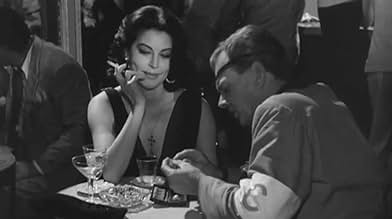
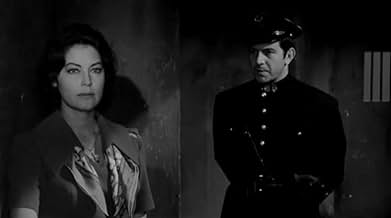
Father Arturo Carrera leaves the priesthood over the church's indifferent position during the Spanish Civil War, but finds himself attracted to beautiful entertainer Soledad.Father Arturo Carrera leaves the priesthood over the church's indifferent position during the Spanish Civil War, but finds himself attracted to beautiful entertainer Soledad.Father Arturo Carrera leaves the priesthood over the church's indifferent position during the Spanish Civil War, but finds himself attracted to beautiful entertainer Soledad.
- Director
- Writers
- Stars


Umberto Alivernini
- Nightclub Customer
- (uncredited)
Robert Bright
- Father Idelfonso
- (uncredited)
Franco Castellani
- José
- (uncredited)

Nino Castelnuovo
- Capt. Trinidad
- (uncredited)
Robert Cunningham
- Mac
- (uncredited)

Gustavo De Nardo
- Maj. Garcia
- (uncredited)
Franco Fantasia
- Cabaret Customer
- (uncredited)
Armando Fracassi
- Nationalist Prisoner
- (uncredited)
- Director
- Writers
- All cast & crew
- Production, box office & more at IMDbPro
5.8917
1
2
3
4
5
6
7
8
9
10
Featured reviews
Politically Daring
This film has an abiding place in my film canon, for one very good reason.
It isn't a great film, as both the other IMDb reviewers have gone out of their way to stress (although some of their criticisms were a little unfair. I thought, for example, that Joseph Cotten fared better than they say). However, it is virtually the only entertainment vehicle I have ever seen - including film, TV, radio, newspaper, magazine - that dares to show the truth about the left-wing Republicans/anti-Nationalists in the Spanish Civil War.
The Spanish Republicans have been lionised for decades for their allegedly heroic struggle against fascism (although it is actually a moot point to what extent Franco's Nationalists were fascist). However, this film is brave enough to show the truth - that the Spanish Republicans singled out religious targets and many harmless middle class targets and killed or persecuted them. It also dares to show the truth that the Republicans ran the areas they controlled along Stalinist lines. Which is not surprising, given the links with Communists and Stalinist Russia that some of them had.
The file deserves enormous credit for showing this, and it is a shame that no-one has pointed this out on IMDb - until now.
It isn't a great film, as both the other IMDb reviewers have gone out of their way to stress (although some of their criticisms were a little unfair. I thought, for example, that Joseph Cotten fared better than they say). However, it is virtually the only entertainment vehicle I have ever seen - including film, TV, radio, newspaper, magazine - that dares to show the truth about the left-wing Republicans/anti-Nationalists in the Spanish Civil War.
The Spanish Republicans have been lionised for decades for their allegedly heroic struggle against fascism (although it is actually a moot point to what extent Franco's Nationalists were fascist). However, this film is brave enough to show the truth - that the Spanish Republicans singled out religious targets and many harmless middle class targets and killed or persecuted them. It also dares to show the truth that the Republicans ran the areas they controlled along Stalinist lines. Which is not surprising, given the links with Communists and Stalinist Russia that some of them had.
The file deserves enormous credit for showing this, and it is a shame that no-one has pointed this out on IMDb - until now.
A Noble Failure
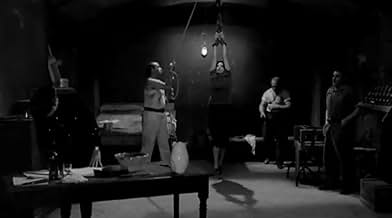
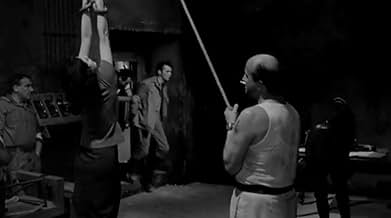
A fairly potent script with an interesting plot device at its core (both believers and non-believers alike chase after a sacred religious relic during a bloody civil war), undermined by rather bland, pedestrian film-making. Thus, it's not terribly surprising this was the last film directed by the prolific screenwriter Nunnally Johnson. He shoots just about everything in an overly dark and cramped way making it often impossible to determine where a scene is set, let alone what is going on or even who is in it. This may have been intentional, with the absence of light meant to convey the spiritual darkness in which the country of Spain was submerged at the time, but it comes off as crude and makes for rough viewing. There's something strange about the sound as well; there are few if any sufficiently lit close ups and it seems as if some of the actors' voices have been dubbed. Vittorio DeSica's character, for instance, comes across a bit like Truman Capote playing General Patton. Joseph Cotten pops up every now and again, as a cynical, gravel-voiced newsman, (in fact, he also narrates) but you never ever really see his face and there is something disembodied about his entire presence. It's all a bit unsettling.
Nonetheless, if you can endure its flaws, the movie raises some thought provoking questions on the nature of faith and religion in times of strife, and Dirk Bogarde is quite impassioned as the troubled priest. Ava Gardner, however, is noticeably past her prime as Bogarde's love interest, and her character isn't adequately fleshed out.
Nonetheless, if you can endure its flaws, the movie raises some thought provoking questions on the nature of faith and religion in times of strife, and Dirk Bogarde is quite impassioned as the troubled priest. Ava Gardner, however, is noticeably past her prime as Bogarde's love interest, and her character isn't adequately fleshed out.
Average stuff
I thought this film was rather lacking in both narrative and film-making technique. The script is far from awful, but also far from interesting in the most part. As the previous reviewer says, the lighting, choice of shots etc. was jarring and obscured characters (Joseph Cotten, who indeed established no presence at all in this film partly due to this). The historical period examined is a curious if comendable choice, and while the general details are correctly conveyed, no attempt is really made to discuss the issues in much depth. Good to see neither of the two sides particularly favoured, although such a commitment might have added at least some drama. Drama is scant in the film, with a few scenes written as exposition, delivered in a way just as stilted.
The film actually has a rather good and eclectic cast for 1960, although the talents are ill used. Finlay Currie, Vittorio De Sica (well, seemingly in the main part a director), Dirk Bogarde (not yet of the stature achieved in films like "The Servant" and "Accident"), Joseph Cotten and Ava Gardner are all of some talent. De Sica's character who does indeed speak in a rather un-Italian, mid-Atlantic accent, which either suggests dubbing or a remarkably odd decision somewhere along the line - the character is portrayed as a Spanish patriot. The character's endless minor disparaging comments about modern warfare are mildly amusing in their frequency. I wouldn't say Ava Gardner is at all "past her prime" in this film, at about 37. Her performance is actually quite good, although lacking some credibility, and there are some pretty reasonable quiet scenes between her and Bogarde. Her beauty seems to have matured well, although the murky, technically below-par direction doesn't help this to show. Bogarde seemed quite good at times, but far from indelible or memorable in this role.
I would say this film is reasonably watchable and far from abject, but it is largely far from gripping or interesting.
Rating:- **/*****
The film actually has a rather good and eclectic cast for 1960, although the talents are ill used. Finlay Currie, Vittorio De Sica (well, seemingly in the main part a director), Dirk Bogarde (not yet of the stature achieved in films like "The Servant" and "Accident"), Joseph Cotten and Ava Gardner are all of some talent. De Sica's character who does indeed speak in a rather un-Italian, mid-Atlantic accent, which either suggests dubbing or a remarkably odd decision somewhere along the line - the character is portrayed as a Spanish patriot. The character's endless minor disparaging comments about modern warfare are mildly amusing in their frequency. I wouldn't say Ava Gardner is at all "past her prime" in this film, at about 37. Her performance is actually quite good, although lacking some credibility, and there are some pretty reasonable quiet scenes between her and Bogarde. Her beauty seems to have matured well, although the murky, technically below-par direction doesn't help this to show. Bogarde seemed quite good at times, but far from indelible or memorable in this role.
I would say this film is reasonably watchable and far from abject, but it is largely far from gripping or interesting.
Rating:- **/*****
A flawed masterpiece
Though far from perfect, I could watch this movie again, and perhaps even more than that. It's a fascinating movie, for one thing, pairing two of the most beautiful people who ever lived, in a story with real depth, or at least the promise of real depth, which says a lot in a world where 99 movies out of 100 don't even try. Imagine, complaining that at 37, Ava Gardner was "past her prime." It is wonderful to see Bogarde, whose roles usually had him sneering worldly-wise ironies, showing heartfelt passion for the good and the true. It is equally wonderful to see Gardner in a role far more suited for her than the calculating charmer or the tormented playgirl. She never seemed to be really trying until this one, where perhaps the part touched something deep in her. Their chemistry was superlative, their love scene one of the greats of all time, in my view.
That this portrayal of a love that goes beyond time and place occurs in the context of one of the most astonishingly wicked and absurd wars of all time is another sublimity that seems to have whizzed right by all but one of the previous reviewers. Hemingway showed only that Robert Jordan thought the war was absurd, he didn't show its absurdity, which director Nunnally Johnson managed to do here in both direction and dialog, and against great odds. Like another of my favorites, Viva Zapata, this movie is a flawed masterpiece, better by far than 100 polished banalities. Blame its flaws on the trials of filming in 1960 (still stuck in the 50s), on sloppy editing, on the meaningless title, and the inevitable hurdles that writers and directors have to overcome in the complicated and difficult art of film-making, truly daunting in the case of this film. (Imagine attempting to film a love story between a priest and a prostitute in 50s Sicily?!) Don't blame the the actors, the director, or the beautiful and poignant story.
That this portrayal of a love that goes beyond time and place occurs in the context of one of the most astonishingly wicked and absurd wars of all time is another sublimity that seems to have whizzed right by all but one of the previous reviewers. Hemingway showed only that Robert Jordan thought the war was absurd, he didn't show its absurdity, which director Nunnally Johnson managed to do here in both direction and dialog, and against great odds. Like another of my favorites, Viva Zapata, this movie is a flawed masterpiece, better by far than 100 polished banalities. Blame its flaws on the trials of filming in 1960 (still stuck in the 50s), on sloppy editing, on the meaningless title, and the inevitable hurdles that writers and directors have to overcome in the complicated and difficult art of film-making, truly daunting in the case of this film. (Imagine attempting to film a love story between a priest and a prostitute in 50s Sicily?!) Don't blame the the actors, the director, or the beautiful and poignant story.
Historical drama struggled to hit its stride
There's an interesting story here on a number of levels but at roughly 1:40 minutes there's not enough time to tell them all well, which it tries to do. Really didn't understand the point of Joseph Cotten's journalist, even as an expository device. I'll leave criticisms or praise of the treatment of the civil war to others with more than the passing knowledge I have. Someone noted the cramped and dark cinematography, which worked for some scenes but not what might have been some of the more grand-scale scenes, which looked like they were cropped or framed so as not to admit incongruous sites or things into the shots. The lovers are a bit too aware of their fate it seems for them to have a realistic relationship. This one's OK for a watch but for characters bound up in a tragic relationship during revolution and civil war, it is no Dr. Zhivago.


Did you know
- TriviaThe film was originally planned to be shot on-location in Spain. However, due to the unflattering portrayal of Nationalists in the Spanish Civil War, the Franco regime declined permission.
- GoofsWhen the prisoners are being marched for several days to be presented to the fascists, the group contains a substantial number of women. At least two women are shown confessing to Arturo. But when the fascists capture the group, Arturo tells the commander that the group consists of 200 men who should not be killed, no mention of women. When Arturo enters the church to tell the prisoners they are to be executed, the group is all men. The women have vanished.
- ConnectionsFeatured in Best in Action: 1960 (2018)
- How long is The Angel Wore Red?Powered by Alexa
Details
Box office
- Budget
- $1,843,000 (estimated)
- Runtime
- 1h 39m(99 min)
- Color
- Aspect ratio
- 1.85 : 1
Contribute to this page
Suggest an edit or add missing content