IMDb RATING
7.0/10
4.9K
YOUR RATING


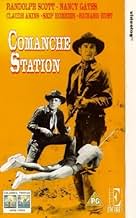
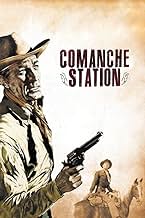
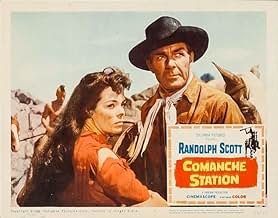
A man saves a woman who had been kidnapped by Comanches, then struggles to get both of them home alive.A man saves a woman who had been kidnapped by Comanches, then struggles to get both of them home alive.A man saves a woman who had been kidnapped by Comanches, then struggles to get both of them home alive.


- Director
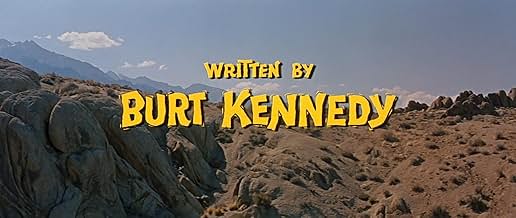
- Writer
- All cast & crew
- Production, box office & more at IMDbPro
7.04.8K
1
2
3
4
5
6
7
8
9
10
Featured reviews
Gallant Knight of the Plains
Comanche Station is the last of several films Randolph Scott made for Budd Boetticher with Columbia pictures. This would have been his last film, but for being lured to do just one more, the immortal Ride the High Country.
The film combines elements of The Naked Spur and Two Rode Together and blends them successfully. Scott is a man with one obsession, to get his wife back from the Comanches who kidnapped here ten years earlier. Whenever he hears of a white woman being put up for trade by the Indians he heads out with trade goods and buys her in the hopes of finding his beloved.
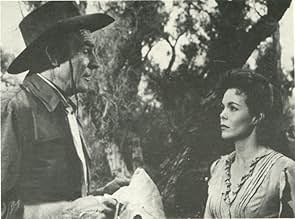
On this trip he ransoms Nancy Gates away from the Comanches. Later on he runs into an old enemy Claude Akins traveling with two young guns, Richard Rust and Skip Homeier. It seems as though Nancy's husband has put up a ten thousand dollar reward for her.
Akins is a truly malevolent figure, a scalphunter who kills Indians and sells their scalps for bounty. Unfortunately the two have need of each other in hostile Indian territory.
Randolph Scott's western heroes usually have an edge to them, they are not pure heroes as Joel McCrea's are. But in this film he's poaching on McCrea's territory in gallantry. His behavior towards Nancy Gates is at all times chivalrous. I wouldn't be surprised if there was a medieval origin to the plot of Comanche Territory.
Had Scott not come back to do Ride the High Country, Comanche Station would have been a good film to go out on.
The film combines elements of The Naked Spur and Two Rode Together and blends them successfully. Scott is a man with one obsession, to get his wife back from the Comanches who kidnapped here ten years earlier. Whenever he hears of a white woman being put up for trade by the Indians he heads out with trade goods and buys her in the hopes of finding his beloved.
On this trip he ransoms Nancy Gates away from the Comanches. Later on he runs into an old enemy Claude Akins traveling with two young guns, Richard Rust and Skip Homeier. It seems as though Nancy's husband has put up a ten thousand dollar reward for her.
Akins is a truly malevolent figure, a scalphunter who kills Indians and sells their scalps for bounty. Unfortunately the two have need of each other in hostile Indian territory.
Randolph Scott's western heroes usually have an edge to them, they are not pure heroes as Joel McCrea's are. But in this film he's poaching on McCrea's territory in gallantry. His behavior towards Nancy Gates is at all times chivalrous. I wouldn't be surprised if there was a medieval origin to the plot of Comanche Territory.
Had Scott not come back to do Ride the High Country, Comanche Station would have been a good film to go out on.
Short T
Saw this film again tonite via the DVD, mainly because it's Scott's penultimate film. Immediately thought of similarity to Scott's The Tall T, later to Ride Lonesome and Seven Men from Now. Difference is I'd give that Elmore Leonard story a few notches on this. Claude Akins is better than just Movin On but doesn't have the menace of Richard Boone or Lee Marvin. Scenery is favored over dialogue. Lots of cutting from scene to scene to indicate time has passed. Skip Hoemeier reprises his role as number 2 gun hand to the villain (Billy Jack to Boone ). Scott is great trading with the Comanche or getting the drop on the bad guys. Lots of good but familiar dialogue- "Seemed like a good idea". He is the archetype noble cowboy true to his values and keeping his dignity, yet always practical. I like this film very much and will watch it again; I'm sure.
The Western, Distilled to its Essence...
Howard Hawks was once asked about his recipe for making a great film. His reply: "Three good scenes, no bad scenes". I would humbly add two other rules: A great film is one where no additional scene is needed, and no existing scene could have been cut. Few competent directors violate the first rule. The mark of a great director is the ability to follow the second. Many inferior directors are too shallow or too vain to understand this - they constantly strive to include superfluous or redundant scenes - Just To Make Sure You Got The Point - when it is wiser to let the audience decide what is important. John Ford was the master at this. Hawks, Wilder, Eastwood, also come to mind. With Commanche Station, Budd Boetticher showed that he knew how to distill a great story (with many elements of a Greek tragedy) to its most basic human elements - Obsession, Greed, Loyalty, Irony, and above all, Honor.
Not only did Boetticher direct a great film, Burt Kennedy (later to become a fair director himself) constructed a great script.
Some good scenes: A conversation between a woman who was taken captive by Commanches (and held for a time) and the stranger who has just paid her ransom... Nancy Lowe: If-if you had a woman taken by the Comanche and-and you got her back... how would you feel knowing? Jefferson Cody: If I loved her, it wouldn't matter. Nancy Lowe: Wouldn't it? Jefferson Cody: No ma'am, it wouldn't matter at all.
Or two friends, hired guns both, contemplating the need to commit a horrible crime for money: Frank: You want to go to work, do you? Dobie: Work? Frank: Making an honest living? Dobie: Oh, no, I don't think I could do that. I could cowboy some. Frank: Well, what will that get you? You work yourself to death for somebody and likely they will have to take up a collection to bury you.
Or a conversation between an honorable man and a young man trying to decide whether he will try to become one: Dobie: A saddle and a shirt, that's all Frank had. It sure ain't much. Jefferson Cody: Sure ain't. Dobie: It wasn't his fault, though. Jefferson Cody: No? Dobie: No, he never knew anything but the wild side. Jefferson Cody: A man can cross over anytime he has the mind.
As for the performances, they are uniformly good. Nancy Gates, Skip Homier, Richard Rust, and Claude Akins hit the right tone - never going too far for a laugh or a tear.
And Randolph Scott was perfect - A word I do not use lightly. Roger Ebert once said that Marlon Brando and Paul Newman started out on the same path: Both came on the scene in the early 1950s, both studied the Method, both looked good in an undershirt. But Brando went on to see what else he could throw in to his performances while Newman went on to see what he could leave out (Newman once said that he was dissatisfied with many of his early performances because "you could see the acting"). In Commanche Station, Randolph Scott provided the inspiration for such an approach. This is what makes a performance (indeed, a film) memorable - by distilling your performance to only that which is necessary, you allow the viewer to remember what is important to them, not what they are told should be important to them.
If I were held to only half a dozen westerns to be labeled as essential, this would be one of them (The others: My Darling Clementine (1946), Shane (1953), The Searchers (1956), The Man Who Shot Liberty Valance (1962) and Unforgiven (1992)).
Not only did Boetticher direct a great film, Burt Kennedy (later to become a fair director himself) constructed a great script.
Some good scenes: A conversation between a woman who was taken captive by Commanches (and held for a time) and the stranger who has just paid her ransom... Nancy Lowe: If-if you had a woman taken by the Comanche and-and you got her back... how would you feel knowing? Jefferson Cody: If I loved her, it wouldn't matter. Nancy Lowe: Wouldn't it? Jefferson Cody: No ma'am, it wouldn't matter at all.
Or two friends, hired guns both, contemplating the need to commit a horrible crime for money: Frank: You want to go to work, do you? Dobie: Work? Frank: Making an honest living? Dobie: Oh, no, I don't think I could do that. I could cowboy some. Frank: Well, what will that get you? You work yourself to death for somebody and likely they will have to take up a collection to bury you.
Or a conversation between an honorable man and a young man trying to decide whether he will try to become one: Dobie: A saddle and a shirt, that's all Frank had. It sure ain't much. Jefferson Cody: Sure ain't. Dobie: It wasn't his fault, though. Jefferson Cody: No? Dobie: No, he never knew anything but the wild side. Jefferson Cody: A man can cross over anytime he has the mind.
As for the performances, they are uniformly good. Nancy Gates, Skip Homier, Richard Rust, and Claude Akins hit the right tone - never going too far for a laugh or a tear.
And Randolph Scott was perfect - A word I do not use lightly. Roger Ebert once said that Marlon Brando and Paul Newman started out on the same path: Both came on the scene in the early 1950s, both studied the Method, both looked good in an undershirt. But Brando went on to see what else he could throw in to his performances while Newman went on to see what he could leave out (Newman once said that he was dissatisfied with many of his early performances because "you could see the acting"). In Commanche Station, Randolph Scott provided the inspiration for such an approach. This is what makes a performance (indeed, a film) memorable - by distilling your performance to only that which is necessary, you allow the viewer to remember what is important to them, not what they are told should be important to them.
If I were held to only half a dozen westerns to be labeled as essential, this would be one of them (The others: My Darling Clementine (1946), Shane (1953), The Searchers (1956), The Man Who Shot Liberty Valance (1962) and Unforgiven (1992)).
Scott dukes it out with Claude Akins
The last of the seven Scott/Boetticher collaborations and although it's not one of my favorites {THE TALL T (1957) and RIDE LONESOME (1959) come out ahead}, it's still worth owning on DVD if Columbia/Tristar ever sees fit to release it.
Randolph Scott plays a rancher named Jefferson Cody who's wife was kidnapped by the Comanches a few years before. When he hears that the Comanches are holding a white woman, he goes to them for a trade and winds up with another man's wife named Mrs. Lowe (Nancy Gates).
As they head back, they stop at Comanche Station in order to water their horses and get fresh supplies. When they arrive there, they see three men being chased by a bunch of Comanches on the warpath. Cody recognizes one of them as Ben Lane (Claude Akins), a soldier he had drummed out of the army for an atrocity against the Indians, many years before. He also suspects Lane is trafficking in scalps and that's why the Indians are after them.
They manage to fight them off and when the coast is clear, Lane informs Mrs. Lowe that she has a $5,000 reward put up for her by her husband. Mrs. Lowe then suspects Cody of his intentions but it's apparent from the beginning that Cody isn't interested in any reward money. He just wants to find out what happened to his wife.
Also Lane has a habit of saying "Ha-lo.." every time he's being addressed. A nice script touch put in there by Burt Kennedy who wrote the script. It gives Lane something to distinguish him by.
It now becomes a battle of wills between Cody and Lane with Mrs. Lowe and Lane's two dimwitted sidemen (played by Skip Homeier and Richard Rust) looking on. When Frank (Homeier) is sent up the creek to see if the Comanches have cut off their trail, he comes floating back down, dead with an arrow in his back. And later when Dobie (Rust) has a change of heart and wants to throw in with Cody, he gets shot in the back by Lane for his efforts.
That shot warns Cody that Lane is nearby and the inevitable showdown takes place in the Lone Pine rocks. We all know who wins that one, right? Cody finally brings Mrs. Lowe back to her husband only to learn that he is blind and really doesn't care what's happened to her. He just wants her back.
Beautiful widescreen print that was remastered in the late 1990s, this one would be a welcome addition to any western library. It needs a DVD release.
7 out of 10
Randolph Scott plays a rancher named Jefferson Cody who's wife was kidnapped by the Comanches a few years before. When he hears that the Comanches are holding a white woman, he goes to them for a trade and winds up with another man's wife named Mrs. Lowe (Nancy Gates).
As they head back, they stop at Comanche Station in order to water their horses and get fresh supplies. When they arrive there, they see three men being chased by a bunch of Comanches on the warpath. Cody recognizes one of them as Ben Lane (Claude Akins), a soldier he had drummed out of the army for an atrocity against the Indians, many years before. He also suspects Lane is trafficking in scalps and that's why the Indians are after them.
They manage to fight them off and when the coast is clear, Lane informs Mrs. Lowe that she has a $5,000 reward put up for her by her husband. Mrs. Lowe then suspects Cody of his intentions but it's apparent from the beginning that Cody isn't interested in any reward money. He just wants to find out what happened to his wife.
Also Lane has a habit of saying "Ha-lo.." every time he's being addressed. A nice script touch put in there by Burt Kennedy who wrote the script. It gives Lane something to distinguish him by.
It now becomes a battle of wills between Cody and Lane with Mrs. Lowe and Lane's two dimwitted sidemen (played by Skip Homeier and Richard Rust) looking on. When Frank (Homeier) is sent up the creek to see if the Comanches have cut off their trail, he comes floating back down, dead with an arrow in his back. And later when Dobie (Rust) has a change of heart and wants to throw in with Cody, he gets shot in the back by Lane for his efforts.
That shot warns Cody that Lane is nearby and the inevitable showdown takes place in the Lone Pine rocks. We all know who wins that one, right? Cody finally brings Mrs. Lowe back to her husband only to learn that he is blind and really doesn't care what's happened to her. He just wants her back.
Beautiful widescreen print that was remastered in the late 1990s, this one would be a welcome addition to any western library. It needs a DVD release.
7 out of 10
Randolph Scott's never-ending search for wife taken by Comanches
After Comanches took his wife away years ago, Randolph Scott's character spends his time tracking down stories of white women abducted by Comanches in hopes of rescuing his wife from captivity. How many white women under Comanche captivity he has come across is unknown, but the one he barters for in Comanche Station (Nancy Gates) also turns out not to be his wife. Even though he strikes out again in his own search, the fact that he is going to return Gates to her family forms a compelling storyline. Scott and Gates travel to a stage coach stop known as Comanche Station where Claude Akins and two young associates, Richard Rust and Skip Homier, await the stage coach's arrival to rob it. Needless to say the coach doesn't get there, but Akins knows Gates's husband has promised to pay $5,000 for her return, a detail of which Scott apparently was unaware. Thus the five ride off on the journey to return Gates, Akins intent on killing Scott, whom he knew before, in order to collect the reward for Gates, who is very beautiful. There is excellent acting along the journey, thanks to a stand out script by Burt Kennedy and direction by Scott's famous partner in westerns Budd Boetticher.


Did you know
- TriviaLast of the "Ranown Westerns", produced by Randolph Scott and his partner Harry Joe Brown under the Ranown Pictures banner. Scott decided to retire after this one, but two years later he was talked out of retirement by Sam Peckinpah for Ride the High Country (1962). After that film, Scott retired for good.
- GoofsDuring the final shootout with Claude Akins, Randolph Scott and Nancy Gates run and hide in a small rock cave in the hills. As they look out of the cave, a crew member in a blue shirt stands in the path in front of them. When Randolph Scott leaves the cave, he runs right past this crew member.
- ConnectionsFeatured in The Guardian Interview with Budd Boetticher (1994)
- How long is Comanche Station?Powered by Alexa
Details
- Runtime
- 1h 13m(73 min)
- Aspect ratio
- 2.35 : 1
Contribute to this page
Suggest an edit or add missing content