
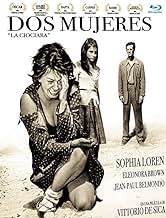
In WWII Italy, a widow and her lonely daughter seek distance between themselves and the horrors of war.In WWII Italy, a widow and her lonely daughter seek distance between themselves and the horrors of war.In WWII Italy, a widow and her lonely daughter seek distance between themselves and the horrors of war.
- Director
- Writers
- Stars
- Won 1 Oscar
- 11 wins & 3 nominations total




Jean-Paul Belmondo
- Michele Di Libero
- (as Jean Paul Belmondo)


- Director
- Writers
- All cast & crew
- Production, box office & more at IMDbPro
7.713.4K
1
2
3
4
5
6
7
8
9
10
Featured reviews
Gut-wrenching performance by leads
I acquired this movie quite a few years a go and only just had my first viewing and was frankly astonished at Sophia's performance. It is a multi-layered rich performance: her anger at men, her absolute devotion to her daughter, the sadness and acceptance at being a widow of a passionless marriage to a much older man, her confusion at awakening feelings of sensuality, her politicization. The last 30 minutes of this movie are heartbreaking, her horror, helplessness and numbness at what has happened to her daughter are some of the most powerful moments I have seen on film. A well deserved Oscar and Sophia, you are right up there with the gifted actors of the past century! 10 out of 10.
Powerful acting from Sophie Loren
It's WWII. Cesira (Sophia Loren) flees Rome away from the allied bombing for the sake of her 13 year old daughter Rosetta (Eleonora Brown). She's a widow of a loveless marriage and she's the object of everyman's desire. They go back to Cesira's home village. The idealistic anti-Fascist Michele Di Libero (Jean Paul Belmondo) falls for her. Mussolini is imprisoned and Michele is overjoyed. They even help a couple of English soldiers. The situation deteriorates as the war closes in and food becomes scarce. A group of Germans force Michele to lead them back to their lines. As the Americans approach, the villagers clear out. Cesira decides to go back to Rome on their own. They take shelter in a bombed out church where they are both raped by a large group of Arab soldiers.
Sophie Loren is magnetic. She powers every scene. Eleonora Brown does a good job keeping up. The story meanders a little. There are a lot of unrelated things that pop up. All of a sudden, there's a Russian deserter. The randomness sometimes help the story. When the story moves to the German occupied town, it really starts to move. The tension gets ratcheted up higher and higher.
Sophie Loren is magnetic. She powers every scene. Eleonora Brown does a good job keeping up. The story meanders a little. There are a lot of unrelated things that pop up. All of a sudden, there's a Russian deserter. The randomness sometimes help the story. When the story moves to the German occupied town, it really starts to move. The tension gets ratcheted up higher and higher.
Unforgettable performance
Sophia loren, undoubtedly and unarguably has delivered the greatest performance in the history of movie. Her performance as the widowed mother of a teen age girl in this movie that depicted the horrors of the second great war was absolutely heart-felt and perfect. Rarely can one actor or actress possibly rise to such occasion to deliver a performance of such magnitude. It demands pure talent. Full credit to the directing great Mr. De sica for his creation. Should be watched in its original version to get the best of it.
A Mark of Daring
Sophia Loren became the first player to win an Acting Oscar for a foreign language film in Two Women or La Ciociara in her native Italy. She plays the title role here, the other woman being her daughter played in La Ciociara by Eleanora Brown.
The story here is a relatively simple one, Sophia and Eleanora leave Rome due to the bombing of Rome just prior to the Allied invasion of Italy. The political situation is in one state of flux to put it mildly. In a matter of days, Benito Mussolini was overthrown and General Badoglio put in charge of the government. But the Nazis suspecting something was afoot sent in troops and met the Allies in a pitched 21 day battle at Salerno which like Waterloo was a close run thing.
At one point Jean-Paul Belmondo asks a couple of stray British paratroopers who landed way up behind enemy lines why the Allies didn't land in Rome. In fact they almost did land an army there, but Eisenhower canceled the landing at the last moment and probably saved a lot of lives doing so.
But this isn't about great battles, it's about Two Women just trying to survive the ravages of war in the best way they can. Sophia decides their best place is in her old village, south towards Naples. Before the film ends, she's given plenty of reason to rethink that decision.
Sophia was the Best Actress in 1961 for this film and for reasons I don't understand it was not given any other Oscar nominations, including for Best Foreign Language Film and for Best Director for Vittorio DeSica.
If La Ciociara has a fault it's that it's Sophia's show totally. The village characters and that of her one time lover Raf Vallone are left undeveloped. Only the daughter and young intellectual Belmondo who falls for the earthy Sophia seem to be on the verge of becoming three dimensional.
The subject matter could never have been done in an American studio with the Code still firmly in place. I remember back in the day La Ciociara was shown at the art house circuit and many young juveniles considered it a mark of daring to get in and see Sophia Loren expose more than her American films had done up to that time.
Sophia Loren deserved that Oscar, every bit of it. And you'll agree if you see La Ciociara.
The story here is a relatively simple one, Sophia and Eleanora leave Rome due to the bombing of Rome just prior to the Allied invasion of Italy. The political situation is in one state of flux to put it mildly. In a matter of days, Benito Mussolini was overthrown and General Badoglio put in charge of the government. But the Nazis suspecting something was afoot sent in troops and met the Allies in a pitched 21 day battle at Salerno which like Waterloo was a close run thing.
At one point Jean-Paul Belmondo asks a couple of stray British paratroopers who landed way up behind enemy lines why the Allies didn't land in Rome. In fact they almost did land an army there, but Eisenhower canceled the landing at the last moment and probably saved a lot of lives doing so.
But this isn't about great battles, it's about Two Women just trying to survive the ravages of war in the best way they can. Sophia decides their best place is in her old village, south towards Naples. Before the film ends, she's given plenty of reason to rethink that decision.
Sophia was the Best Actress in 1961 for this film and for reasons I don't understand it was not given any other Oscar nominations, including for Best Foreign Language Film and for Best Director for Vittorio DeSica.
If La Ciociara has a fault it's that it's Sophia's show totally. The village characters and that of her one time lover Raf Vallone are left undeveloped. Only the daughter and young intellectual Belmondo who falls for the earthy Sophia seem to be on the verge of becoming three dimensional.
The subject matter could never have been done in an American studio with the Code still firmly in place. I remember back in the day La Ciociara was shown at the art house circuit and many young juveniles considered it a mark of daring to get in and see Sophia Loren expose more than her American films had done up to that time.
Sophia Loren deserved that Oscar, every bit of it. And you'll agree if you see La Ciociara.
Great Italian Cinema
Sophia Loren, aside from being one of the most sumptuously sexy women I have ever seen, proves herself here to be a tremendous actress. She has a melodramatic Italian flair that impassions her lovably aggressive character, a widowed shopkeeper in Rome during the Allied bombing in WWII, who flees with her beloved daughter to her impoverish mountainous native region. Throughout the story, she proves to be a strong woman, seasoned by pain and not having lost the fire and fight in her.
Like many European films of its time, Two Women is all about the characters and the current on which they flow through the film, a realistic capsule of a time and place. Vittorio De Sica, who made the beautifully small-scale film The Bicycle Thief, which is about a relationship between father and son, forms a companion piece with Two Women, which is about a relationship between mother and daughter. He addresses strikingly the unbearable love between a parent and their child.
Truly one of the greatest Italian films, this is an absorbing, emotional, modest journey with wonderful music; coarse, down-to-earth cinematography from the wonderful old days of gritty film prints and old school hands-on editing; incredible acting not only from Loren but from the young actress playing her daughter, who drastically transforms; and also from Jean- Paul Belmondo, who convincingly plays completely against type; and a beautifully emotional final shot. For those who feel detached from older foreign films, especially neo-realist, I have yet to see an Italian neo-realist film any more alive than this one!
Like many European films of its time, Two Women is all about the characters and the current on which they flow through the film, a realistic capsule of a time and place. Vittorio De Sica, who made the beautifully small-scale film The Bicycle Thief, which is about a relationship between father and son, forms a companion piece with Two Women, which is about a relationship between mother and daughter. He addresses strikingly the unbearable love between a parent and their child.
Truly one of the greatest Italian films, this is an absorbing, emotional, modest journey with wonderful music; coarse, down-to-earth cinematography from the wonderful old days of gritty film prints and old school hands-on editing; incredible acting not only from Loren but from the young actress playing her daughter, who drastically transforms; and also from Jean- Paul Belmondo, who convincingly plays completely against type; and a beautifully emotional final shot. For those who feel detached from older foreign films, especially neo-realist, I have yet to see an Italian neo-realist film any more alive than this one!


Did you know
- TriviaSophia Loren claims that Director Vittorio De Sica, so caught up in the story, regularly cried on the set when filming particularly emotional scenes.
- GoofsNear the beginning, Cesira and Rosetta choose to walk rather than wait aboard their stranded train. However, they set off in the opposite direction to the train's destination.
- Quotes
[subtitled version]
Cesira: Do you know what they have done those "heroes" that you command? Do you know what your great soldiers have done in a holy church under the eyes of the Madonna? Do you know?
American Soldier: Peace, peace.
Cesira: Yes, peace, beautiful peace! You ruined my little daughter forever! Now she's worse than dead. No, I'm not mad, I'm not mad! Look at her! And tell me if I am mad! Rotten crazy bastards!
- ConnectionsEdited into Al Centro del cinema (2015)
Details
- Release date
- Countries of origin
- Languages
- Also known as
- ...und dennoch leben sie
- Filming locations
- Chiesa San Francesco d'Assisi, Fondi, Lazio, Italy(interiors: rape scene in the church)
- Production companies
- See more company credits at IMDbPro
Box office
- Gross worldwide
- $14,062
- Runtime
- 1h 41m(101 min)
- Color
- Sound mix
- Aspect ratio
- 1.66 : 1
Contribute to this page
Suggest an edit or add missing content