
During the 1960s in Britain, tense race relations between whites and blacks are affecting the workplace, the family, the dating scene, and the society at large.During the 1960s in Britain, tense race relations between whites and blacks are affecting the workplace, the family, the dating scene, and the society at large.During the 1960s in Britain, tense race relations between whites and blacks are affecting the workplace, the family, the dating scene, and the society at large.
- Nominated for 1 BAFTA Award
- 1 nomination total


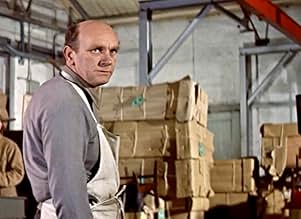


John Adams
- Man Attending Union Meeting
- (uncredited)
Bart Allison
- Man Attending Union Meeting
- (uncredited)
- Director
- Writer
- All cast & crew
- Production, box office & more at IMDbPro
6.7465
1
2
3
4
5
6
7
8
9
10
Featured reviews
Far Too Stagey
This film is more of a social document than an entertaining piece of film making.It was made just 3 years after the infamous Notting Hill Riots.This was at a time when immigrants were just starting to settle in the Uk and met some resistance from the local population.I would add that prejudice was still rife in the population at the time.Both myself at school and my father in public office suffered anti semitism.So this country was good for a good shake up.I doubt that this film did much to advance the cause.It is just so dull at times i am sure that it would not have done that well commercially at the time.It is odd to note that John mills here plays Sylvia Sims father when a couple of years earlier in "Ice Cold In Alex" he portrayed her potential lover.
Still relevant today
Roy Ward Baker, who had a good track record for directing colourful films (eg: The Vampire Lovers), gives us an extremely interesting retrospective of racial tensions in London in the early 1960's with Flame In The Streets. Race issues still exist and it would be naive to pretend otherwise judging by some recent events in 2020 although mixed marriages seem to have cleared hurdles that were more of an issue in 1960 which is the dominant theme in this film. Sylvia Syms, never looking more beautiful, falls in love with a black colleague and wants to marry him, much to the aggravation of her prejudiced mother. Mum, played with gusto by Brenda De Banzie (never better) is shocked to her core when she discovers her daughter is seeing the young black man. Dad, played by John Mills is far more liberal and as a union leader, he's argued for equality in the workplace for recent immigrants and in a particularly punchy scene, fights for Earl Cameron to be promoted. Mr Cameron only recently passed away at the grand age of 102 by the way. What surprised me, looking back 60 years, is that the film seems so relevant still today with black and white issues. It will be better when things can eventually unite peacefully and I have seen improvements in my lifetime but we still have a long way to go otherwise we wouldn't still recognise some of the issues in Flame In The Streets so readily. It's a film that although dated is an interesting snapshot that many could learn from if they recognised the obvious human failings depicted in it, particularly from De Banzie's prejudice, some of the ugly thuggery carried out by white youths and the bad attitudes of some of John Mills' work colleagues. Beware also of offensive racial language although it would be dishonest if all these films were hidden away as we can learn from historical films like this and be aware.
`Guess Who's Coming to Dinner?' among the British working class
Some people might steer clear of this movie because of its race relations theme. They'd be missing a good movie.
Despite a few warts, this is mostly a well-acted and well-directed drama. To be sure, some of the issues that the characters confront are dated. However, other issues are as relevant today as they were in 1961 when this film was made.
Above all else, I enjoyed the dominating performance of the always reliable John Mills. I enjoyed his stirring speeches as Jacko Palmer, a leader in his labor union. I also enjoyed his sensitive handling of family issues, trying to negotiate a difficult path between the starkly conflicting viewpoints of his wife Nell and his daughter Kathie.
Some of the dialogue in this movie is painful to hear. A couple of white factory workers tell Jacko `We don't like to take orders from spades.' Nell Palmer tells her daughter `They're not like us . If you marry him (her West Indian boyfriend), you'll have a roomful of black children . The thought of them (Kathie and her boyfriend) in bed makes me sick . You're worse than a whore.' Nell uses the `N word' twice.
Not surprisingly, Kathie shrugs off her mother's acid-tongued advice. However, it's harder for her to ignore her father's advice, which is geared toward making her understand the risks of her (marriage) decision. Her reasoning is so clouded by love that she tells him `Prejudice will end someday.' Well, not in her lifetime, as we in the 21st Century know.
The movie is sometimes heavy-handed and melodramatic. Even the title is somewhat `inflammatory' (There is only one flame in the movie ... a large bonfire, a British tradition for the celebration of Guy Fawkes Day). The movie ends without a tidy resolution, but this is fitting considering the predicament of the characters and their social environment.
I reviewed this movie as part of a project at the Library of Congress. I've named the project FIFTY: 50 Notable Films Forgotten Within 50 Years. As best I can determine, this film, like the other forty-nine I've identified, has not been on video, telecast, or distributed in the U.S. since its original release. In my opinion, it is worthy of being made available again.
Despite a few warts, this is mostly a well-acted and well-directed drama. To be sure, some of the issues that the characters confront are dated. However, other issues are as relevant today as they were in 1961 when this film was made.
Above all else, I enjoyed the dominating performance of the always reliable John Mills. I enjoyed his stirring speeches as Jacko Palmer, a leader in his labor union. I also enjoyed his sensitive handling of family issues, trying to negotiate a difficult path between the starkly conflicting viewpoints of his wife Nell and his daughter Kathie.
Some of the dialogue in this movie is painful to hear. A couple of white factory workers tell Jacko `We don't like to take orders from spades.' Nell Palmer tells her daughter `They're not like us . If you marry him (her West Indian boyfriend), you'll have a roomful of black children . The thought of them (Kathie and her boyfriend) in bed makes me sick . You're worse than a whore.' Nell uses the `N word' twice.
Not surprisingly, Kathie shrugs off her mother's acid-tongued advice. However, it's harder for her to ignore her father's advice, which is geared toward making her understand the risks of her (marriage) decision. Her reasoning is so clouded by love that she tells him `Prejudice will end someday.' Well, not in her lifetime, as we in the 21st Century know.
The movie is sometimes heavy-handed and melodramatic. Even the title is somewhat `inflammatory' (There is only one flame in the movie ... a large bonfire, a British tradition for the celebration of Guy Fawkes Day). The movie ends without a tidy resolution, but this is fitting considering the predicament of the characters and their social environment.
I reviewed this movie as part of a project at the Library of Congress. I've named the project FIFTY: 50 Notable Films Forgotten Within 50 Years. As best I can determine, this film, like the other forty-nine I've identified, has not been on video, telecast, or distributed in the U.S. since its original release. In my opinion, it is worthy of being made available again.
Sort of like a British version of "Guess Who's Coming to Dinner".
This film is a very enjoyable and courageous film about racism in London in the early 1960s. Apparently, there was a lot of negative feeling towards West Indians living there--and it's all quite similar to the feelings in much of the US at the same time.
The first portion of the film involves workers and their union. A major problem is that a lot of white workers are resentful of blacks--especially when they are placed in positions of authority. One of the union reps, Jacko Palmer (John Mills), believes in promoting people according to their merits--and goes to bat for these people.
Ironically, at the same time this is happening, Jocko's daughter is dating a Jamaican man. She is uneasy about how people will treat her but she loves the man and wants to marry him. When she tells her 'liberal-minded family', they show themselves to by hypocritical butt-heads--and the mother is truly vile in the way she talks about blacks and shows herself to be a shameful mother. How is all this to work out by the end of the film?
I liked the film and appreciate that it didn't pull its punches. I love "Guess Who's Coming to Dinner?" but at times it did seem a bit too sanitary and 'nice'. In contrast, this British film used extremely disturbing and graphic language--and better showed the ugliness of racism. Well worth seeing.
The first portion of the film involves workers and their union. A major problem is that a lot of white workers are resentful of blacks--especially when they are placed in positions of authority. One of the union reps, Jacko Palmer (John Mills), believes in promoting people according to their merits--and goes to bat for these people.
Ironically, at the same time this is happening, Jocko's daughter is dating a Jamaican man. She is uneasy about how people will treat her but she loves the man and wants to marry him. When she tells her 'liberal-minded family', they show themselves to by hypocritical butt-heads--and the mother is truly vile in the way she talks about blacks and shows herself to be a shameful mother. How is all this to work out by the end of the film?
I liked the film and appreciate that it didn't pull its punches. I love "Guess Who's Coming to Dinner?" but at times it did seem a bit too sanitary and 'nice'. In contrast, this British film used extremely disturbing and graphic language--and better showed the ugliness of racism. Well worth seeing.
Flames in the Streets
It wasn't just in the USA that racial tension was rife in the 1960s, it was also pretty toxic for many living in urban Britain too. That's exemplified here by the young "Peter" (Johnny Sekka) who works at a factory where there's a sort of truce between the colours that's striven for by union man "Jacko" (John Mills) who just happens to be the father of "Kathie" (Sylvia Syms) who just happens to be the girlfriend of "Peter". Small world, but not an happy one. Her mother "Nell" (Brenda de Banzie) is more openly hostile to this pairing but dad isn't a great fan either. It's so much because they are racist in themselves, but more that they have a concern for their daughter in a big city where mixed-race relationships were distinctly frowned upon and "half-caste" babies even more so. These aren't just paper-based threats, we can see from the stirring that goes on at their workplace that the young locals are just as keen on causing trouble; making their lives awkward and even dangerous. It's all building to a Guy Fawkes night bonfire that's likely to burn more than old wood from bomb-damaged buildings. There's some good and poignant writing underpinning this drama and the solid efforts of Mills, Syms, Sekka and Earl Cameron help condense quite a lot that's visceral into this tautly directed feature. It's de Banzie, though, who stands out for me. The conflicted mother whose not just concerned about her daughter, but also about the state of a marriage that she feels has systematically neglected her at the expense of her husband's union career and her family. That all comes to a boil too, leaving us with quite a lively and thought-provoking series of conclusions. It's violent at times, but ultimately Roy Ward Baker has let the words and the imagery do most of the heavy lifting here, and I thought it a potent piece of British cinema.


Did you know
- TriviaWilfrid Brambell (Mr. Palmer Senior) was four years younger than Sir John Mills (Jacko Palmer).
- Quotes
Gabriel Gomez: He say a car for him is a number-one necessity.
Judy Gomez: He's just a number-one pimp.
Details
- Release date
- Country of origin
- Language
- Also known as
- Schwarze Fackel
- Filming locations
- Hawley Road, Camden Town, London, England, UK(scene of Guy Fawkes bonfire)
- Production companies
- See more company credits at IMDbPro
- Runtime
- 1h 33m(93 min)
- Sound mix
- Aspect ratio
- 2.35 : 1
Contribute to this page
Suggest an edit or add missing content