

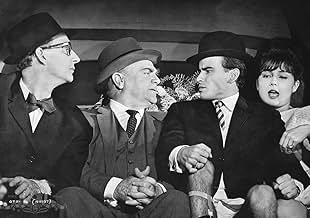
In West Berlin during the Cold War, a Coca-Cola executive is given the task of taking care of his boss' socialite daughter.In West Berlin during the Cold War, a Coca-Cola executive is given the task of taking care of his boss' socialite daughter.In West Berlin during the Cold War, a Coca-Cola executive is given the task of taking care of his boss' socialite daughter.
- Director
- Writers
- Stars
- Nominated for 1 Oscar
- 1 win & 8 nominations total


- Fräulein Ingeborg
- (as Lilo Pulver)


- Melanie Hazeltine
- (as Lois Bolton)


- Krause
- (voice)
- …
- Cindy MacNamara
- (uncredited)
- Director
- Writers
- All cast & crew
- Production, box office & more at IMDbPro
Featured reviews
Outstanding Comedy
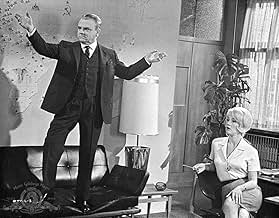
It's one of those movies in which the gags would be spoiled if they were described to a person who hadn't yet seen the film. For the most part they are tied closely to the plot and often build on one another. But I'm compelled to give one example. Cagney is an executive in Berlin and his first-hand man is Schlemmer. Schlemmer has a habit of clicking his heels before and after addressing Cagney. At one point Cagney chews him out and asks him, "just between us," what Schlemmer did in the war. "I was in the underground," says Schlemmer. "Oh, the resistance?" "No, the underground. The subway. I was a conductor." Cagney says supiciously, "And I suppose you never were a supporter of Adolf." Schlemmer: "Adolf who? You see, I was always in the underground. They never told us anything down there."
The dialogue is shouted rather than spoken. Heels are clicked, people leap to attention, fingers are snapped, orders are flung about. The only person who doesn't run around frantically is Lilo Pulver who does not have to run to attract anyone's attention. She can simply stand still and get the job done. She's Cagney's secretary and tells him she's thinking of getting a job elsewhere as a translator. "Don't forget I am bilingual." "Don't I know it," Cagney mutters ruefully.
But I won't go on because I'll just wind up giving away more gags. Check the trivia entries too. This was Cagney's last major role and one of Wilder's best comedies. It's simply hilarious and not to be missed.
One of Cagney's last great roles
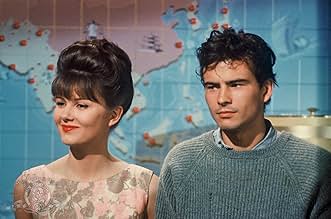
The story concerns an American Coca-Cola executive, C.R. McNamara, heading up an office in Berlin who is asked by his boss to host his daughter (Pamela Tiffin). Hoping for a plum assignment in London, C.R. and his wife (Arlene Francis) welcome the young woman with open arms. She's southern, beautiful, flirtatious, and before they know it, she's got a Communist boyfriend (Horst Bucholz) Then he becomes her Communist husband, and that London promotion is looking less and less likely unless C.R. can pull off a miracle.
Wilder's direction for this was to have the dialogue shouted rather than spoken and to keep the film moving at a very fast pace. Admittedly this can get a little exhausting. Cagney gives a high-voltage performance and is extremely funny as the harried executive. And there are some hysterical bits as well as the madcap feeling of a '30s film. The rest of the cast is wonderful: Arlene Francis as C.R.'s long-suffering wife, Lilo Pulver as C.R.'s sexy secretary, and Hanns Lothar as Schlemmer, C.R.'s assistant who was "underground" during the war. ("The resistance?" "No, the subway. Nobody told me anything down there.") Though this was not a happy set - Wilder and Cagney had their differences, and Horst Buccholz was a major pain - the result is very good. Late in their careers, Wilder and Cagney still had it. Big time.
Differences of opinion may be understandable!
But it was shown (letterboxed - "The only way to fly!") on Turner Classic Movies the other night and I quite enjoyed it, since it may now be enhanced somewhat at today's distant remove from the politics and the contemporary references of its period.
Cagney's performance is really amazing and it's not so surprising that this was his last major film role on the big screen. He must have been exhausted when filming wrapped!
The rest of the cast seems to be thoroughly in the service of what Wilder intended, which certainly wasn't subtlety, to say the least. And the production values and behind-the-scenes contributions (especially Andre Previn's witty score) are Class "A" all the way (except for that flat-looking studio mock-up of the air terminal interior, apparently necessitated by problems that couldn't have been foreseen).
It's not Wilder's best but it's a cut above (and then some) so much of the stuff that passes for comedy on the multiplex screens today.
the film
Perfect, Hysterical Madcap Comedy
Billy Wilder's "One Two Three" is one of the greatest comedy films ever made. This wonderfully zany 1961 gem is a lightning-paced, hysterical farce (and with it's classic instrumental theme of "The Sabre Dance," you know you're in for a rollicking, rapid-fire comedy). Based on a French play, much of the movie plays out like a stage comedy, as Wilder simply turns his camera on the actors and lets them do their thing. The entire cast is simply superb, their comic timing perfect. James Cagney gives one of his all-time greatest performances as C.R. MacNamara. In almost every scene, with the bulk of the script on his shoulders, Cagney is sharp, quick on the draw, and just plain hilarious as the bewildered executive. Arlene Francis lends fine comic support as Cagney's sarcastic wife, Horst Buchholz is very funny & perfectly cast as the rebellious Otto, and the gorgeous Pamela Tiffin is simply a riot as the hot-blodded, dim-witted Scarlett. But ALL the actors in this movie are funny & terrific. Billy Wilder's direction is marvelous, and his script co-written with I.A.L. Diamond is clever and hilarious.
Some may find the quick pace of "One Two Three" a little exhausting, as the movie's energy level remains high from beginning to end, rarely stopping for air, but it works for me. This movie is pure farce, plain and simple. It makes no apologies for what it is, and it's goal is to make you laugh loudly. "One Two Three" is one of the most hysterical movies I've ever seen in my life, and it never fails to give me bellylaughs. Thank you Billy, Jimmy, and all the rest for this magnificent comedy gem.


Did you know
- TriviaJoan Crawford (then on the board of PepsiCo) telephoned director Billy Wilder to protest the movie's Coca-Cola connection. Wilder then added a final scene in which James Cagney buys four bottles of Coke from a vending machine. The last bottle out of the machine isn't Coke but another brand . . . Pepsi.
- GoofsSchlemmer calls his former superior officer in the SS "Herr Oberleutnant". The SS had no rank of Oberleutnant nor did its members call each other Herr. Oberleutnant was a German Army rank. The corresponding SS rank was Obersturmführer. In the German (dubbed) version, Schlemmer correctly addresses him as "Obersturmführer".
- Quotes
Borodenko: When will papers be ready?
C.R. Macnamara: I'll put my secretary right to work on it.
Mishkin: Your secretary? She's that blonde lady?
C.R. Macnamara: That's the one.
Peripetchikoff: [after conferring with the others] You will send papers to East Berlin with blonde lady in triplicate.
C.R. Macnamara: You want the papers in triplicate, or the blonde in triplicate?
Peripetchikoff: See what you can do.
- ConnectionsEdited into Grand format: Amérique, notre histoire (2006)
Details
- Release date
- Country of origin
- Languages
- Also known as
- 1, 2, 3
- Filming locations
- Production companies
- See more company credits at IMDbPro
Box office
- Budget
- $3,000,000 (estimated)
- Gross worldwide
- $146
- Runtime
- 1h 44m(104 min)
- Color
- Aspect ratio
- 2.35 : 1