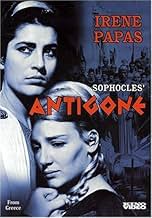
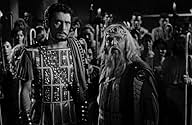
Antigone defies her uncle's decree that her traitorous brother should go unburied and therefore find no rest in the afterlife; however, her actions have tragic consequences.Antigone defies her uncle's decree that her traitorous brother should go unburied and therefore find no rest in the afterlife; however, her actions have tragic consequences.Antigone defies her uncle's decree that her traitorous brother should go unburied and therefore find no rest in the afterlife; however, her actions have tragic consequences.
- Awards
- 3 wins & 1 nomination total
Yorgos Karetas
- Elder of Thebes
- (as Giorgos Karetas)
Mimis Rougeris
- Elder of Thebes
- (as Dimitris Rougeris)
- Director
- Writers
- All cast & crew
- Production, box office & more at IMDbPro
7.2970
1
2
3
4
5
6
7
8
9
10
Featured reviews
A Greek rendition of a Greek classic, this film has remained with me for 40 years.
This film, seen in my youth, has etched itself indelibly into my psyche. Achingly bleak, this story of a sister's love is portrayed in a classical style, with Irene Pappas powerfully projecting the character of the title role. This is a worthwhile way to use your valuable time.
Justice
Antigone represents the epitome of philosophical thought in antiquity. The ruler in Creon is set opposite to the loyal sister in Antigone. The ethical dilemma presented in the film is much like Plato's works: Euthyphro and Republic. Creon, as the ruler Thebes, thinks it just to not bury the fallen enemies near the city as it would disgrace the city. Antigone on the other hand feels it just to her fallen brother, a confederate to the previous regime, that he be given a proper burial in regard to his and Antigone's beliefs in the Gods.
The conflict gets its genesis from a varying view of what is just or the right thing to do. Take Plato's dialogue between Socrates and Euthyphro in Euthyphro. Euthyphro explains to Socrates that something pious (just, good) is something unanimously loved by the Gods. Socrates raises the question as to whether the gods love the pious because it is the pious or whether something pious is only pious because it is loved by the gods. The circular dilemma present by Euthyphro brings a question to Antigone. Is she right for wanting her brother buried and disrupting edicts by Creon's rule? Is her pious belief in the Gods something she ought to uphold? Does the good or justice in her brother's burial supersede Creon's rule? Additionally, in Plato's Republic Thraseymachus explains to Socrates that the just is the advantage of the stronger, and that it is just to obey one's rulers. Socrates argues against this conclusion but with weak premises. For Euthyphro, Antigone would be justified in wanting her brother buried in his religious fashion which would dictate his corpse not rotting in the woods. Thraseymachus on the other hand would say that the justice resides in the ruler, Creon, for better or worse. Which is right?
I leave this earth with my life unspent
The play 'Antigone', written by Sophocles in 441 BC is not just a great piece of theatre but also raises political, ethical and philosophical issues which render it timeless. The blind Tiresias upbraids King Creon with 'All tyrants are gluttons for their ill-gotten power' and warns him that he will pay a terrible price for having denied Polyneices burial and condemning Antigone to entombment.
Athenians at the time would certainly have related to the folly of tyranny.
Unlike most 'absolute rulers' he relents but alas too late.
This is a very accomplshed adaptation by writer/director Yorgos Tzavallas with a fine score by Argyris Kournadis.
The cast is uniformly excellent. The striking Irene Papas, no stranger to tragic Greek heroines on both stage and screen, deservedly won an award at the Berlin International Film Festival for her performance as Antigone. Her character arouses our sympathy but one should not forget that her grim fate and the play's tragedy stems as much from her own stubbornness as from Creon's intractability. Manos Katrakis is absolutely stupendous as Creon. He too was recognised for his performance at the International Film Festival in San Francisco. Papas and Katrakis went on to excel in 'Electra' for Cacoyannis two years later.
One does not have to be a classical scholar to appreciate this first class film but should seeing it arouse ones interest in the wonders of Greek tragedy then it has more than served its purpose.
Needs viewing thrice.
It is true the more knowledge of the play by Sophocles and of Greek plays, in general, the more you can appreciate this rendition. However, the interesting thing about this presentation is you can start from ground zero and come away with everything the tragedy is about. Even though the story is well known, I will not go through it in case this is your first time.
There is an introduction to bring you up to date from Oedipus through his descendants and history to today where you meet Antigone and her sister Ismene. Their decisions are partially ordained and those of the new king Creon decide the outcome. You may find yourself quoting this play as you would Shakespeare's plays.
The reason for watching it multiple times is the first time around you may be busy reading the subtitles of which some flash and are gone. The second time around you may keep an eye on the acting. Third, you will get used to the Greek and even if you do not speak it, you will find much filled in that was not subtitled. By now you will be hooked and have to watch it periodically.
There is an introduction to bring you up to date from Oedipus through his descendants and history to today where you meet Antigone and her sister Ismene. Their decisions are partially ordained and those of the new king Creon decide the outcome. You may find yourself quoting this play as you would Shakespeare's plays.
The reason for watching it multiple times is the first time around you may be busy reading the subtitles of which some flash and are gone. The second time around you may keep an eye on the acting. Third, you will get used to the Greek and even if you do not speak it, you will find much filled in that was not subtitled. By now you will be hooked and have to watch it periodically.
A Greek Tragedy of Sophocles
In Thebes in ancient Greece, King Oedipus kills his father and marries his mother Jocasta, having two sons – Eteocles and Polyneices – and two daughters – Ismene and Antigone. King Oedipus dies a beggar in the exile after gouging out his own eye, and Eteocle agrees to reign in Thebes in alternating years with Polynices. However, he refuses to resign after the first year and Polynieces raises an army and attacks Thebes, and they kill each other.
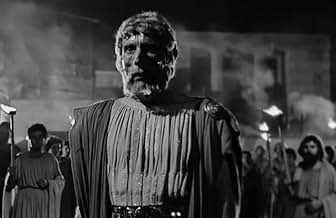
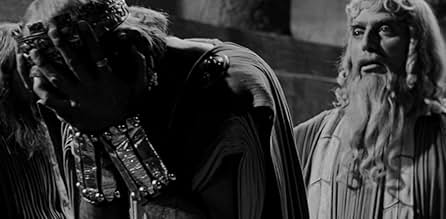
The ruler of Thebes Creon (Manos Katrakis) decrees that Eleocles should have an honorable burial while the body of the traitor Polyneices should be left on the battlefield to be eaten by the jackals and vultures. However, Antigone (Irene Papas), who was betrothed to Creon's surviving son Haemon (Nikos Kazis), defies Creon's orders and buries her brother. When Creon is reported of the attitude of Antigone, he sentences her to be placed in a tomb alive. Antigone hangs herself in the tomb and Haemon tries to kill his father first and then he kills himself with his sword. When Creon's wife Eurydice (Ilia Livykou) is informed of the death of her son, she also commits suicide, leaving Creon alone.
The theatrical "Antigoni" is a nice feature about the famous Greek tragedy of Sophocles focused in Antigone, the incestuous daughter of Oedipus and therefore also his half-sister and Jocasta's granddaughter. The movie begins with an important big picture of Thebes and the major characters of that period, and is extremely well acted. This is the first time that I watch this movie and I saw it in an American VHS. I only regret the quality of the subtitles that are visibly too much summarized since there are long speeches of characters that are translated in two or three words in English. My vote is eight.
Title (Brazil): Not Available
The ruler of Thebes Creon (Manos Katrakis) decrees that Eleocles should have an honorable burial while the body of the traitor Polyneices should be left on the battlefield to be eaten by the jackals and vultures. However, Antigone (Irene Papas), who was betrothed to Creon's surviving son Haemon (Nikos Kazis), defies Creon's orders and buries her brother. When Creon is reported of the attitude of Antigone, he sentences her to be placed in a tomb alive. Antigone hangs herself in the tomb and Haemon tries to kill his father first and then he kills himself with his sword. When Creon's wife Eurydice (Ilia Livykou) is informed of the death of her son, she also commits suicide, leaving Creon alone.
The theatrical "Antigoni" is a nice feature about the famous Greek tragedy of Sophocles focused in Antigone, the incestuous daughter of Oedipus and therefore also his half-sister and Jocasta's granddaughter. The movie begins with an important big picture of Thebes and the major characters of that period, and is extremely well acted. This is the first time that I watch this movie and I saw it in an American VHS. I only regret the quality of the subtitles that are visibly too much summarized since there are long speeches of characters that are translated in two or three words in English. My vote is eight.
Title (Brazil): Not Available
Did you know
- TriviaThe movie sold 43,705 tickets. It came in 12th out of 68 movies.
- ConnectionsReferenced in Dinos Katsourides: A Life Like a Movie (2012)
- How long is Antigone?Powered by Alexa
Details
- Release date
- Country of origin
- Language
- Also known as
- Antigone: A Tragedy by Sophocles
- Filming locations
- Alfa Studios, Athens, Greece(Studio)
- Production company
- See more company credits at IMDbPro
- Runtime
- 1h 33m(93 min)
- Color
- Sound mix
- Aspect ratio
- 1.37 : 1
Contribute to this page
Suggest an edit or add missing content