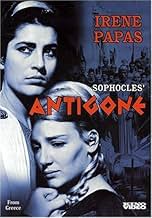
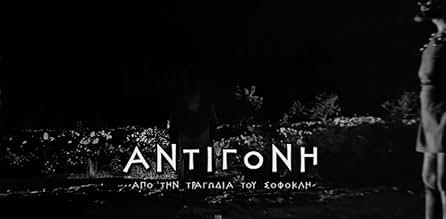
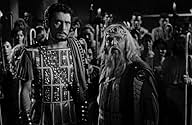
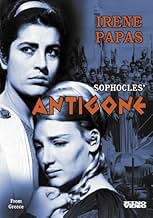
Antigone defies her uncle's decree that her traitorous brother should go unburied and therefore find no rest in the afterlife; however, her actions have tragic consequences.Antigone defies her uncle's decree that her traitorous brother should go unburied and therefore find no rest in the afterlife; however, her actions have tragic consequences.Antigone defies her uncle's decree that her traitorous brother should go unburied and therefore find no rest in the afterlife; however, her actions have tragic consequences.
- Awards
- 3 wins & 1 nomination total
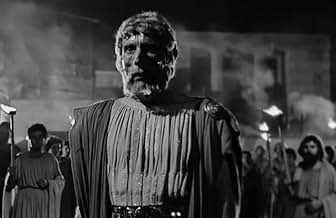
Yorgos Karetas
- Elder of Thebes
- (as Giorgos Karetas)
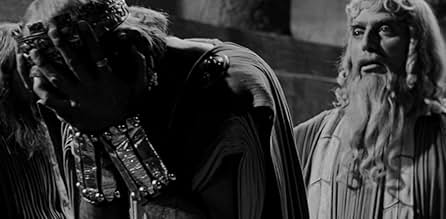
Mimis Rougeris
- Elder of Thebes
- (as Dimitris Rougeris)
- Director
- Writers
- All cast & crew
- Production, box office & more at IMDbPro
7.2970
1
2
3
4
5
6
7
8
9
10
Featured reviews
Needs viewing thrice.
It is true the more knowledge of the play by Sophocles and of Greek plays, in general, the more you can appreciate this rendition. However, the interesting thing about this presentation is you can start from ground zero and come away with everything the tragedy is about. Even though the story is well known, I will not go through it in case this is your first time.
There is an introduction to bring you up to date from Oedipus through his descendants and history to today where you meet Antigone and her sister Ismene. Their decisions are partially ordained and those of the new king Creon decide the outcome. You may find yourself quoting this play as you would Shakespeare's plays.
The reason for watching it multiple times is the first time around you may be busy reading the subtitles of which some flash and are gone. The second time around you may keep an eye on the acting. Third, you will get used to the Greek and even if you do not speak it, you will find much filled in that was not subtitled. By now you will be hooked and have to watch it periodically.
There is an introduction to bring you up to date from Oedipus through his descendants and history to today where you meet Antigone and her sister Ismene. Their decisions are partially ordained and those of the new king Creon decide the outcome. You may find yourself quoting this play as you would Shakespeare's plays.
The reason for watching it multiple times is the first time around you may be busy reading the subtitles of which some flash and are gone. The second time around you may keep an eye on the acting. Third, you will get used to the Greek and even if you do not speak it, you will find much filled in that was not subtitled. By now you will be hooked and have to watch it periodically.
a fist of questions
Easy to define it as inspired adaptation of Sophocles play. The superb Antigone proposed by Irene Papas, Creod isolated in his convinctions and fears and presumed vulnerabilitz, well performed by Manos Katrakis , Maro Kodou as Ismene or Ilia Lyvikou as Euridyce are the good reasons to see it as exceptional adaptation.
But the basic reason remains the option of Giorgos Tzavellas to suggest a direct interogation to audience.
Gestures in name of justice.
Laws and attitudes.
Radical answers against injustice.
And falls.
Indeed, all known from the Old Greek or Philosophy classes , from lectures of early ages , from other adaptations.
But the strong virtue of Irene Papas to be one with her character , maybe the language itself , maybe the set are details giving to this Antigoni a profound special status . And this makes it real different.
But the basic reason remains the option of Giorgos Tzavellas to suggest a direct interogation to audience.
Gestures in name of justice.
Laws and attitudes.
Radical answers against injustice.
And falls.
Indeed, all known from the Old Greek or Philosophy classes , from lectures of early ages , from other adaptations.
But the strong virtue of Irene Papas to be one with her character , maybe the language itself , maybe the set are details giving to this Antigoni a profound special status . And this makes it real different.
Pride Goes Before A Fall...
...Or, Two Rights Make A Wrong. Over the years I've seen many versions of Antigone, both films and TV and even read two translations of the timeless tale by Sophocles but I was mainly interested in seeing this one as I've never heard it spoken in Greek before. Can't understand a word; whether it makes it more authentic or not is debatable - and after digesting all the concepts in the play whether you need another idea to debate is also debatable – but it certainly adds another dimension.
Strong minded woman Antigone wants to bury her brother Polyneices returned from exile who kills but is killed in battle by her other brother Eteocles who is feted as Thebes' saviour and given a hero's burial. Wilful King Creon decrees death to anyone honourably burying the traitor Polyneices bringing calamity and endless moral dilemmas for all concerned. Antigone is excellently played by Irene Papas, fresh from The Guns of Navarone the year before. This is Sophocles whizzed through in eighty minutes, concentrating on this wilfulness, pride and refusal to listen either to their gods, counsel or commonsense. It's been a salutary lesson for all people but especially despots and politicians of all eras; some wilfully blind leaders lead nations to war and destruction with their gods on their side and in the aftermath justify themselves even if it means black must be white and vv too of course. The ever modern tragedies are that the despots and politicians never heed the lessons in here though and indeed that ordinary people still desire shepherds to lead them. Without going into any of the moral and ethical points raised (plenty mentioned in other comments here) as a film it's a reasonable effort and well acted and engrossing enough although I'd always imagined Thebes to be a little grander somehow. If you're still unsure: memorable, lots to chew over but absolutely no laughs.
A Greek rendition of a Greek classic, this film has remained with me for 40 years.
This film, seen in my youth, has etched itself indelibly into my psyche. Achingly bleak, this story of a sister's love is portrayed in a classical style, with Irene Pappas powerfully projecting the character of the title role. This is a worthwhile way to use your valuable time.
let's trying judging it without its classical heritage
Most people who watch this film will be doing it in order to see an example of a classic Greek tragedy. They will be satisfied. It is dignified, stately, and absolutely dripping with fate, destiny, and tragedy.
But what if you are more like an average movie-goer? Does it hold up under more normal criteria? I think it does to some extent, but not particularly well. The plot is started at the very beginning of the opening scene as Antigone expresses her determination to bury her dead brother, and everything else follows inevitably - the entire story is plot-driven. It's a rather simple plot, but it does carry you along. I'm not sure there's a lot more that's really compelling about the film. It's pretty stagey, with actors and extras forming nice patterns, as if lining up with chalk lines on the floor. Although there are a number of small processions and such, this is not a costume epic with a cast of thousands and crane shots filling the screen with colourful eye candy. It's filmed in black and white. Is the acting good? Sure, but bear in mind that the range of emotions is quite limited, and characters pretty much talk in set speeches. They do imbue their dignified speeches with the correct emotions and make them sound sincere.
But, to be honest, I don't think you would recommend this film to anyone unless they had a pre-existing interest in classical Greek drama.
But what if you are more like an average movie-goer? Does it hold up under more normal criteria? I think it does to some extent, but not particularly well. The plot is started at the very beginning of the opening scene as Antigone expresses her determination to bury her dead brother, and everything else follows inevitably - the entire story is plot-driven. It's a rather simple plot, but it does carry you along. I'm not sure there's a lot more that's really compelling about the film. It's pretty stagey, with actors and extras forming nice patterns, as if lining up with chalk lines on the floor. Although there are a number of small processions and such, this is not a costume epic with a cast of thousands and crane shots filling the screen with colourful eye candy. It's filmed in black and white. Is the acting good? Sure, but bear in mind that the range of emotions is quite limited, and characters pretty much talk in set speeches. They do imbue their dignified speeches with the correct emotions and make them sound sincere.
But, to be honest, I don't think you would recommend this film to anyone unless they had a pre-existing interest in classical Greek drama.
Did you know
- TriviaThe movie sold 43,705 tickets. It came in 12th out of 68 movies.
- ConnectionsReferenced in Dinos Katsourides: A Life Like a Movie (2012)
- How long is Antigone?Powered by Alexa
Details
- Release date
- Country of origin
- Language
- Also known as
- Antigone: A Tragedy by Sophocles
- Filming locations
- Alfa Studios, Athens, Greece(Studio)
- Production company
- See more company credits at IMDbPro
- Runtime
- 1h 33m(93 min)
- Color
- Sound mix
- Aspect ratio
- 1.37 : 1
Contribute to this page
Suggest an edit or add missing content