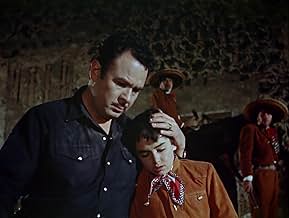
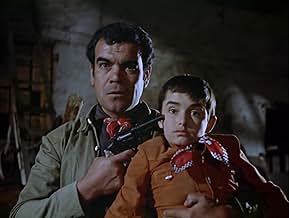
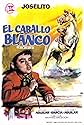
The first of the Spanish-Mexican co-productions starring Joselito, it is a true vehicle for the distinguished child prodigy, who always acts very likeable and performs engaging songs in his own style. Joselito embarks on a journey from Spain when his grandmother (Sara García), living in a Mexican village, requests his presence, as the boy's parents died in an accident a year earlier. While traveling by stagecoach toward his destination, the vehicle is attacked by bandits. However, the boy escapes, wandering aimlessly through the countryside until he meets Antonio (Antonio Aguilar), with whom he becomes good friends. A horseman whose profession and livelihood are high-stakes card games. Thus, the two become close friends and close colleagues. And Joselito, who already considers himself a young man, is very comfortable with his new friend, and does not want to leave his side by any means. But Antonio forces him to appear at his grandmother's house. The change from Mexican life is sometimes frustrating and too abrupt for the young boy. Various situations at school lead the singing boy to fall platonically in love with his teacher (Luz María Aguilar), and when he sees that his mentor Antonio also falls in love with the teacher, Joselito becomes deeply jealous.
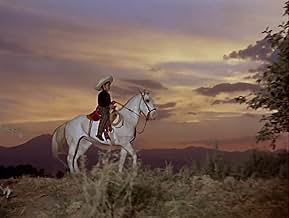
This is a simple and light-hearted musical melodrama, to the greater glory of Joselito, as well as Mexican star Antonio Aguilar. The child prodigy Joselito not only enjoyed enormous popularity in Spain but also in Mexico, where he filmed several co-productions, this being the third in the series, in which he was paired with local star Antonio Aguilar. It was passably produced by expert filmmaker Rafael Baledón, who shot an attractively edited film. Financed by the all-powerful Spanish producer Cesáreo González, with Joselito's regular director, Antonio del Amo, as production assistant, and showcasing attractive Mexican exteriors. There are priceless musical scenes, like when Joselito and Aguilar, riding on the same horse, sing in unison, or when Antonio sings the classic "Guadalajara" to a packed corral while everyone hums along. Thus, our two beloved singers sing the following songs: "El emigrante," "La mancormadora," "Ay, Ay, Ay, Ay," "La malagueña," "El caballo blanco," "El pastor," "Guadalajara," "Princesita," and "Lucerito."
This is one of several co-productions-this time between Spain and Mexico-starring Joselito, providing a true vehicle for the distinguished child prodigy, who performs engagingly and sings captivating songs in his own imperturbable style. Joselito's career was short but prosperous and flourishing. It was the actor and singer Luis Mariano who convinced him to perform together in Paris and gave him work on French radio and television. Discovered by Antonio del Amo, he directed Joselito in eight of his fourteen films. The success of his first three films, the so-called Nightingale trilogy, consisting of "El pequeño ruiseñor" 1956, "Saeta del Ruiseñor" 1957, and "El ruiseñor de las cumbres" 1958, was of immense proportions in Spain, but also in France, Italy, Latin America and even Japan, so much so that he became one of the undisputed stars of Spanish cinema, and Pier Paolo Pasolini included one of his songs in the soundtrack of "Mamma Roma" 1962. Among his other feature films it is worth mentioning "La Vida Nueva de Pedrito de Andalucía" 1964 by Rafael Gil and "Loca juventud" 1963, and ¨El secreto de Tomy¨, these last films were not the expected success, since as a teenager his voice changed for the worse, and because of all this Joselito retired from acting and singing, dedicating himself to other tasks, even working as a mercenary in African countries. Co-starring Antonio Aguilar, who was very successful in his native country, Aguilar is one of the most iconic actors and singers in Mexican cinema. He began his career as a singer in the 1940s and made his debut in Mexican national cinema in 1952, during its golden age. Later in his acting career, Aguilar stood out for his brilliant interpretations of revolutionary heroes and folk songs in historical films. He won the ACE Award for Best Actor for his performance in Zapata (1970). Aguilar married his frequent co-star Flor Silvestre in 1959. He was awarded a Star on the Hollywood Walk of Fame for his Recording at 7060 Hollywood Boulevard, Hollywood, California, on September 7, 2000. He has the distinction of portraying revolutionary leaders Pancho Villa and Emiliano Zapata in Mexican cinema. His first film, co-starring his second wife, Flor Silvestre, was La huella del chacal (1956). This was an installment in the "Mauricio Rosales 'El Rayo'" western film series. They also co-starred in the final official installment of the series, The Dead Don't Speak (1958), and a later remake, A Taste of Blood (1980). It co-stars the always sweet Sara Garcia, the grandmother from Mexico. She usually played the grandmother/aunt/mother-in-law alongside many Mexican movie stars, including Pedro Infante, Cantinflas, Antonio Espino "Clavillazo," Flor Silvestre, Luis Aguilar, and Antonio Aguilar. There's also a cameo by a slender horse named "Rebelde," who performs some captivating pirouettes.
The feature film was unevenly but professionally directed by Rafael Baledón. He was a prolific Mexican artisan who directed all kinds of genres, with a preference for typical Aztec dramas, and also made some exploitation films. He was an actor and director, and was married to actress Lilia Michel. He is said to have directed nearly 100 films in virtually every genre. His acting career spanned more than 55 years and was even more prolific until his death in 1994. His films include "Los salvajes" (1957), "Una piedra en el zapato" (1956), and "El infierno de Frankenstein" (1960). "El caballo blanco" score: 6/10. Joselito fans will love this film.