

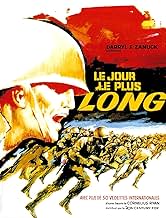
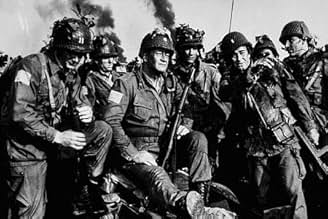
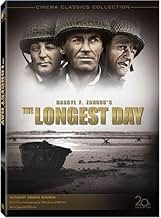
The events of D-Day, told on a grand scale from both the Allied and German points of view.The events of D-Day, told on a grand scale from both the Allied and German points of view.The events of D-Day, told on a grand scale from both the Allied and German points of view.
- Won 2 Oscars
- 8 wins & 6 nominations total
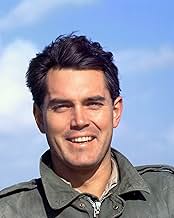


Irina Demick
- Janine Boitard
- (as Irina Demich)

7.762.1K
1
2
3
4
5
6
7
8
9
10
Featured reviews
Classic WWII Film!!
The Longest Day (1962) - CO-Directors: Ken Annakin & Andrew Morton Everyone knows this was producer Darryl F. Zanuck's baby and it earns its place in cinema history as one of those epic style movies that treats its subject matter with the most serious of attitudes. Obviously a war is no laughing matter but, for better or worse, movies tend to simplify logistics while highlighting emotional chords, such as bravery and homemade apple pie. Zanuck, however, wanted the audience to understand the scope and grandeur of an enterprise like D-Day.
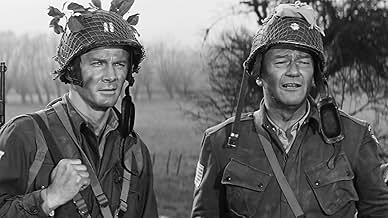
Utilizing a cast of thousands, half of which seemed to be cameo appearances by major stars of the day, Zanuck presents on wide screen all the action and turmoil that surrounded this turning point of WW II. The ever-fighting Republican John Wayne is there, along with Democrat Henry Fonda, tough guy Bob Mitchum, brooding Richard Burton, sexy Sean Connery and pit bullish Rod Steiger. Still for my money, one of the best landing on the beach scenes ever filmed. Sorry Mr.Spielberg. (B&W)
Utilizing a cast of thousands, half of which seemed to be cameo appearances by major stars of the day, Zanuck presents on wide screen all the action and turmoil that surrounded this turning point of WW II. The ever-fighting Republican John Wayne is there, along with Democrat Henry Fonda, tough guy Bob Mitchum, brooding Richard Burton, sexy Sean Connery and pit bullish Rod Steiger. Still for my money, one of the best landing on the beach scenes ever filmed. Sorry Mr.Spielberg. (B&W)
Still a classic after 42 years!
Invariably compared with "Saving Private Ryan" (SPR), this scores over the more modern work because of the focus on all the major sides of the action (British, American, French and German).
All languages are used (with subtitles as appropriate - eg the Germans speak in German, etc).
While true that the battle scenes are not gory as SPR's, and that the sounds of battle are muted during the dialog (unlike SPR's), it should be borne in mind that in '62, the audience rating of the time *was* a General Release ("G" in the US, "A" in the UK (I'm guessing for the UK, but it is now PG)) - which more detail would not have allowed.
I think part of the purpose of this film is to allow *everyone* to see what happened 18 years before!
All languages are used (with subtitles as appropriate - eg the Germans speak in German, etc).
While true that the battle scenes are not gory as SPR's, and that the sounds of battle are muted during the dialog (unlike SPR's), it should be borne in mind that in '62, the audience rating of the time *was* a General Release ("G" in the US, "A" in the UK (I'm guessing for the UK, but it is now PG)) - which more detail would not have allowed.
I think part of the purpose of this film is to allow *everyone* to see what happened 18 years before!
Not a fair comparison
THE LONGEST DAY is one of the if not the greatest World War II movie epics. However, it is unfair to compare it to Steven Spielberg's SAVING PRIVATE RYAN. To do so would really be comparing apples and oranges. Spielberg's movie was meant to convey the gore and horror of war and succeeded quite admirably. In THE LONGEST DAY, which was shot in semi-documentary style, Zanuck's intent was to show the monumental effort involved, on the part of the allies, in mounting a successful cross channel invasion. In that regard this film also succeeded quite admirably. It should be regarded more as a history lesson rather than as simply dramatic entertainment. The historical value of the film far outweighs any minor dramatic licenses taken by Zanuck.
A great film within its context
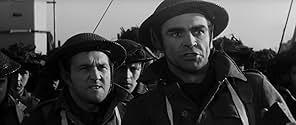
The Longest Day works on several levels - the most obvious being the "don't blink or you might miss several" nature of the Star-Studded cast. Much of the cast works very well (Sean Connery's little comedy double act with Norman Rossington is an unexpected highlight). Some less so, and some is just downright tokenism - Rod Steiger getting all of 43 seconds on-screen for example. But overall, it's always a watchable movie - beautifully shot.
Some previous comment have surprised me, particularly the assertion that The Longest Day is, in any way, a "pro-war" film. I'm not sure if there *is* such a thing, but if there is then The LOngest Day certainly doesn't fall into this category - the scene of bewilderment between Richard Burton and Richard Beymer at the end about the confusion and directionlessness of war is the perfect example, ending with the memorable line "I wonder who won".
I'm also surprised that a European reviewer should have accused this film, of all world war II movies, of being American propoganda. I wonder how many other WWII films include both German and (almost unqiuely) French perspectives of the war to such an extent that almost half of the dialogue in them is in a language other than English. I find the German sequences in The Longest Day to be amongst the most interesting historically and dramatically.
The film is certainly as accurate as it's possible for a fictional movie to be - the list of advisors that it had working on it should prove that - including many people who are portrayed by actors in the movie itself. These include the characters played by Peter Lawford, Richard Todd and Kenneth More, along with several of the German field officers. Little touches that seem utterly out of place (like the nuns procession through the French village bringing a temporary ceasefire) are actually historically spot-on.
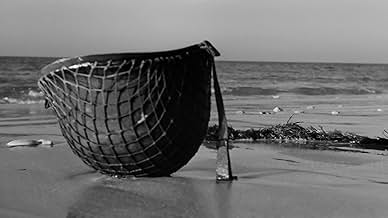
The final problem for the modern reviewer, of course, is the inevitable comparison between this film and Saving Private Ryan. But, as several other contributors have noted, SPR is not only the product of a different age with a different view of these events - historical as opposed to something which happened so recently that half of the audience are likely to have lived through them. But, ultimately, something usually forgotten about Operation Overlord is that Omaha Beach was merely one battle of a very long day indeed. Americans tend to focus on it because of the death toll, but the taking of Utah, Sword and Gold were just as important to the overall outcome. The Longest Day is a film about five beaches, many battles, and many men - some, as Richard Burton says, dead, some crippled and some lost. It is an anti-war film which proves that you can be anti-war and still celebrate and acknowledge heorism. The heroism of the young American and British troops, falling face-first into the salt water of the Normandy killing grounds. The incredible bravery of the Rangers who scaled the cliffs at Pointe du Luc on and, ultimately, meaningless mission. The heroism of the two Luftwaffe pilots commanded to face the invading armies alone, and who did so (another historically accurate point).
The Longest Day is a historic film about a historical event and it should be viewed as such.
9/10
Some previous comment have surprised me, particularly the assertion that The Longest Day is, in any way, a "pro-war" film. I'm not sure if there *is* such a thing, but if there is then The LOngest Day certainly doesn't fall into this category - the scene of bewilderment between Richard Burton and Richard Beymer at the end about the confusion and directionlessness of war is the perfect example, ending with the memorable line "I wonder who won".
I'm also surprised that a European reviewer should have accused this film, of all world war II movies, of being American propoganda. I wonder how many other WWII films include both German and (almost unqiuely) French perspectives of the war to such an extent that almost half of the dialogue in them is in a language other than English. I find the German sequences in The Longest Day to be amongst the most interesting historically and dramatically.
The film is certainly as accurate as it's possible for a fictional movie to be - the list of advisors that it had working on it should prove that - including many people who are portrayed by actors in the movie itself. These include the characters played by Peter Lawford, Richard Todd and Kenneth More, along with several of the German field officers. Little touches that seem utterly out of place (like the nuns procession through the French village bringing a temporary ceasefire) are actually historically spot-on.
The final problem for the modern reviewer, of course, is the inevitable comparison between this film and Saving Private Ryan. But, as several other contributors have noted, SPR is not only the product of a different age with a different view of these events - historical as opposed to something which happened so recently that half of the audience are likely to have lived through them. But, ultimately, something usually forgotten about Operation Overlord is that Omaha Beach was merely one battle of a very long day indeed. Americans tend to focus on it because of the death toll, but the taking of Utah, Sword and Gold were just as important to the overall outcome. The Longest Day is a film about five beaches, many battles, and many men - some, as Richard Burton says, dead, some crippled and some lost. It is an anti-war film which proves that you can be anti-war and still celebrate and acknowledge heorism. The heroism of the young American and British troops, falling face-first into the salt water of the Normandy killing grounds. The incredible bravery of the Rangers who scaled the cliffs at Pointe du Luc on and, ultimately, meaningless mission. The heroism of the two Luftwaffe pilots commanded to face the invading armies alone, and who did so (another historically accurate point).
The Longest Day is a historic film about a historical event and it should be viewed as such.
9/10
The Cast & The Actual Event: Overwhelming Numbers
This was an another one of these all-star casts that you don't see in more modern times, in which about everyone who was actor made an appearance....or it just seems that way. For those unfamiliar with this film, take a look back on the main page here and check out the famous names in this movie. Click the "more" under the cast overview and you'll see all the names. It's unbelievable. Some of them, to be fair, had very short roles in here, such as Henry Fonda, Rod Steiger and Roddy McDowell, but this is a real "Who's Who" of the acting profession in 1962. There are also a lot of German actors in here speaking German (with subtitles provided), perhaps numbering even more than the English-speaking stars. That's because the famous day of June 6, 1944, is seen from both sides of the conflict.
At three hours, it gives you plenty of D-Day World War II action. Almost two-thirds of the movie involves action from that famous invasion. In some spots, it just gets to be too much. Frankly, the whole film is too much and almost bogs down in too many areas....and it shouldn't, but it is a very technical film. And, for a film 45 years old, the action is pretty realistic. I thought the best shots were the overheads during one particular scenes when the Alies were going through a town.
I am anything but a WWII expert so how much detail of the infamous 'D-Day" here is correct, Since they went into such detail, I'll assume they were fairly accurate. I can't say but this movie educated me on the size of the task. I had no idea "D-Day" was this huge in scope: three million men and 5,000 ships??!!! Amazing.
At three hours, it gives you plenty of D-Day World War II action. Almost two-thirds of the movie involves action from that famous invasion. In some spots, it just gets to be too much. Frankly, the whole film is too much and almost bogs down in too many areas....and it shouldn't, but it is a very technical film. And, for a film 45 years old, the action is pretty realistic. I thought the best shots were the overheads during one particular scenes when the Alies were going through a town.
I am anything but a WWII expert so how much detail of the infamous 'D-Day" here is correct, Since they went into such detail, I'll assume they were fairly accurate. I can't say but this movie educated me on the size of the task. I had no idea "D-Day" was this huge in scope: three million men and 5,000 ships??!!! Amazing.


Did you know
- TriviaWhile clearing a section of the Normandy beach near Pointe du Hoc, the crew unearthed a tank that had been buried in the sand since the original invasion. Mechanics cleaned it off, fixed it up and it was used in the movie as part of the British tank regiment.
- GoofsA compound fracture of the ankle indicates blood and/or protruding bones, of which Vandervoort's ankle had none. It also would have been impossible to put any weight on the ankle.
- Quotes
Flight Officer David Campbell: The thing that's always worried me about being one of the few is the way we keep on getting fewer.
- Crazy creditsThere is a 20-second overture on a black screen, no 20th Century Fox logo (in spite of this being one of their most expensive productions), and a six-minute cold open before the title is displayed. Apart from the title, there are no credits at the beginning of the film. All cast and crew credits are at the end of the film.
- Alternate versionsSome video copies omits Jean Servais scenes as a Free French admiral making a short speech to his crew before the shore bombardments starts.
- ConnectionsEdited into All This and World War II (1976)
Details
- Release date
- Country of origin
- Official site
- Languages
- Also known as
- El día más largo del siglo
- Filming locations
- Sainte-Mère-Eglise, Manche, France(parachutists landing in the village)
- Production company
- See more company credits at IMDbPro
Box office
- Budget
- $10,000,000 (estimated)
- Runtime
- 2h 59m(179 min)
- Color
- Black and White(original version)
- Aspect ratio
- 2.35 : 1
Contribute to this page
Suggest an edit or add missing content