
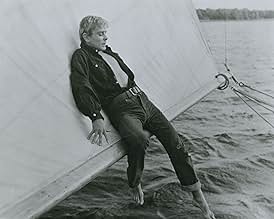
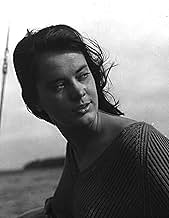
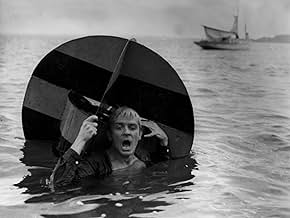
A couple pick up a hitchhiker on the way to their yacht. The husband invites the young man to come along for their day's sailing. As the voyage progresses, the antagonism between the two men... Read allA couple pick up a hitchhiker on the way to their yacht. The husband invites the young man to come along for their day's sailing. As the voyage progresses, the antagonism between the two men grows. A violent confrontation is inevitable.A couple pick up a hitchhiker on the way to their yacht. The husband invites the young man to come along for their day's sailing. As the voyage progresses, the antagonism between the two men grows. A violent confrontation is inevitable.
- Director
- Writers
- Stars
- Nominated for 1 Oscar
- 1 win & 2 nominations total



Anna Ciepielewska
- Krystyna
- (voice)
- (uncredited)

Roman Polanski
- Young Man
- (voice)
- (uncredited)
- Director
- Writers
- All cast & crew
- Production, box office & more at IMDbPro
7.424.8K
1
2
3
4
5
6
7
8
9
10
Featured reviews
very creative and surprisingly interesting
I liked this film more than I thought I would. Perhaps this was because the last Polanski film I saw was REPULSION--a technically well-made but repulsive film (that few average people would ever want to see). It is a very simple story with only three characters but manages, somehow, not to bore the viewer or give in to what is expected. For example, when the couple met the hitchhiker, I expected the old cliché of the "psychotic drifter" who would ultimately terrorize and/or kill them. But, as the film unfolded, I kept waiting and waiting and waiting and he never dismembered or terrorized them at all. In fact, one of the OTHER main characters turned out to be the jerk! Now that's interesting.
Why not an even higher score? Well, the ending of the movie just didn't make sense. The nasty husband jumped overboard to try and rescue the drifter but the husband appears to have drowned. BUT, when the wife and drifter take the sailboat back to shore, the nasty husband meets the boat!!! How could this have happened unless maybe there was a submarine in the lake that rescued him?! My daughter thinks maybe he could walk on water, but that's a pretty rare occurrence. This is a pretty big mistake, now that I think about it--and it's a shame since the rest of the movie is so good.
ADDENDUM--I received a message on IMDb from Chris-Krzysztof indicating that this was NOT the way the film ended. His post is given below:
"I guess you missed something in the subtitles or there was something "lost in translation". After having searched the boy for some time the couple thinks he had drowned, they have a fight and when the husband disappears, he's not searching the boy anymore, but he's swimming to the shore to a police station to confess what happened (mostly to prove his wife he's not a coward). In the morning, they meet at the shore (the husband of course didn't have enough courage to go the police, he's making excuses that it was in the night, he was almost naked, couldn't get into the car - the keys were on the yacht). When they leave the marina, he stops the car at the crossroads, where we can see a sign (not sure if it was translated) "Do posterunku MILICJI obywatelskiej, 10 km" (To the POLICE station, 10 km). And the car remains there, so we don't know which way he chooses ... "
As I responded to him, in the version I saw, this is not how the ending was translated. Considering I think Chris speaks Polish, I am sure he is right. However, many older films exist in multiple versions and translations and I think the version I saw was mistranslated. As a result, I am adding this addendum to clarify things.
Why not an even higher score? Well, the ending of the movie just didn't make sense. The nasty husband jumped overboard to try and rescue the drifter but the husband appears to have drowned. BUT, when the wife and drifter take the sailboat back to shore, the nasty husband meets the boat!!! How could this have happened unless maybe there was a submarine in the lake that rescued him?! My daughter thinks maybe he could walk on water, but that's a pretty rare occurrence. This is a pretty big mistake, now that I think about it--and it's a shame since the rest of the movie is so good.
ADDENDUM--I received a message on IMDb from Chris-Krzysztof indicating that this was NOT the way the film ended. His post is given below:
"I guess you missed something in the subtitles or there was something "lost in translation". After having searched the boy for some time the couple thinks he had drowned, they have a fight and when the husband disappears, he's not searching the boy anymore, but he's swimming to the shore to a police station to confess what happened (mostly to prove his wife he's not a coward). In the morning, they meet at the shore (the husband of course didn't have enough courage to go the police, he's making excuses that it was in the night, he was almost naked, couldn't get into the car - the keys were on the yacht). When they leave the marina, he stops the car at the crossroads, where we can see a sign (not sure if it was translated) "Do posterunku MILICJI obywatelskiej, 10 km" (To the POLICE station, 10 km). And the car remains there, so we don't know which way he chooses ... "
As I responded to him, in the version I saw, this is not how the ending was translated. Considering I think Chris speaks Polish, I am sure he is right. However, many older films exist in multiple versions and translations and I think the version I saw was mistranslated. As a result, I am adding this addendum to clarify things.
Lubricated Blade
There is nothing more thrilling than discovering a natural filmmaker for the first time. There are only so many, and you can only have menarche once. Its an introduction into another life.
I first saw this in 1965 at the Orson Welles Cinema near Harvard Square. We were told it was made behind the backs of Iron Curtain thugs, only surviving because of international attention. (I wouldn't meet Tarkovsky or Kieslowski until later.) And that it was made by the fellow who had made the striking "Repulsion," which at that time was anticipated but yet unseen in the States.
I've since learned some striking things: that both Polanski and his co-writer wanted to play the hitchhiker and indeed it is Polanski's voice. And that the mistress who seems only half alive was in fact played by a non-actress they found by looking at swimming pools. Also that the situation was suggested by a long planned and discussed Orson Welles project ("The Deep") that was started after this and never completed.
The writing is good of course, especially the central image the title denotes, but the camera finds the perfect place always. It is like Altman's camera (after this) that discovers the action rather than, say Spielberg's where the action is obviously happening in such a way to be cleanly seen by the camera. And so much harder on a boat!
But the interesting thing about such an introduction to a filmmaker is the relationship that follows: we know certain things about how he thinks and sees. We expect the conversation to continue and mature over the years. And what a rocky ride this man has taken us on, through perfectly created worlds (in which I include "Ninth Gate") but also through pure dreck and rank sentimentality (both of which tag "The Pianist").
Sometimes he's internal to the narrative, even the charmed actor. Sometimes he is outside the narrative, pulling strings (as with this film) but sometimes it is clear he never got out of bed.
As with Kubrick and so many others, you really must start at the beginning, which essentially means here.
Ted's Evaluation -- 3 of 3: Worth watching.
I first saw this in 1965 at the Orson Welles Cinema near Harvard Square. We were told it was made behind the backs of Iron Curtain thugs, only surviving because of international attention. (I wouldn't meet Tarkovsky or Kieslowski until later.) And that it was made by the fellow who had made the striking "Repulsion," which at that time was anticipated but yet unseen in the States.
I've since learned some striking things: that both Polanski and his co-writer wanted to play the hitchhiker and indeed it is Polanski's voice. And that the mistress who seems only half alive was in fact played by a non-actress they found by looking at swimming pools. Also that the situation was suggested by a long planned and discussed Orson Welles project ("The Deep") that was started after this and never completed.
The writing is good of course, especially the central image the title denotes, but the camera finds the perfect place always. It is like Altman's camera (after this) that discovers the action rather than, say Spielberg's where the action is obviously happening in such a way to be cleanly seen by the camera. And so much harder on a boat!
But the interesting thing about such an introduction to a filmmaker is the relationship that follows: we know certain things about how he thinks and sees. We expect the conversation to continue and mature over the years. And what a rocky ride this man has taken us on, through perfectly created worlds (in which I include "Ninth Gate") but also through pure dreck and rank sentimentality (both of which tag "The Pianist").
Sometimes he's internal to the narrative, even the charmed actor. Sometimes he is outside the narrative, pulling strings (as with this film) but sometimes it is clear he never got out of bed.
As with Kubrick and so many others, you really must start at the beginning, which essentially means here.
Ted's Evaluation -- 3 of 3: Worth watching.
Superb!
This film is a masterpiece for a movie fan that understands sharp dialog and is interested in so called "mind" suspense. Characters in the movie are psychologically fully developed and the direction is superb; if you include Komeda's nervous jazz elements, the result is Perfection with big P. Polanski knows exactly what perfectionism is about - the devil is in the details, and the devil has no place in this great little classic. I recommend this movie to everyone that wants to get involved in film industry. Let it be the reminder why movies exist in the first place. It's the story that matters and it's the impact that dialog provides; if scenes or words stay with you long after you've seen the movie, you know that something BIG has hit you. You know that you actually start THINKING about yourself...
"If two men are onboard, one's the skipper"
Roman Polanski's first full length feature is a simple, minimalist piece filled with male posturing, dead end situations, claustrophobic environments and eerie calm. This is part of Polanski's art house beginnings, but many of its themes and much of its style would be carried through to his later, more accessible work.
Like many a Polanski picture, Knife in the Water shows us men competing over a woman. Typically however this is to the end of making the men look ridiculous rather than objectifying the woman. Here the competition is the central theme, and the bulk of the film is basically a series of set pieces in which the middle-aged husband and the young hitchhiker attempt to outdo each other or show the other up. This drama is concentrated and focused by having only the three characters, and confining the action almost entirely to one location. This kind of minimalism is a safe, simple way to make a straightforward, uncluttered story a good strategy for an up and coming director but it's a lot harder to make a really great picture out of such simple elements, and the young Polanski does fall somewhat short here.
What Polanski does have is his natural talent and feel for cinematic form. His sense of rhythm was evident from his earliest shorts, and by this point he had clearly settled upon a style of slow, even paces, letting scenes take as much time as they needed and never being afraid to hold a shot into so-called "dead time" if he felt it was necessary. Often, the stillness of Polanski's pictures could build up a greater feeling of dread or tension than speed and shocks. Here, the pace is leisurely, in tune with Komeda's breezy jazz score, a sound synonymous with early Polanski. It may be slow but Knife in the Water has great atmosphere.
Another of Polanski's strengths was in his feel for space, particularly confined space. In Knife in the Water we have a kind of contradiction on this level, because a small boat in the middle of a lake is both a very wide open space and a small confined one. You kind of get half the effect of a later Polanski picture such as The Tenant you do get the sense that the characters and the camera itself are incredibly restricted in their environment, but of course you don't get that feeling of all the walls pressing in on you. Nevertheless, Polanski was a master at creating this sense, and he does tend to surround the camera with bits of boat or actor. There are numerous close-ups typical of the early Polanski although it's something he would drop later in his career which give a slightly surreal look to some of the shots. A particularly effective moment is the first shot of the boat drifting out across the lake with trees dotted in the background, which then cuts to a close-up of Krystyna, the wife, lying on her back filling the lower half of the frame, with the exact same background as the previous shot.
Knife in the Water is a fairly good film with some good ideas. It suffers a bit from style over substance but is well acted and well directed and is not long enough to get overly tedious. Better things were to come from Polanski once he moved out of Poland and began his English-language film career.
Like many a Polanski picture, Knife in the Water shows us men competing over a woman. Typically however this is to the end of making the men look ridiculous rather than objectifying the woman. Here the competition is the central theme, and the bulk of the film is basically a series of set pieces in which the middle-aged husband and the young hitchhiker attempt to outdo each other or show the other up. This drama is concentrated and focused by having only the three characters, and confining the action almost entirely to one location. This kind of minimalism is a safe, simple way to make a straightforward, uncluttered story a good strategy for an up and coming director but it's a lot harder to make a really great picture out of such simple elements, and the young Polanski does fall somewhat short here.
What Polanski does have is his natural talent and feel for cinematic form. His sense of rhythm was evident from his earliest shorts, and by this point he had clearly settled upon a style of slow, even paces, letting scenes take as much time as they needed and never being afraid to hold a shot into so-called "dead time" if he felt it was necessary. Often, the stillness of Polanski's pictures could build up a greater feeling of dread or tension than speed and shocks. Here, the pace is leisurely, in tune with Komeda's breezy jazz score, a sound synonymous with early Polanski. It may be slow but Knife in the Water has great atmosphere.
Another of Polanski's strengths was in his feel for space, particularly confined space. In Knife in the Water we have a kind of contradiction on this level, because a small boat in the middle of a lake is both a very wide open space and a small confined one. You kind of get half the effect of a later Polanski picture such as The Tenant you do get the sense that the characters and the camera itself are incredibly restricted in their environment, but of course you don't get that feeling of all the walls pressing in on you. Nevertheless, Polanski was a master at creating this sense, and he does tend to surround the camera with bits of boat or actor. There are numerous close-ups typical of the early Polanski although it's something he would drop later in his career which give a slightly surreal look to some of the shots. A particularly effective moment is the first shot of the boat drifting out across the lake with trees dotted in the background, which then cuts to a close-up of Krystyna, the wife, lying on her back filling the lower half of the frame, with the exact same background as the previous shot.
Knife in the Water is a fairly good film with some good ideas. It suffers a bit from style over substance but is well acted and well directed and is not long enough to get overly tedious. Better things were to come from Polanski once he moved out of Poland and began his English-language film career.
The games people play
Polanski's first feature, on paper, sounds like nothing more than a run-of-the-mill claustrophobic thriller set on a boat - a couple takes a loner on board, you figure out the rest. 'Dead Calm', 'The Deep', etc etc etc.
Instead, 'Knife In The Water' is an agonisingly tense look at male posturing & ego, the husband & hitch-hiker constantly challenging each other in every possible way - sailing prowess, games of fiddlesticks, knife throwing & just generally strutting about. There's almost never a single moment where the two aren't trying to trump each other, & one gets the impression that it's not even to impress the girl, so much as themselves. As the film progresses, the tension mounts & tempers fray.
In a Hollywood film, this would build up to a dramatic climax of violence & catharsis, accompanied with thunder & lightning. Polanski doesn't let us off the hook that easily - things get rough, but the games continue, right until the very end of the film.
Shot in black & white, with a cast of three, & virtually one small location, 'Knife In The Water' puts bigger films to shame. No stars, no pyrotechnics, no special effects, probably very little budget, & it's completely riveting from start to finish.
It was nominated for the Best Foreign Film at the Oscars - the first feature of a young Polish film student - & rightly so.
A brilliant start to a brilliant career.
Instead, 'Knife In The Water' is an agonisingly tense look at male posturing & ego, the husband & hitch-hiker constantly challenging each other in every possible way - sailing prowess, games of fiddlesticks, knife throwing & just generally strutting about. There's almost never a single moment where the two aren't trying to trump each other, & one gets the impression that it's not even to impress the girl, so much as themselves. As the film progresses, the tension mounts & tempers fray.
In a Hollywood film, this would build up to a dramatic climax of violence & catharsis, accompanied with thunder & lightning. Polanski doesn't let us off the hook that easily - things get rough, but the games continue, right until the very end of the film.
Shot in black & white, with a cast of three, & virtually one small location, 'Knife In The Water' puts bigger films to shame. No stars, no pyrotechnics, no special effects, probably very little budget, & it's completely riveting from start to finish.
It was nominated for the Best Foreign Film at the Oscars - the first feature of a young Polish film student - & rightly so.
A brilliant start to a brilliant career.


Did you know
- TriviaThe first scene in the film shows Andrzej and Krystyna driving a car. As shooting from the platform in front of the car was not yet available, the crew was tied to the car, standing on its mask. To get the proper light effects, they held a blanket with a small hole for the camera. Leon Niemczyk (Andrzej) was really driving this car quite fast (this was crucial to this scene), but he couldn't see anything. He drove the car using the tops of the trees to imagine where the road is.
- GoofsWhen the young boy is trying to stabilize the Christine by hanging off its side, the railing of the camera boat can be seen in the lower left-hand corner of the screen.
- ConnectionsEdited into Catalogue of Ships (2008)
- How long is Knife in the Water?Powered by Alexa
Details
- Runtime
- 1h 34m(94 min)
- Color
- Sound mix
- Aspect ratio
- 1.37 : 1
Contribute to this page
Suggest an edit or add missing content