IMDb RATING
8.3/10
4.5K
YOUR RATING
A simple yet devout Christian makes a vow to Saint Barbara after she saves his donkey, but everyone he meets seems determined to misunderstand his intentions. Will he be able to keep his pro... Read allA simple yet devout Christian makes a vow to Saint Barbara after she saves his donkey, but everyone he meets seems determined to misunderstand his intentions. Will he be able to keep his promise in the end?A simple yet devout Christian makes a vow to Saint Barbara after she saves his donkey, but everyone he meets seems determined to misunderstand his intentions. Will he be able to keep his promise in the end?
- Director
- Writers
- Stars
- Nominated for 1 Oscar
- 4 wins & 1 nomination total
Leonardo Villar
- Zé do Burro
- (as Leonardo Vilar)
Antonio Pitanga
- Coca
- (as Antonio L. Sampaio)
João Di Sordi
- Police Detective
- (as João Desordi)
Veveldo Diniz
- Sacristão
- (as Velvedo Diniz)
Napoleao Lopes Filho
- Bispo
- (as Napoleão L. Filho)
- Director
- Writers
- All cast & crew
- Production, box office & more at IMDbPro
8.34.5K
1
2
3
4
5
6
7
8
9
10
Featured reviews
A man whom no one understands.
The film carries many important subtexts yet begins from a simple premise. A man made a promise and tries to keep it.
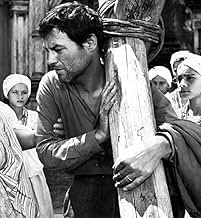
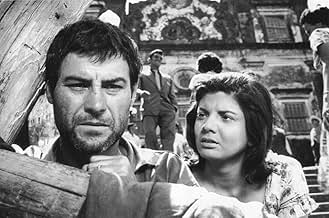
The promise itself was simple. He would walk carrying a cross until he reached the inside of the church. However, that turned out to be the easiest part. At the beginning of the film he has already completed the path and stands with the cross on his shoulders ready to finish his mission when the men appear.
This is the message that resonated most with me throughout the film, the people who created the real weight of the cross. Many individuals each driven by their own interests and none willing to listen to the man bearing the cross, only trying to take advantage of him.
It is a tragedy repeated stubborn and human.
The promise itself was simple. He would walk carrying a cross until he reached the inside of the church. However, that turned out to be the easiest part. At the beginning of the film he has already completed the path and stands with the cross on his shoulders ready to finish his mission when the men appear.
This is the message that resonated most with me throughout the film, the people who created the real weight of the cross. Many individuals each driven by their own interests and none willing to listen to the man bearing the cross, only trying to take advantage of him.
It is a tragedy repeated stubborn and human.
Contemporary and Universal
The only old thing about this movie is its release date. It's very contemporary and universal. O Pagador de Promessas (1962) is based on a play written by Dias Gomes and performed for the first time in 1960.
(About the first scene so not really a spoiler) Zé and his wife, Rosa, left their land, in the country, and went to the city so Zé could pay a promise he made for a saint called Santa Bárbara. He promised to carry a wooden cross all the way to the city and enter Santa Bárbara church with it if his best friend was healed by the saint. (Paying promisses is still common in Brazil ).
I won't say why exactly but the priest doesn't let he enters the church.
It might seem a minor conflict, but it's not and it escalates through the narrative in a chocking way to Zé, Rosa and audience.
Through the obstacles, Gomes criticizes many social institutions and Brazilian society as a whole in a brilliant way, mixing comedy with drama, what was totally brought to light in Anselmo's adaptation.
In this path, the acting is really important and it's fantastic.
Leonardo Villar portrays perfectly Zé certainty and naivety; Glória Menezes thought of everything, from the accent to the way of moving and the confusion Rosa shows; Dionísio Azevedo made a perfect traditional priest and everybody else were great in their respective roles, an awesome cast.
The technical features are amazing, the sets, the costume design, Duarte's shots, Chock Fowle cinematography and Gabriel Migliori scores.
What stands out in the movie is the representation of Brazilian Culture, which is what the film defends, the beautiful mix Brazil is, of European, Indian, African and many other cultures.
(About the first scene so not really a spoiler) Zé and his wife, Rosa, left their land, in the country, and went to the city so Zé could pay a promise he made for a saint called Santa Bárbara. He promised to carry a wooden cross all the way to the city and enter Santa Bárbara church with it if his best friend was healed by the saint. (Paying promisses is still common in Brazil ).
I won't say why exactly but the priest doesn't let he enters the church.
It might seem a minor conflict, but it's not and it escalates through the narrative in a chocking way to Zé, Rosa and audience.
Through the obstacles, Gomes criticizes many social institutions and Brazilian society as a whole in a brilliant way, mixing comedy with drama, what was totally brought to light in Anselmo's adaptation.
In this path, the acting is really important and it's fantastic.
Leonardo Villar portrays perfectly Zé certainty and naivety; Glória Menezes thought of everything, from the accent to the way of moving and the confusion Rosa shows; Dionísio Azevedo made a perfect traditional priest and everybody else were great in their respective roles, an awesome cast.
The technical features are amazing, the sets, the costume design, Duarte's shots, Chock Fowle cinematography and Gabriel Migliori scores.
What stands out in the movie is the representation of Brazilian Culture, which is what the film defends, the beautiful mix Brazil is, of European, Indian, African and many other cultures.
A powerful Brazilian film about a religious circus
O Pagador de Promessas / Keeper of Promises (1962) :
Brief Review -
A powerful Brazilian film about a religious circus. The film centers on Zé, a man who is a strong believer in God. When his donkey falls ill, he promises to carry a cross to the Santa Bárbara church in exchange for the donkey's health. As the miracle occurs, the donkey is saved and becomes healthy in just one day. Zé carries a cross on his shoulder for seven leagues and reaches the church alongside his wife, who is reluctant about his beliefs and promises. Just for the sake of a bed, she spends a night with a local pimp, becoming disloyal to her kind-hearted husband. This is the film's biggest flaw, as we later see a crowd gathered outside the church learning about his wife's affair with the pimp, yet Zé does nothing about it. That was quite foolish. Anyway, the father of the church denies Zé's entry because he made his promise in a way that contradicts Catholic beliefs. Zé's simple promise becomes a topic of political, religious, and social hysteria, and he becomes a sensation in no time. While he could make money and become a hero, he denies fame and remains true to his promise. The system does everything to stop him, and the tragic ending shatters you from within. I liked the theme, the way events are explored, and the powerful climax. I just didn't appreciate the wife's character. She was so shameless that she asked her husband to take her home after spending a night with a pimp. One of the hookers humiliates her and her husband in front of a large crowd by calling him a "cuckold," and still, there are no reactions from him regarding her or her mistake. This conflict undermines the purity of the otherwise noble subject, making it appear highly contradictory. Thanks to the powerful message in the climax and the one-man show by Leonardo Villar, this film is a must-watch.
RATING - 7/10*
By - #samthebestest.
A powerful Brazilian film about a religious circus. The film centers on Zé, a man who is a strong believer in God. When his donkey falls ill, he promises to carry a cross to the Santa Bárbara church in exchange for the donkey's health. As the miracle occurs, the donkey is saved and becomes healthy in just one day. Zé carries a cross on his shoulder for seven leagues and reaches the church alongside his wife, who is reluctant about his beliefs and promises. Just for the sake of a bed, she spends a night with a local pimp, becoming disloyal to her kind-hearted husband. This is the film's biggest flaw, as we later see a crowd gathered outside the church learning about his wife's affair with the pimp, yet Zé does nothing about it. That was quite foolish. Anyway, the father of the church denies Zé's entry because he made his promise in a way that contradicts Catholic beliefs. Zé's simple promise becomes a topic of political, religious, and social hysteria, and he becomes a sensation in no time. While he could make money and become a hero, he denies fame and remains true to his promise. The system does everything to stop him, and the tragic ending shatters you from within. I liked the theme, the way events are explored, and the powerful climax. I just didn't appreciate the wife's character. She was so shameless that she asked her husband to take her home after spending a night with a pimp. One of the hookers humiliates her and her husband in front of a large crowd by calling him a "cuckold," and still, there are no reactions from him regarding her or her mistake. This conflict undermines the purity of the otherwise noble subject, making it appear highly contradictory. Thanks to the powerful message in the climax and the one-man show by Leonardo Villar, this film is a must-watch.
RATING - 7/10*
By - #samthebestest.
A must see movie!
A shame such an important movie has no poster here on IMDb. I wanted to add the one that is used on Wikipedia, but I would have to pay to do that. Strange. (Edit: it has a poster now.)
If you are critical of religion fanaticism, you must see this movie! It shows what can become of fanatic people, how lack of education plays an important role in fanaticism, the arrogance of the church and the hypocrisy of our society.
Zé do Burro (Joe of the Donkey) has the soul of a child. He is a good guy, but extremely naive. His naivety is shamelessly exploited, and people cruelly distort his good intentions, making an evil person out of him, when all he wanted was to do good.
The movie won the Golden Palm in Cannes and other prizes. It's a classic. Dialogs are a bit theatrical (only if you understand Portuguese), but so they used to be that time. A movie that will get under your skin.
If you are critical of religion fanaticism, you must see this movie! It shows what can become of fanatic people, how lack of education plays an important role in fanaticism, the arrogance of the church and the hypocrisy of our society.
Zé do Burro (Joe of the Donkey) has the soul of a child. He is a good guy, but extremely naive. His naivety is shamelessly exploited, and people cruelly distort his good intentions, making an evil person out of him, when all he wanted was to do good.
The movie won the Golden Palm in Cannes and other prizes. It's a classic. Dialogs are a bit theatrical (only if you understand Portuguese), but so they used to be that time. A movie that will get under your skin.
A brilliant satire on religion, society, the media and humanity in general
One of those overlooked Films in Cinema History, Honest, multi-layered and amazingly contemporary, this is one of those movies that have admirably stood the test of time, add to that Winning the prestigious Palm d'Or at Cannes 1962.
Did you know
- TriviaFirst Brazilian film to be nominated for an Oscar.
- ConnectionsEdited into A Edição do Nordeste (2023)
- How long is The Given Word?Powered by Alexa
Details
- Release date
- Country of origin
- Language
- Also known as
- Payer of Promises
- Filming locations
- Production company
- See more company credits at IMDbPro
Box office
- Gross worldwide
- $8,229
- Runtime
- 1h 38m(98 min)
- Color
- Sound mix
- Aspect ratio
- 1.33 : 1
Contribute to this page
Suggest an edit or add missing content