IMDb RATING
6.7/10
2.5K
YOUR RATING


Famous Spanish bandit Artiguez returns to his native Spanish village after 20 years in French exile, but Spanish cop Vinolas sets a trap for him.Famous Spanish bandit Artiguez returns to his native Spanish village after 20 years in French exile, but Spanish cop Vinolas sets a trap for him.Famous Spanish bandit Artiguez returns to his native Spanish village after 20 years in French exile, but Spanish cop Vinolas sets a trap for him.





Marietto
- Paco Dages
- (as Marietto Angeletti)

Perrette Pradier
- Maria, Hussy
- (as Perette Pradier)


- Director
- Writers
- All cast & crew
- Production, box office & more at IMDbPro
6.72.5K
1
2
3
4
5
6
7
8
9
10
Featured reviews
Underrated gem
This excellent film tells the story of a stubborn Spanish republican, Manuel Artiguez, who refused to give up the fight when his side lost the Spanish civil war to the fascists in 1938. The film takes place twenty years later, when after many successful raids, Artiguez has lost the will to continue. However, his adversary, a Spanish police chief called Vinolas, has not yet given up on capturing or killing him and sets a trap for him. The trap and the question of whether Artiguez will fall into it it will keep you on your seat for most of the movie. Three men caught between Artiguez and Vinolas, an informer, a priest, and an idealistic Spanish exile boy, add a rich psychological and moral dimension to the film, following themes of idealism, revenge, and the uses of violence.
"Behold" is a great thriller with highly complex characters and a profound moral sensibility. The idealism of Spanish republicans like the boy is on the one hand supported by the oily and hypocritical Vinolas, and on the other hand undercut by the rawness and violence of Artiguez. Neither of the adversaries is vindicated, but neither are they equivalent to one another. The ending will set you thinking for hours, if you're so inclined.
Performances by Peck (Artiguez) and Quinn (Vinolas) are great. Peck is less stuffy than usual. I'm not generally a fan of earnest, wet-eyed Sharif (the priest), but his performance here suits the movie quite well. I can still hear his voice saying "Did the informer escape? Is the bandit safe?"
My only complaint is that for all of its thematic complexity and richness of character the film is at times somewhat melodramatic and the dialogue is sometimes a little clunky. And for some reason its parts, good characters, good plot, good actors, all excellent, do not quite add up into a perfect whole. Nor is it as good as some of the movies it slightly resembles: Guns of Navarone, Battle of Algiers, Wild Bunch. However, it is definitely worthwhile for fans of 'thoughtful thrillers'.
"Behold" is a great thriller with highly complex characters and a profound moral sensibility. The idealism of Spanish republicans like the boy is on the one hand supported by the oily and hypocritical Vinolas, and on the other hand undercut by the rawness and violence of Artiguez. Neither of the adversaries is vindicated, but neither are they equivalent to one another. The ending will set you thinking for hours, if you're so inclined.
Performances by Peck (Artiguez) and Quinn (Vinolas) are great. Peck is less stuffy than usual. I'm not generally a fan of earnest, wet-eyed Sharif (the priest), but his performance here suits the movie quite well. I can still hear his voice saying "Did the informer escape? Is the bandit safe?"
My only complaint is that for all of its thematic complexity and richness of character the film is at times somewhat melodramatic and the dialogue is sometimes a little clunky. And for some reason its parts, good characters, good plot, good actors, all excellent, do not quite add up into a perfect whole. Nor is it as good as some of the movies it slightly resembles: Guns of Navarone, Battle of Algiers, Wild Bunch. However, it is definitely worthwhile for fans of 'thoughtful thrillers'.
Totally Forgotten...Reasons?
This is a film which has almost faded into total obscurity, and that's tragic, because it's well worth seeing. It's sort of a thinking person's suspense movie, better appreciated if you know some details about the intricate historical background in which it is set. Even so, it can be appreciated for its dramatic settings and characterizations. It has a complicated plot, to be sure, but the story rolls right along...not a lot of action until the end, but the tension builds steadily. I'm no fan of Peck, but his role here really drew me in. He looks beaten down by a hard life and way too much unhealthy passion. Quinn doesn't have much screen time, but I liked some of the minor characters best...their faces were great. The credit sequence, meshed together perfectly with newsreels, shows a long line of defeated soldiers, their faces reflecting defeat and confusion... a great tracking scene.
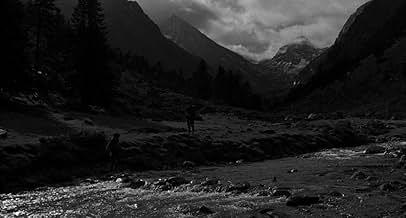
Here are some reasons I think the film is unknown: 1. The main character is an atheist communist anti-catholic guerilla bandit. Not a popular icon in American movies. 2. Complex historical background. 3. Knowledge of political situation in Spain a minimum requirement. Not a priority on many American's lists. 4. Black and white photography in 1964. (Hey, I liked the scenery...but you always wonder how it would look in color...and this was a late date for a black and white feature film.) 5. Civil War movies (even Spain's) always run a risk...you might alienate half the audience.
Here are some reasons I think the film is unknown: 1. The main character is an atheist communist anti-catholic guerilla bandit. Not a popular icon in American movies. 2. Complex historical background. 3. Knowledge of political situation in Spain a minimum requirement. Not a priority on many American's lists. 4. Black and white photography in 1964. (Hey, I liked the scenery...but you always wonder how it would look in color...and this was a late date for a black and white feature film.) 5. Civil War movies (even Spain's) always run a risk...you might alienate half the audience.
BEHOLD A PALE HORSE (Fred Zinnemann, 1964) ***
I had been looking forward to this one for some time, due to its rather imposing credentials; it's certainly well-made and acted but also heavy-going, slow and excessively talky.
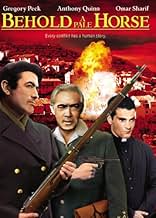
Gregory Peck is even stiffer and glummer than usual as a washed-out guerrilla fighter; Anthony Quinn is generally more subdued than is customary for him, being effectively cast against type as Peck's nemesis (though his character is completely absent from the film's mid-section); after a belated entrance, Omar Sharif manages to steal the acting honors from under the nose of his more experienced companions by giving a moving portrayal of a conflicted priest. The excellent cast is rounded out by Paolo Stoppa, Christian Marquand, Daniela Rocca, Mildred Dunnock, Rosalie Crutchley and Michel Lonsdale.
Ultimately, the film lacks the touch of greatness but the unusual subject matter (adapted from an Emeric Pressburger novel) and the surprising but affecting child's eye view it takes of events keep one watching. Furthermore, the climactic assault on the hospital is both suspenseful and exciting and the ever-reliable Maurice Jarre contributes a subtly effective score.
Gregory Peck is even stiffer and glummer than usual as a washed-out guerrilla fighter; Anthony Quinn is generally more subdued than is customary for him, being effectively cast against type as Peck's nemesis (though his character is completely absent from the film's mid-section); after a belated entrance, Omar Sharif manages to steal the acting honors from under the nose of his more experienced companions by giving a moving portrayal of a conflicted priest. The excellent cast is rounded out by Paolo Stoppa, Christian Marquand, Daniela Rocca, Mildred Dunnock, Rosalie Crutchley and Michel Lonsdale.
Ultimately, the film lacks the touch of greatness but the unusual subject matter (adapted from an Emeric Pressburger novel) and the surprising but affecting child's eye view it takes of events keep one watching. Furthermore, the climactic assault on the hospital is both suspenseful and exciting and the ever-reliable Maurice Jarre contributes a subtly effective score.
A film about death
Revelations 6:8 in the Bible quoted at the start of the film refers to death in the form of a pale horse.
If one reflects on the film, written by Emeric Pressburger (who wrote and directed films) and scripted by the interesting J. P. Miller, the film is considerably about death more than the Spanish politics. Only two major characters die in the film; yet the film is all about death of unseen characters. The young boy Paco crosses the Spanish border to France to avenge in his own way his father's death. A priest, Francisco, (played by Omar Sharif), became one after his father was killed in Lorca. When queried about which faction killed his father, he replies rhetorically, "Does either side have a right to take his life?" Even the dying Pilar (Mildred Dunnock) who is an agnostic, responds to the priest Francisco on her deathbed when he philosophically states "The Lord giveth and taketh" with an acerbic repartee "Mostly taketh." Even Vinolas (Anthony Quinn) who plays a negative character and laughs at his secret lover's religious fervour to visit Lourdes as a pilgrim, goes to a church to pray that he succeeds and comes out alive after he sets out an elaborate trap to catch Manuel Artiguez (Gregory Peck).
Zinnemann's direction of the film gives one the foretaste of his future work "The Day of the Jackal" in exciting the build-up to the finale. The film belongs to Zinnemann, Pressburger and Miller even though all the major actors do a commendable job.
If one reflects on the film, written by Emeric Pressburger (who wrote and directed films) and scripted by the interesting J. P. Miller, the film is considerably about death more than the Spanish politics. Only two major characters die in the film; yet the film is all about death of unseen characters. The young boy Paco crosses the Spanish border to France to avenge in his own way his father's death. A priest, Francisco, (played by Omar Sharif), became one after his father was killed in Lorca. When queried about which faction killed his father, he replies rhetorically, "Does either side have a right to take his life?" Even the dying Pilar (Mildred Dunnock) who is an agnostic, responds to the priest Francisco on her deathbed when he philosophically states "The Lord giveth and taketh" with an acerbic repartee "Mostly taketh." Even Vinolas (Anthony Quinn) who plays a negative character and laughs at his secret lover's religious fervour to visit Lourdes as a pilgrim, goes to a church to pray that he succeeds and comes out alive after he sets out an elaborate trap to catch Manuel Artiguez (Gregory Peck).
Zinnemann's direction of the film gives one the foretaste of his future work "The Day of the Jackal" in exciting the build-up to the finale. The film belongs to Zinnemann, Pressburger and Miller even though all the major actors do a commendable job.
A psychological confrontation in an historic background.
When the Spanish War was finished, winners devoted to go after anybody who reflected the red light of the communism or any other color they dislike. On the other hand, few guerilla fighter continued his actions against the winners. But their strength was lower every time. One of this guerrilla was Valentin González "el campesino", which figure is portrayed in this film in a free form (not in an historical form).
Twenty years after the Civil war conclusion, the Spanish police has a good option to capture one of these ex-combatants, who was in exile in France. The description of the methods and day-to-day life of the Spanish police could be the reason which explains that the Spanish Government forbade any more Columbia's film in Spain.
You need no knowledge about the twenty Century Spain's history to understand the film, although you can enjoy more it if you know something. In fact, the film put in a specific political situation the psychological confrontation between two men. It could be a good exercise to understand the motives which impulse his actions.
Twenty years after the Civil war conclusion, the Spanish police has a good option to capture one of these ex-combatants, who was in exile in France. The description of the methods and day-to-day life of the Spanish police could be the reason which explains that the Spanish Government forbade any more Columbia's film in Spain.
You need no knowledge about the twenty Century Spain's history to understand the film, although you can enjoy more it if you know something. In fact, the film put in a specific political situation the psychological confrontation between two men. It could be a good exercise to understand the motives which impulse his actions.


Did you know
- TriviaThe movie was banned in Spain, which was still ruled by Generalisimo Francisco Franco, the fascist victor of the Spanish Civil War.
- GoofsIn the first 5 minutes of the movie it is supposed to be 1939 and the Loyalist (Republican) soldiers are crossing into exile on the French border. As they cross over they are turning in their guns and the first one to turn in his gun turns in a Soviet PPSh-41 sub-machine gun. The PPSh-41 was not developed until 1941.
- Crazy creditsOpening credits - the first card shown contains the passage from Revelations 6:8, which contains the phrase "Behold a Pale Horse", the title of the film.
- ConnectionsFeatured in Hollywood contra Franco (2008)
- How long is Behold a Pale Horse?Powered by Alexa
Details
Box office
- Budget
- $3,900,000 (estimated)
- Runtime
- 2h 1m(121 min)
- Color
- Sound mix
- Aspect ratio
- 1.85 : 1
Contribute to this page
Suggest an edit or add missing content