IMDb RATING
7.2/10
6.1K
YOUR RATING


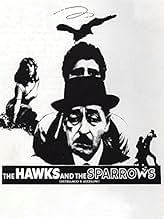
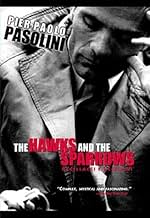
Totò and his son Ninetto are drifting on a road in Italy when they meet a speaking crow.Totò and his son Ninetto are drifting on a road in Italy when they meet a speaking crow.Totò and his son Ninetto are drifting on a road in Italy when they meet a speaking crow.
- Awards
- 4 wins & 4 nominations total


Totò
- Totò Innocenti
- (as Toto')
- …

Ninetto Davoli
- Ninetto Innocenti
- (as Davoli Ninetto)
- …


Nello Appodia
- Party Guest
- (uncredited)
Gabriele Baldini
- Dante's Dentist
- (uncredited)
Pietro Davoli
- Mascalzone
- (uncredited)

Rossana Di Rocco
- Ninetto's Girlfriend
- (uncredited)

- Director
- Writer
- All cast & crew
- Production, box office & more at IMDbPro
7.26.1K
1
2
3
4
5
6
7
8
9
10
Featured reviews
Big Birds, Small Birds
"Where goes humanity?" - "I don't know!" Maybe it's a comedy, but I don't think anyone is 100% sure what kind of a film this really is. It's not really comedic, because behind all those absurdities and silliness there lies a seriously political and religious concern, a bittersweet desire and infallible disappointment. Maybe we should take the film as what it is, as one-of-a-kind, a cinematic high jump which gives rise to all sorts of speculation and conjectures without knowing where to start and where it ends.
Not only the viewer is left unsure, the protagonists are, too. They embody the condition of the film's unsureness perfectly, as well as the nature of one of the most unique works of Italian cinema, which is also the most variant and formally abstract film project of Pasolini: A weird story, a picaresque tale which mixes metaphors and cinematic references (from Keaton's statics to Chaplin's poesy of the dusty road to Fellini's clowns to Rossellini's monks); a philosophic apology which depicts the end of ideologies, the crisis of Marxism on the background of the clash of rulers and subjects (hawks and sparrows) and the unfortunate encounter of those who have the blessing of knowledge (the wise raven) and those who outlive themselves without the awareness of being part of this world: Totò and Ninetto, father and son. Both are walking the eternal road of a universe which is merciless, discuss pretentious things and express themselves with the help of their basic instincts: physical needs, but also the hate towards inferiors and subservience to superiors. On their way, they encounter the mystery of life and death (birth of a child, a family that kills themselves with gas, a funeral), as well as the mortal fear of those who starve. Until the raven appears, decides to go along with them and overwhelms them with needless wisdoms.
It's great to see Totò in here, a masterful actor who often was criminally misused in abysmal Italian entertainment movies and shows here the wide range of his talent. The interaction with the young, intuitive Ninetto Davoli is probably the biggest joy in this film.
Not only the viewer is left unsure, the protagonists are, too. They embody the condition of the film's unsureness perfectly, as well as the nature of one of the most unique works of Italian cinema, which is also the most variant and formally abstract film project of Pasolini: A weird story, a picaresque tale which mixes metaphors and cinematic references (from Keaton's statics to Chaplin's poesy of the dusty road to Fellini's clowns to Rossellini's monks); a philosophic apology which depicts the end of ideologies, the crisis of Marxism on the background of the clash of rulers and subjects (hawks and sparrows) and the unfortunate encounter of those who have the blessing of knowledge (the wise raven) and those who outlive themselves without the awareness of being part of this world: Totò and Ninetto, father and son. Both are walking the eternal road of a universe which is merciless, discuss pretentious things and express themselves with the help of their basic instincts: physical needs, but also the hate towards inferiors and subservience to superiors. On their way, they encounter the mystery of life and death (birth of a child, a family that kills themselves with gas, a funeral), as well as the mortal fear of those who starve. Until the raven appears, decides to go along with them and overwhelms them with needless wisdoms.
It's great to see Totò in here, a masterful actor who often was criminally misused in abysmal Italian entertainment movies and shows here the wide range of his talent. The interaction with the young, intuitive Ninetto Davoli is probably the biggest joy in this film.
You've never seen anything like this!
How does one describe a film like this? Imagine a Bunuel film like THE MILKY WAY. A couple of men walking on an empty road. They're on a strange journey only their destination is the beginning of their journey (huh?) and the two men are as funny as the best cinema clowns in screen history. Somewhat Felliniesque, somewhat Chaplinesque, throw in a little De Sica and even a dash of Monty Python and you can begin to have some idea of what this incredible blend of absurd and hilarious satire is like. Unlike Bunuel's films, this film is joyous. It has heart, passion, and an imagination springing somewhere from the soul. The film takes its stabs at religion, academics, and government but it does it in a playful way that leaves one feeling rejuevenated instead of that sour feeling that one feels after watching most social satires. It's hard to believe that this is a Pasolini film. It's about as far on the spectrum from SALO that one can get, yet it's sad that in comparison this film is almost completely unknown.
This is definitley worth seeking out on video. I'm hoping that I can find a soundtrack recording for this. It is one of the best Ennio Morricone scores I've heard, which is saying a great deal!
This is definitley worth seeking out on video. I'm hoping that I can find a soundtrack recording for this. It is one of the best Ennio Morricone scores I've heard, which is saying a great deal!
One delightful saturday afternoon spent with this movie at the portuguese Cinema Museum.
One delightful saturday afternoon spent with this movie at the portuguese Cinema Museum. This picture can be identified as "another Pasolini movie" or as well as "another Toto movie", and both reasons are more than enough to make anyone curious to see it. Pasolini gives us a pleasant Toto comedie, filled with intelectual and political information, pretty well disguised as a fable about birds and priests. After this, I am convinced that a title with the name PASOLINI on it doesn't necessarily have to be a though, brutal, sexual, 3-hour-lengthed filmic exercise. It can be a simple weekend afternoon movie to watch with your parents or your kids. On the other hand, a simple comedy with one of its masters ("toto") doesnt necessarily have to be shallow and basic. This movie is worth a "jump like a sparrow" into a theatre, whenever you have a re-run around.
Comedy That Thinks
Confusing but fascinating motion picture about the experiences of a father and son. A Felliniesque story with the two main characters experiencing anything strange or surreal tht comes their way. Maybe influenced from the work Pasolini did with Fellini on Nights of Cabiria(1957) and La Dolce Vita(1960). Has many areas in it that is characteristic of a Federico Fellini film. Even the father reminds me of some characters from a Fellini picture. The direction is simple as well as subtle. Uccellacci E Uccellini/Hawks & Sparrows(1965) is Pasolini's lightest and most gentle picture of his filmography. Light years away from the controversial and nilistic sections of his later films. An uncharacteristic film for Pier Paolo Pasolini because of its cheerful and clownish nature. The comedy in Hawks and Sparrows(1965) is in the tradition of such silent greats as Chaplin, Keaton, and Lloyd. Complex film that probably should be seen more than once to attempt at getting a clear meaning of its allegoric nature.
Hawks and Sparrows(1965) gets some good acting from the leads Toto and Ninetto Davoli. On casting people for Pasolini's film he remarked("I use both actors and non-actors, and I am not interested in their ability. I take them for what they are") with an interesting line. This quote from Pasolini is important in the casting of Hawks and Sparrows(1965) because of his personal perference of non actors over actors. The first film I have seen with the actor Toto. Ninetto Davoli does a decent job for a person who never acted before in his life. The rest of the actors are good in the segments they are in. The director liked using non actors because he wanted a natural and unconscious style that could not be possible with a pro actor. Pier Paolo Pasolini was one of the best and most rare type of movie makers to inhibit is cinema with mostly non actors. Each episode is funny and yet intellegent. Pasolini conveys the character of Toto as someone who is unaware of life around him. Filled with the usual political beliefs Pasolini was into.
The opening credits are creative and very unusual. They are played over the screen in the form of a prose. I only wish that more films would use this kind of opening credits instead of the usual opening credits because its more interesting here. The director's intention was to make a film that was pure prose and in the tradition of Buster Keaton and Charles Chaplin. Hawks and Sparrows(1965) does retain the elements of the tragic comedy with the themes of class and poverty. Ennio Morricone plays one of his best film scores in a non Leone film. Pasolini and Morricone did some good work together as director and film composer. Shows how good Pasolini was at in using simple images to push forward a themematic idea. The bird that follows the father and son represents something that is the total opposite of the two. Visual poetry at its finest and and most beautiful. One scene that has recently resurfaced during the late 1980s was an unreleased episode called "Toto At The Circus".
Hawks and Sparrows(1965) gets some good acting from the leads Toto and Ninetto Davoli. On casting people for Pasolini's film he remarked("I use both actors and non-actors, and I am not interested in their ability. I take them for what they are") with an interesting line. This quote from Pasolini is important in the casting of Hawks and Sparrows(1965) because of his personal perference of non actors over actors. The first film I have seen with the actor Toto. Ninetto Davoli does a decent job for a person who never acted before in his life. The rest of the actors are good in the segments they are in. The director liked using non actors because he wanted a natural and unconscious style that could not be possible with a pro actor. Pier Paolo Pasolini was one of the best and most rare type of movie makers to inhibit is cinema with mostly non actors. Each episode is funny and yet intellegent. Pasolini conveys the character of Toto as someone who is unaware of life around him. Filled with the usual political beliefs Pasolini was into.
The opening credits are creative and very unusual. They are played over the screen in the form of a prose. I only wish that more films would use this kind of opening credits instead of the usual opening credits because its more interesting here. The director's intention was to make a film that was pure prose and in the tradition of Buster Keaton and Charles Chaplin. Hawks and Sparrows(1965) does retain the elements of the tragic comedy with the themes of class and poverty. Ennio Morricone plays one of his best film scores in a non Leone film. Pasolini and Morricone did some good work together as director and film composer. Shows how good Pasolini was at in using simple images to push forward a themematic idea. The bird that follows the father and son represents something that is the total opposite of the two. Visual poetry at its finest and and most beautiful. One scene that has recently resurfaced during the late 1980s was an unreleased episode called "Toto At The Circus".
Viaggio in Italia con Pasolini
"Uccellacci e Uccellini" is probably the best chance to get acquainted with Pasolini's political thoughts pre-1968 other than reading him. It's a candid, allegoric and provocative attempt to express his ideas about a very specific epoch in Italian history, after the death of left-wing political "father" Palmiro Togliatti in 1964 (whose funeral is one of the great scenes of "Uccellacci") and the "death" of Neo-Realism. It also reflects the intense differences between social classes, intellectual trends and political forces that would lead to the acts of "contestazione generale" in the late 1960s.
WIth "Uccellacci", we can learn some of Pasolini's thoughts on Marxism, Fascism, religion, the Catholic church, the role of intellectuals, the bourgeoisie, political parties, the dire conditions of the campesinato and the borgate (slums), poverty, greed, famine, cultural and social apartheid -- you name it. That's the main problem with this passionately personal and visually stunning walking-road-movie: too many targets, too little time to hit them all in the bull's eye.
A natural follow-up to his documentary "Comizi d'Amore" (1965) -- in which he traveled all over Italy interviewing people about their thoughts on love and sex -- Pasolini shows in "Uccellacci e Uccellini" the unofficial apartheid in Italy, a basically "unmelting" pot of dozens of different ethnic, linguistic and cultural backgrounds "artificially" unified in mid-19th century but still plagued by social/economical/cultural chasm. And he also denounces the sterility of the discourse of the "official-left" intelligentsia, which he clearly despised (and which heavily attacked him on many issues and occasions).
In the Italy of the 1960s, the Left was concerned with the struggle of workers, intellectuals and students against the establishment; the contadini (peasants) weren't even properly considered as a political force -- they were the symbol of archaic, pre-boom Italy. Pasolini was the main voice to take the side of the peasants; against famine, sophism falls flat, as the intellectual crow will shockingly discover at the end of "Uccellacci". The political discourse can no longer be theoretical; it has to be urgent, pragmatic, directed towards action. Godard, Bertolucci, Alea, Ruy Guerra, Resnais and others also approached the theme at the time; but, unlike the majority of intellectual-filmmakers of the 60s, Pasolini ACTUALLY had had a rural (though highly literate) background.
Wildly (in)famous at the time as poet/filmmaker/writer/anti-Vatican political activist (but, contrary to a false general belief, he was never a gay militant, though he certainly wasn't in the closet), Pasolini picks up the journey into the "Italia profonda" from Visconti's "Ossessione" and "La Terra Trema" to most of Rossellini and leaves his own distinctive signature in the very complex era of the economic boom.
Pasolini smartly uses the parable genre with much comic relief so he can talk about serious political issues in a "commercial" film, relying heavily on veteran champion Totò's immense talent, charisma and experience. In one of his last films, Totò is joined by 16 year-old newcomer Ninetto Davoli, here in a completely relaxed, natural performance; they make a perfect duo. The cinematography by master Tonino delli Colli features jaw- dropping locations and compositions. The music by Ennio Morricone is memorable, his very personal touch instantly recognizable; and there are funny sung (!) opening credits. There are two minor letdowns that prevent total audience adhesion: 1) it lacks a brighter tempo, the rhythm falters at times; 2) the episodes are rather loosely linked 3) there are episodes which might be shorter (the wonderful but overlong St. Francis story) and others might be longer (the visit to the rich landowner's house).
"Uccellacci e Uccellinni" is a very personal Pasolini ("my favorite" he said in a 1969 interview) and one of his few films not based on literature classics, mythology or the Bible. It's mandatory for all interested in Pasolini's work and/or the political issues of the 1960s, as well as for fans of the unforgettable, one and only Totò.
WIth "Uccellacci", we can learn some of Pasolini's thoughts on Marxism, Fascism, religion, the Catholic church, the role of intellectuals, the bourgeoisie, political parties, the dire conditions of the campesinato and the borgate (slums), poverty, greed, famine, cultural and social apartheid -- you name it. That's the main problem with this passionately personal and visually stunning walking-road-movie: too many targets, too little time to hit them all in the bull's eye.
A natural follow-up to his documentary "Comizi d'Amore" (1965) -- in which he traveled all over Italy interviewing people about their thoughts on love and sex -- Pasolini shows in "Uccellacci e Uccellini" the unofficial apartheid in Italy, a basically "unmelting" pot of dozens of different ethnic, linguistic and cultural backgrounds "artificially" unified in mid-19th century but still plagued by social/economical/cultural chasm. And he also denounces the sterility of the discourse of the "official-left" intelligentsia, which he clearly despised (and which heavily attacked him on many issues and occasions).
In the Italy of the 1960s, the Left was concerned with the struggle of workers, intellectuals and students against the establishment; the contadini (peasants) weren't even properly considered as a political force -- they were the symbol of archaic, pre-boom Italy. Pasolini was the main voice to take the side of the peasants; against famine, sophism falls flat, as the intellectual crow will shockingly discover at the end of "Uccellacci". The political discourse can no longer be theoretical; it has to be urgent, pragmatic, directed towards action. Godard, Bertolucci, Alea, Ruy Guerra, Resnais and others also approached the theme at the time; but, unlike the majority of intellectual-filmmakers of the 60s, Pasolini ACTUALLY had had a rural (though highly literate) background.
Wildly (in)famous at the time as poet/filmmaker/writer/anti-Vatican political activist (but, contrary to a false general belief, he was never a gay militant, though he certainly wasn't in the closet), Pasolini picks up the journey into the "Italia profonda" from Visconti's "Ossessione" and "La Terra Trema" to most of Rossellini and leaves his own distinctive signature in the very complex era of the economic boom.
Pasolini smartly uses the parable genre with much comic relief so he can talk about serious political issues in a "commercial" film, relying heavily on veteran champion Totò's immense talent, charisma and experience. In one of his last films, Totò is joined by 16 year-old newcomer Ninetto Davoli, here in a completely relaxed, natural performance; they make a perfect duo. The cinematography by master Tonino delli Colli features jaw- dropping locations and compositions. The music by Ennio Morricone is memorable, his very personal touch instantly recognizable; and there are funny sung (!) opening credits. There are two minor letdowns that prevent total audience adhesion: 1) it lacks a brighter tempo, the rhythm falters at times; 2) the episodes are rather loosely linked 3) there are episodes which might be shorter (the wonderful but overlong St. Francis story) and others might be longer (the visit to the rich landowner's house).
"Uccellacci e Uccellinni" is a very personal Pasolini ("my favorite" he said in a 1969 interview) and one of his few films not based on literature classics, mythology or the Bible. It's mandatory for all interested in Pasolini's work and/or the political issues of the 1960s, as well as for fans of the unforgettable, one and only Totò.


Did you know
- TriviaFilm's opening credits are not only displayed on screen but also comically sung in Italian to a jaunty Ennio Morricone score, with a memorably droll rhyming of the film title with the director's full name.
- Crazy creditsThe opening credits are performed as a song.
- ConnectionsEdited into Histoire(s) du cinéma: Une histoire seule (1989)
- SoundtracksUccellacci E Uccellini (Titoli Di Testa)
Composed by Ennio Morricone and Pier Paolo Pasolini
Performed by Domenico Modugno
- How long is The Hawks and the Sparrows?Powered by Alexa
Details
- Release date
- Country of origin
- Language
- Also known as
- Jastrebovi i vrabci
- Filming locations
- Production company
- See more company credits at IMDbPro
Box office
- Gross worldwide
- $3,348
- Runtime
- 1h 31m(91 min)
- Color
- Sound mix
- Aspect ratio
- 1.85 : 1
Contribute to this page
Suggest an edit or add missing content