
A bear wakes out of hibernation in the middle of a human society that blindly refuses to recognize him as an animal.A bear wakes out of hibernation in the middle of a human society that blindly refuses to recognize him as an animal.A bear wakes out of hibernation in the middle of a human society that blindly refuses to recognize him as an animal.
- Directors
- Writers
- Stars

- Read by
- (voice)

- Vocalist
- (uncredited)
- Directors
- Writers
- All cast & crew
- Production, box office & more at IMDbPro
Featured reviews
When Four Geniuses Come Together ...
Tashlin's Thurbur-like story, which I won't spoil, is a delightful double satire on big business bureaucracy and perception vs. reality, with our hapless ursine hero somehow preserving his dignity and sanity in a situation that rapidly snowballs into indignity and insanity. Tashlin's witty script calls to mind his best work in live-action films, Jones and Noble's direction and designs are among their best, and the understated humor of Frees's voice characterizations wrap up this comic package nicely. That this film wasn't even nominated for an Academy Award is inexplicable.
As I revise these comments, some three years after I originally wrote them, "The Bear That Wasn't" has finally come out on DVD, as part of the Loony Tunes Gold Collection, Volume 3. Do yourself a favor and see it.
Progress isn't everything!
The phrase 'To thine own self be true' could have been coined for this film. The bear who hibernates and awakes in the midst of an industrial estate could be forgiven for wanting to blend in with the crowd, but to celebrate individuality, however illogical it may seem, is more important to him.
The bear is a character we can empathise with, even given the difference in species ... and perhaps this fable proves that with progress, truth does not automatically follow.
Well drawn and tightly written, it can be found as an extra on the 3rd volume of the Looney Tunes Golden Collection.
Severely over-rated
With a sledgehammer's subtlety, the message is made clear about one-quarter of the way into this short. After that it's repeated... and repeated... and repeated. And then, a full minute in the middle is spent rehashing what you just watched while the theme song (from the opening credits) plays... yet again. Some of the animation here is done beautifully, like the birds; while other parts are strange and utterly unnecessary, like the bizarre floor-arrows. There are very few characters, none of which have any real characterization; and what little conflict there is (necessary to ANY story) simply vanishes about halfway. The predictable ending comes with almost zero difficulty, plot-wise, and has me completely puzzled as to why a story so simplistic had to be ten minutes long?
I'm a big big fan of classic WB and H&B animation, and I thought at first I was about to be exposed to a hidden gem; but it's pretty understandable why I've never heard of this short. I can only assume that it appeals to young children and the memories of those who saw it when they were very young. It probably deserves a 2-vote when compared to everything else Jones et al did, and a 6-vote when compared to other animation... so, on average, 4 out of 10.
Unconventional little cartoon strictly a product of the rebellious '60s...
Nice modern animation, some bright colors, an abstract look--and an ultra-silly storyline make this one of Chuck Jones' lesser cartoons of the era.
Whatever satire existed in the original work has been made senseless by this cartoon. Viewed as the way nature has been disturbed by the invasion of man's industrial society, some adults may approve of it.
Not my idea of a truly entertaining cartoon for all ages.
Faithfully Distinct Adaptation of a Satirical Children's Tale
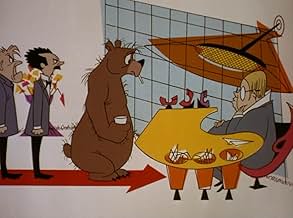
Now the primary concept of a bear finding himself in a factory after hibernation does set up the plot of all the company executives stubbornly believing he is a man that needs a shave perfectly. That being said, a few notable differences between the book and film are quite prevalent. Where Tashlin's art style was visually colorless and more subtle in its dry social satire, Jones's bright and stylish presentation makes for a more absurdist manner. It might be safe to say that the book gets its point across stronger than the film as its muted illustrations keep readers focused on the foolishness rather than distract from it. However, the film's take on societal brainwashing is still shown effectively through the cold nature of conformist authority through Jones' bold direction, making this adaptation more of a sincere interpretation rather than a mere imitation verbatim. Certain touches like musical interludes in between the action or the factory itself looking like a surreally dynamic landscape are proof that simple stories like this could make for strong commentary demonstrated through presentation as much as satirical value.
Going beyond the essential content, Paul Frees carries the film in voicing every character (besides Gloria Wood as the singing secretaries) distinctively and triumphantly. As the circumstances escalate higher and higher, Frees' vocal range becomes more pronounced and intense with each passing executive, almost as if the bear is having arguments with various versions of himself. The bear himself is easily the most sympathetic character here due to how much unnecessary hassle he has to go through, making the film's payoff all the more relieving once he comes to term with the lie he was gaslit on. It's really hard to make smug and overly dumb bosses work in media, but the executives shown in the film are delightfully humorous in how willfully blind they are to reality, almost as if Tashlin and Jones were lampooning authoritative ignorance rather than indulging in it. Lastly, composer Dean Elliott blends a solid mix of soothing jazz orchestrations and intense melodies as the film's content gets more and more absurd.
In regards to Tashlin's personal thoughts on this adaptation, I think The Bear That Wasn't lacks the dry nature of the original book in favor of content that's more pronounced and vocally elevated. But with that said, it's still a strong short on its own that elevates its content to an appropriate level of absurdity. Much like Tashlin's book, the humor and social satire are just as appealing to children as they are to adults, and the film has stood the test of time as one of Chuck Jones' more under appreciated solo efforts (at least in terms of adaptations). It's a short as deserving of your time as it is deserving of a brand new restoration.


Did you know
- TriviaThis was MGM's last theatrical animated short. MGM's animation focused on television after this title was released.
- Quotes
Foreman: Alright, you! Coffee break's over. Get back to work!
Bear: [stutters] But, I... I don't work here.
Foreman: You wanna go on report, huh? Do ya?
Bear: [stutters] But, but I don't work here. I'm a bear.
Foreman: A what? A bear? *laughs* A BEAR? OH, BOY! *guffaws*
Foreman's Badge: What an excuse to keep from working! *laughs*
Bear: I -am- a bear.
Foreman: [stops laughing and looks the bear in the eye] Look, bud. Don't give me none of that! You are a silly man who needs a shave and wears a fur coat! And the General Manager's gonna hear of this!
- ConnectionsFeatured in Zomergasten: Episode #16.3 (2003)
Details
- Runtime
- 10m
- Sound mix
- Aspect ratio
- 1.37 : 1