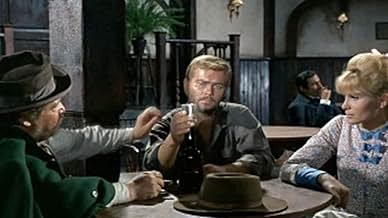
Django's father is framed by his business partner Clusker and shot by a bounty Killer. Django inherits his fathers part of the business and a score to settle with Clusker.Django's father is framed by his business partner Clusker and shot by a bounty Killer. Django inherits his fathers part of the business and a score to settle with Clusker.Django's father is framed by his business partner Clusker and shot by a bounty Killer. Django inherits his fathers part of the business and a score to settle with Clusker.
Glenn Saxson
- Glenn Garvin
- (as Glen Saxson)
- …
Ida Galli
- Jessica Kluster
- (as Evelyn Stewart)
Guido Lollobrigida
- Ward
- (as Lee Burton)
Ettore Arena
- Saloon Guest
- (uncredited)
Fortunato Arena
- Cluster Gunman
- (uncredited)
Bruno Ariè
- Cluster Henchman
- (uncredited)
John Bartha
- Thomas Garvin
- (uncredited)
Augusto Brenna
- Bank Customer
- (uncredited)
Amerigo Castrighella
- Saloon dance costumer
- (uncredited)
6.0693
1
2
3
4
5
6
7
8
9
10
Featured reviews
a solid, entertaining example of the genre
This spaghetti western has a great story-line that grabs you from the get-go, and keeps you interested til the end.
The performances from the actors are about average for the genre. The most recognizable euro-western actor in the film, Fernando Sancho, is OK in this movie, but not as good as he usually is. Of course, one always has to keep in mind that the portrayal is not his alone, since the voice in English is done by someone else.
The movie has a very good spaghetti-style music score, nice camera work, some riveting scenes, and a great revenge plot with some unique elements and a couple of twists. The end was a real kick. I was going to give it a 7 out of 10, but then the ending made me want to push it up a notch.
If you are a fan of spaghetti westerns, and not just the well-known ones, you will most likely really enjoy this one.
The performances from the actors are about average for the genre. The most recognizable euro-western actor in the film, Fernando Sancho, is OK in this movie, but not as good as he usually is. Of course, one always has to keep in mind that the portrayal is not his alone, since the voice in English is done by someone else.
The movie has a very good spaghetti-style music score, nice camera work, some riveting scenes, and a great revenge plot with some unique elements and a couple of twists. The end was a real kick. I was going to give it a 7 out of 10, but then the ending made me want to push it up a notch.
If you are a fan of spaghetti westerns, and not just the well-known ones, you will most likely really enjoy this one.
Another Enjoyable Trip To The Italian West
Easygoing saddle tramp Glenn Saxson finds his father cooling off on the back of a bounty hunter's horse. Killing the bounty hunter, he takes his father's body into town to claim the reward, where he's informed by ambitious local Fernando Sancho, that his dad was actually quite wealthy and set up by his greedy business partner. The two then team up with a mystery man, carrying a switchblade stiletto cane, to take on the murderous big-shot.
Django Shoots First is another colorful, fast-paced spaghetti western. There isn't much new here, but it's a pleasantly entertaining way to spend an hour and a half, with an adequate amount of action, plot-twists, and gun-wielding heavies.
There's also a good score by Ennio Morricone's frequent collaborator Bruno Nicolai and a neat early cameo in the film's final scene, by Italian genre favorite George Eastman, who's minus his distinctive facial hair.
Django Shoots First is another colorful, fast-paced spaghetti western. There isn't much new here, but it's a pleasantly entertaining way to spend an hour and a half, with an adequate amount of action, plot-twists, and gun-wielding heavies.
There's also a good score by Ennio Morricone's frequent collaborator Bruno Nicolai and a neat early cameo in the film's final scene, by Italian genre favorite George Eastman, who's minus his distinctive facial hair.
DJANGO SHOOTS FIRST (Alberto De Martino, 1966) **
This Spaghetti Western isn't as bad as it's been described in "Stracult", a compilation of essays on Italian B-movies that I purchased at the 2004 Venice Film Festival, but it's certainly not anything special either! Glenn Saxson is a cheerful lead in the Errol Flynn vein, which is incongruous for the genre - at least in this early phase, before comedy set in with the Terence Hill/Bud Spencer films!
Still, the revenge/control-of-a-Western-town plot is fairly engaging - though it has nothing whatsoever to do with the original DJANGO (1966; whose 2-Disc LE Set via Blue Underground, incidentally, I should be receiving soon) - and even includes some nice, original touches: Django taking his outlaw father's corpse (after dispatching the bounty hunter who murdered him) to town to pick up the reward money for himself; a "Three Musketeers"-like subplot involving a beautiful but wicked woman (Evelyn Stewart) and her former husband, friend of the hero, who warns him against her; an amusing double-twist at the end in which, first, heroine Erika Blanc outwits a fleeing (i.e. uncommitted) Django, thus making sure that he goes back to her - followed by a reprisal of the film's opening sequence with the arrival of a new gunslinger in town, this time to challenge Django's own authority! The climax, set inside a graveyard, is also effective - as is Bruno Nicolai's bouncy score.
Having said that, the film is too slowly-paced and, even at a little over 90 minutes, it feels protracted - particularly the silly bar-room brawl towards the end!
Still, the revenge/control-of-a-Western-town plot is fairly engaging - though it has nothing whatsoever to do with the original DJANGO (1966; whose 2-Disc LE Set via Blue Underground, incidentally, I should be receiving soon) - and even includes some nice, original touches: Django taking his outlaw father's corpse (after dispatching the bounty hunter who murdered him) to town to pick up the reward money for himself; a "Three Musketeers"-like subplot involving a beautiful but wicked woman (Evelyn Stewart) and her former husband, friend of the hero, who warns him against her; an amusing double-twist at the end in which, first, heroine Erika Blanc outwits a fleeing (i.e. uncommitted) Django, thus making sure that he goes back to her - followed by a reprisal of the film's opening sequence with the arrival of a new gunslinger in town, this time to challenge Django's own authority! The climax, set inside a graveyard, is also effective - as is Bruno Nicolai's bouncy score.
Having said that, the film is too slowly-paced and, even at a little over 90 minutes, it feels protracted - particularly the silly bar-room brawl towards the end!
Serviceable spaghetti saga
This has nothing to do with the Franco Nero "Django" movie, though I'm pretty sure you already know that. Though this "Django" movie is not up to the Nero movie, it is a competent little spaghetti western. Certainly, it's not perfect. A number of characters are stereotypes found in other spaghetti westerns, like the goofy bearded tubby fellow who helps the protagonist. The hero is kind of smug and arrogant at times. There is a minimum of plot, which is really evident when things are wrapped up for the most part long before the very end. On the other hand, the movie does have a nice musical score, sports some good scenes of action as well as moments of suspense, and doesn't have any boring sequences. There is also a twist at the end that I didn't see coming. The movie doesn't break new ground, but it's adequate for spaghetti western fans.
Almost a good Spaghetti Western
As most genre fans expect, there's no overlap between this incarnation of a Django and Franco Nero's original. Glenn Saxon straddles the fence between laconic and dull in the wronged hero role. The plot begins with a clever twist on his revenge motive, but meanders for most of its duration. After the natural point for a rousing and satisfying ending, the film drags on for about 15 minutes to accomplish what should have taken 3-5, at most. That drops this below the average for these generally enjoyable, even when not memorable, imported oaters.
Did you know
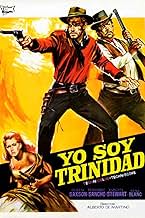
- TriviaThis fake sequel of Django (1966) was released in Spain in 1974 with the title "Yo soy Trinidad" (I'm Trinity), after the success of They Call Me Trinity (1970), changing the name of the main character in the dubbing, calling him Trinidad (Trinity) instead of Django.
- ConnectionsFollowed by Return of Django (1967)
- How long is Django Shoots First?Powered by Alexa
Details
Contribute to this page
Suggest an edit or add missing content