IMDb RATING
7.2/10
7.5K
YOUR RATING

Rescued from abandonment and raised by the King and Queen, Oedipus is still haunted by a prophecy--he'll murder his father and marry his mother.Rescued from abandonment and raised by the King and Queen, Oedipus is still haunted by a prophecy--he'll murder his father and marry his mother.Rescued from abandonment and raised by the King and Queen, Oedipus is still haunted by a prophecy--he'll murder his father and marry his mother.
- Director
- Writers
- Stars
- Awards
- 4 wins & 4 nominations total






Giovanni Ivan Scratuglia
- Sacerdote
- (as Ivan Scratuglia)


Laura Betti
- Jocasta's Maid
- (uncredited)

Pier Paolo Pasolini
- High Priest
- (uncredited)

Isabel Ruth
- Jocasta's Maid with a Lamb
- (uncredited)
- Director
- Writers
- All cast & crew
- Production, box office & more at IMDbPro
7.27.4K
1
2
3
4
5
6
7
8
9
10
Featured reviews
Autobiographical sensorium
This tale of Oedipus starts off and ends in the twentieth century, though for the most part is set in a primitive version of ancient Greece. There is not much rational connection between the stories, but Pasolini manages to forge himself a free pass on that one. Whilst the Oedipus Complex theme of the first story is meant to be taken quite literally, and is basically autobiographical, the middle story, recognisably Sophoclean, is more, in my opinion, meant to be about an angry confused man who cannot stomach his fate nor confront truths about his identity. As both sections do genuinely feel autobiographical they knit together just fine.
The first section of the film set in the 1920s is the best piece of filming I have seen from Pasolini and made me really excited. There's a wide open scene of children running off around a playing field on a hot piercing day, one of those thick childhood days when the emotions battened down the hatches on squire intellect. I was reminded very much of an Edith Sitwell poem (Green Flows the River of Lethe - O):
"I stood near the Cities of the Plains / And the young girls were chasing their hearts like the gay butterflies / Over the fields of summer - / O evanescent velvets fluttering your wings / Like winds and butterflies on the Road from Nothing to Nowhere!"
The sentiment all the more surprisingly apt given that the second part of the film is shot in what could be the ruins of Sodom and Gomorrah (the Cities of the Plains) for all we know.
The rage of Oedipus, which occurs frequently in the movie could be liked to another part of the poem:
"But in the summer drought / I fled, for I was a Pillar of Fire, I was destruction / Unquenched, incarnate and incarnadine // I was Annihilation / Yet white as the Dead Sea, white as the Cities of the Plains / For I listened to the noontide and my veins / That threatened thunder and the heart of roses."
Part of Pasolini's drive for shooting the films seems to be to continue his fascination with ancient buildings and ruins which he demonstrated three years earlier in his superb 1964 documentary The Walls of Sana'a for which he travelled to Yemen.
The end of the playing field scene features Jocasta suckling Oedipus. She gazes directly at the camera and thus the audience for a long period, in which she goes through a range of emotions, including what could be arousal, followed by disquiet, which ultimately turns into a distanced understanding. For me this is cinematically equivalent to the Mona Lisa, which is also a gay man's meditation on his mother, greatly cryptic yet provocative, set in against a natural backdrop.
Silvana Mangano, who plays the mother in both parts of the movie (and would star in Pasolini's Teorema the following year), carries a lot of it. Her beauty, her alabaster skin and wispy eyebrows, her perfectly tangled plaits (which would send Fuseli to his knees), are commanding. She has an artistic skill that eclipses that of Franco Citti (Oedipus) and Ninetto Davoli (Thebes' crier) quite totally. Franco Citti's lack of skill, whilst occasionally infuriating in the context of the story (his is not the demeanour of a king) do however lend the film a level of authenticity, given the primary motive of this sequence, which was to demonstrate a pained adolescent fury and denial, which was ignorant at its base.
There's an unusual device of writing characters' thoughts in black lettering on a white background, which doesn't quite work but which would be far better than the presumable alternative of camera-faced soliloquies.
Some of the locations in the movie felt truly dream-like to me, for instance the unkempt walled piazza-garden of Jocasta, the crumbled ruin where Oedipus meets a naked adolescent girl on his peregrinations, the mountainous areas between cities.
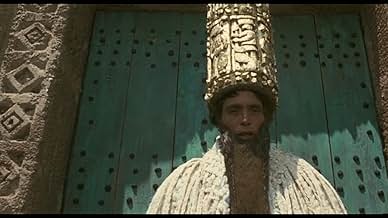
The props in the movie are cheap and fantastical but quite brilliant, the wind-blown hands on the milestones to Thebes, the quite bizarre head gear of the Pythoness, the soldiers, and King Laius. Modern producers who delight in throwing money at movies, please note how Pasolini achieves far better results with great economy.
Cultural references abound, my favourite being the Japanese music, which doesn't seem to have been referenced anywhere (there are no closing credits in the movie), but sounded very much like the Toru Takemitsu scores of Ansatsu (Assasination), Woman in the Dunes, and Harakiri.
The story in a strict narrative sense has problems, Citti doesn't convince as any type of king or warrior, giving the appearance of not understanding his lines at some points, and the suicide of Jocasta makes no sense in the wake of her discussions with her son. It is a movie where feeling rather than thinking brings greater rewards.
The first section of the film set in the 1920s is the best piece of filming I have seen from Pasolini and made me really excited. There's a wide open scene of children running off around a playing field on a hot piercing day, one of those thick childhood days when the emotions battened down the hatches on squire intellect. I was reminded very much of an Edith Sitwell poem (Green Flows the River of Lethe - O):
"I stood near the Cities of the Plains / And the young girls were chasing their hearts like the gay butterflies / Over the fields of summer - / O evanescent velvets fluttering your wings / Like winds and butterflies on the Road from Nothing to Nowhere!"
The sentiment all the more surprisingly apt given that the second part of the film is shot in what could be the ruins of Sodom and Gomorrah (the Cities of the Plains) for all we know.
The rage of Oedipus, which occurs frequently in the movie could be liked to another part of the poem:
"But in the summer drought / I fled, for I was a Pillar of Fire, I was destruction / Unquenched, incarnate and incarnadine // I was Annihilation / Yet white as the Dead Sea, white as the Cities of the Plains / For I listened to the noontide and my veins / That threatened thunder and the heart of roses."
Part of Pasolini's drive for shooting the films seems to be to continue his fascination with ancient buildings and ruins which he demonstrated three years earlier in his superb 1964 documentary The Walls of Sana'a for which he travelled to Yemen.
The end of the playing field scene features Jocasta suckling Oedipus. She gazes directly at the camera and thus the audience for a long period, in which she goes through a range of emotions, including what could be arousal, followed by disquiet, which ultimately turns into a distanced understanding. For me this is cinematically equivalent to the Mona Lisa, which is also a gay man's meditation on his mother, greatly cryptic yet provocative, set in against a natural backdrop.
Silvana Mangano, who plays the mother in both parts of the movie (and would star in Pasolini's Teorema the following year), carries a lot of it. Her beauty, her alabaster skin and wispy eyebrows, her perfectly tangled plaits (which would send Fuseli to his knees), are commanding. She has an artistic skill that eclipses that of Franco Citti (Oedipus) and Ninetto Davoli (Thebes' crier) quite totally. Franco Citti's lack of skill, whilst occasionally infuriating in the context of the story (his is not the demeanour of a king) do however lend the film a level of authenticity, given the primary motive of this sequence, which was to demonstrate a pained adolescent fury and denial, which was ignorant at its base.
There's an unusual device of writing characters' thoughts in black lettering on a white background, which doesn't quite work but which would be far better than the presumable alternative of camera-faced soliloquies.
Some of the locations in the movie felt truly dream-like to me, for instance the unkempt walled piazza-garden of Jocasta, the crumbled ruin where Oedipus meets a naked adolescent girl on his peregrinations, the mountainous areas between cities.
The props in the movie are cheap and fantastical but quite brilliant, the wind-blown hands on the milestones to Thebes, the quite bizarre head gear of the Pythoness, the soldiers, and King Laius. Modern producers who delight in throwing money at movies, please note how Pasolini achieves far better results with great economy.
Cultural references abound, my favourite being the Japanese music, which doesn't seem to have been referenced anywhere (there are no closing credits in the movie), but sounded very much like the Toru Takemitsu scores of Ansatsu (Assasination), Woman in the Dunes, and Harakiri.
The story in a strict narrative sense has problems, Citti doesn't convince as any type of king or warrior, giving the appearance of not understanding his lines at some points, and the suicide of Jocasta makes no sense in the wake of her discussions with her son. It is a movie where feeling rather than thinking brings greater rewards.
The story of Oedipus told in comedic, violent and surreal vignettes
Pier Paolo Pasolini's Oedipus Rex is a relatively faithful adaptation of Sophocles' Greek tragedy Oedipus the King. Beginning in 1920's Italy, a baby boy is born and is instantly envied by the displaced father. The setting then changes to ancient times, where a baby boy is being carried out into the desert by a servant to be left out to die from exposure. He is eventually picked up by a shepherd, who takes him back to the King and Queen of Corinth, who adopt the youngster and love him like one of their own. The child grows up to be Edipo (Pasolini's frequent collaborator Franco Citti), an arrogant youth who wishes to see the world for himself. And so he set out on the road to Thebes, the place of his birth.
Plagued by a prophecy that dictates he is destined to murder his father and marry his mother, Edipo is a tortured but intuitive soul. He murders a rich man and his guards after they demand he clear a path for them on the road, and later frees a town from the clutches of a Sphinx by solving its riddle. Staying true to his own recognisable style, Pasolini tells the story of Oedipus not with a sweeping narrative, but through a collection of comedic, violent and often surreal vignettes, the most bizarre and ultimately thrilling being the scene in which Edipo murders the guards. He runs away from them as they chase him, before charging at them one by one and cutting them down. It's a moment without any real motivational insight, offering but a glimpse into Edipo's damaged psyche.
Post-Freud, the story of Oedipus cannot be experienced without reading into the incestuous and patricidal undertones. But these themes are less explored by Pasolini than the idea of Edipo being ultimately responsible for his own downfall. Rather than the inevitability of fate, Edipo creates his own path, committing murder on a whim and marrying while blinded by ambition. For a bulk of the film, Pasolini keeps the audience at arm's length, favouring his own brushes of surrealism over a traditional narrative. While this may be occasionally frustrating - the pre-war scenes than book-end the film seem out of place and confusing - Citti's wide-eyed performance is a fantastic distraction, and the Moroccan scenery helps provide a ghostly, Biblical atmosphere as well as a beautiful backdrop.
Plagued by a prophecy that dictates he is destined to murder his father and marry his mother, Edipo is a tortured but intuitive soul. He murders a rich man and his guards after they demand he clear a path for them on the road, and later frees a town from the clutches of a Sphinx by solving its riddle. Staying true to his own recognisable style, Pasolini tells the story of Oedipus not with a sweeping narrative, but through a collection of comedic, violent and often surreal vignettes, the most bizarre and ultimately thrilling being the scene in which Edipo murders the guards. He runs away from them as they chase him, before charging at them one by one and cutting them down. It's a moment without any real motivational insight, offering but a glimpse into Edipo's damaged psyche.
Post-Freud, the story of Oedipus cannot be experienced without reading into the incestuous and patricidal undertones. But these themes are less explored by Pasolini than the idea of Edipo being ultimately responsible for his own downfall. Rather than the inevitability of fate, Edipo creates his own path, committing murder on a whim and marrying while blinded by ambition. For a bulk of the film, Pasolini keeps the audience at arm's length, favouring his own brushes of surrealism over a traditional narrative. While this may be occasionally frustrating - the pre-war scenes than book-end the film seem out of place and confusing - Citti's wide-eyed performance is a fantastic distraction, and the Moroccan scenery helps provide a ghostly, Biblical atmosphere as well as a beautiful backdrop.
Authenticity is not the issue
We do ourselves no favour by fixating on how well a film uses every little detail and line in an original text. Certainly, by those standards this is a mediocre, and possibly lazy, film at best. But at the same time there is the problem of being so liberal in one's adaptation that every goes sour, the latest attempt at "Vanity Fair" is a perfect example. But this film, along with Bresson's "Pickpocket," should stand as the rules of adaptation for every young director. Both films are very interpretative, but the directors aren't so naive as to think that mere plot details can constitute a film. So what pushes this film beyond a mere surface-level adaptation? In this case, it takes a deep insight into the nature of Greek tragedy itself. Tragedy's dualism (the representational and the chaotic) is prevalent in all Pasolini's works, it was especially essential in his "Gospel," and I was excited to see how it played out in its own source, and the results are absolutely fantastic. Visually imaginative and so intellectually superior to its contemporaries it seems out of place in film.
5 out of 5 - Essential
5 out of 5 - Essential
past events and just who did what with whom and for why become rather wearing.
The early and late sequences filmed within Italy are some of the best Pasolini has filmed. His confident and measured pace as well as his eye for composition and love of such basics as trees and sky and grass are a joy to behold. As for the rest, it can be very taxing. The Moroccan desert and mountain scenery is wondrous and the placing and movement of large numbers of peoples impressive but there is a lot of ponderous and somewhat languorous adherence to this titular tale. The associated screaming and passionate pondering as to the ins and outs of past events and just who did what with whom and for why become rather wearing.
Hauntingly beautiful!
I was very impressed, I really do think that this is a masterpiece! Pasolini used the original text of Sophocles' tragedy, so the story is tightly knotted, which gives the whole film a tangible urgency. There are, apart from the at times stunning amounts of extra's, only two main actors. Silvana Mangano as Giocasta only appears halfway through the movie and has hardly any lines, but she plays her part impressively by her facial expressions and her stature. Franco Citti as Oedipus is the absolute core of the movie, he dominates the screen with his rugged and fascinating face, he laughs and cries and screams, and all the time stays totally convincing as the self-assured ego-tripping hero, who gradually slips into the awareness that his whole life is based on unspeakable crimes and that he is toyed with by the gods and fate. Some reviewers opinioned he acted way over the top, but I assume it was all deliberately so orchestrated by Pasolini, emphasizing the origin of a Greek tragedy that had to be delivered from an open-air rostrum to a distant audience.
The locations are dazzlingly beautiful, Morocco in fact, not Greece, but it works wonderfully well, as do the weird costumes which look like they were sowed and tinkered by the crew or the many locals themselves, but with the amazing effect of something out of a dream (or nightmare). The musical score is extremely subtle, at many times just the soft bleak rhythmic blows of a single drumstick, with an almost haunting effect.
Strangely enough the prologue and epilogue are set in modern times, this doesn't add anything as far as I'm concerned, but as it was it gives us yet some other beautiful images, with the same vast green lawns and waving tree-tops in the opening and closing scene, completing a perfect circle.
The locations are dazzlingly beautiful, Morocco in fact, not Greece, but it works wonderfully well, as do the weird costumes which look like they were sowed and tinkered by the crew or the many locals themselves, but with the amazing effect of something out of a dream (or nightmare). The musical score is extremely subtle, at many times just the soft bleak rhythmic blows of a single drumstick, with an almost haunting effect.
Strangely enough the prologue and epilogue are set in modern times, this doesn't add anything as far as I'm concerned, but as it was it gives us yet some other beautiful images, with the same vast green lawns and waving tree-tops in the opening and closing scene, completing a perfect circle.


Did you know
- ConnectionsEdited into Days of Nietzsche in Turin (2001)
- How long is Oedipus Rex?Powered by Alexa
Details
- Release date
- Countries of origin
- Languages
- Also known as
- Edipo, el hijo de la fortuna
- Filming locations
- Production companies
- See more company credits at IMDbPro
Box office
- Gross worldwide
- $2,364
- Runtime
- 1h 44m(104 min)
- Aspect ratio
- 1.85 : 1
Contribute to this page
Suggest an edit or add missing content