
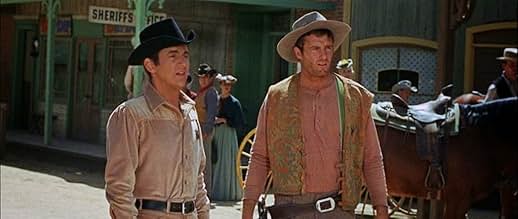
A sheriff, haunted by the accidental killing of his best friend, refuses to wear a gun. But when the brother of his best friend is murdered, the lawman must make a choice.A sheriff, haunted by the accidental killing of his best friend, refuses to wear a gun. But when the brother of his best friend is murdered, the lawman must make a choice.A sheriff, haunted by the accidental killing of his best friend, refuses to wear a gun. But when the brother of his best friend is murdered, the lawman must make a choice.
- Director
- Writers
- Stars


- Director
- Writers
- All cast & crew
- Production, box office & more at IMDbPro
5.6580
1
2
3
4
5
6
7
8
9
10
Featured reviews
Solid Western well worth a look
Besides one other Western, Journey to Shiloh' (1968) and the obscure early effort Lonnie' (1963), William Hale has worked principally in TV since the start of his career. This is a shame as from the evidence of Gunfight in Abeline' at least, he is able to work comfortably in a major genre with none of the small screen inhibitions which seems to affect directors who cross over.
The present film was received indifferently by critics upon its first appearance and it is hard to see why. While no masterpiece, it is a solid, engaging piece of work, offering Darin one of his finest and most dramatic roles. When one remembers the dull screen impression made by his nearest equivalent in Westerns, that of Audie Murphy (another actor who died relatively young), Darin's considerably more interesting screen persona seems to have been badly wasted. Add to his acting abilities as a vocalist and songwriter - as evidenced by the memorable ballad Amy' over which the credits of this film play out Darin's versatility is very interesting. In fact he was briefly marketed by the ever hopeful studio as the "new Sinatra".
In Abeline' Darin plays Cal Wayne, a man haunted by two accidents: that of the injury of Grant Evers' arm when they where children, and of the death of Evers' brother during a skirmish during the Civil War. Evers' arm is a constant reminder of Wayne's incipient guilt, as well as suggesting the cattle magnate's unfeeling morality. But Evers is no simple black hearted villain. He has behaved with perfect honour towards his intended bride Amy and, although a ruthless businessman, initially at least strives to avoid confrontation and violence with the farming lobby. Far more reprehensible is his henchman Jack Slade, and the mutual distaste between the two is always evident. (The difference is particularly noteworthy when Slade upbraids Evers for his weakness in paying compensation to the farmers for his early trespassing and crop destruction.) Even Evers' final act of violence towards Wayne is one generated through impulsiveness, as the now-sherriff confesses how he killed his employer's brother.
Abeline' builds a compact and satisfying Western drama, albeit small-scale, around the Wayne-Amy-Evers-Slade relationships, and Hale's widescreen compositions, his dollying and tracking are very effective without drawing attention to themselves. Most noticeable is the final showdown. Here he employs some off-centred camera angles to frame the boastful Slade, while the montage of facial shots accompanying the ultimate draw anticipates some of the flamboyance of Leone.
This is a film which is entirely successful in its own rewarding and modest terms, and only fails being memorable by an absence of more colourful supporting actors. Neilsen too (acting straight here, long before the days of 'Airplane!')lacks a certain charisma and some of the film comes across as being slightly glum. If Hale had been able to add a Brennan or a Devine into the mix, them the results could have been marvellous. Instead we have a Western drama well worth seeking out, as a traditional, effective genre outing.
The present film was received indifferently by critics upon its first appearance and it is hard to see why. While no masterpiece, it is a solid, engaging piece of work, offering Darin one of his finest and most dramatic roles. When one remembers the dull screen impression made by his nearest equivalent in Westerns, that of Audie Murphy (another actor who died relatively young), Darin's considerably more interesting screen persona seems to have been badly wasted. Add to his acting abilities as a vocalist and songwriter - as evidenced by the memorable ballad Amy' over which the credits of this film play out Darin's versatility is very interesting. In fact he was briefly marketed by the ever hopeful studio as the "new Sinatra".
In Abeline' Darin plays Cal Wayne, a man haunted by two accidents: that of the injury of Grant Evers' arm when they where children, and of the death of Evers' brother during a skirmish during the Civil War. Evers' arm is a constant reminder of Wayne's incipient guilt, as well as suggesting the cattle magnate's unfeeling morality. But Evers is no simple black hearted villain. He has behaved with perfect honour towards his intended bride Amy and, although a ruthless businessman, initially at least strives to avoid confrontation and violence with the farming lobby. Far more reprehensible is his henchman Jack Slade, and the mutual distaste between the two is always evident. (The difference is particularly noteworthy when Slade upbraids Evers for his weakness in paying compensation to the farmers for his early trespassing and crop destruction.) Even Evers' final act of violence towards Wayne is one generated through impulsiveness, as the now-sherriff confesses how he killed his employer's brother.
Abeline' builds a compact and satisfying Western drama, albeit small-scale, around the Wayne-Amy-Evers-Slade relationships, and Hale's widescreen compositions, his dollying and tracking are very effective without drawing attention to themselves. Most noticeable is the final showdown. Here he employs some off-centred camera angles to frame the boastful Slade, while the montage of facial shots accompanying the ultimate draw anticipates some of the flamboyance of Leone.
This is a film which is entirely successful in its own rewarding and modest terms, and only fails being memorable by an absence of more colourful supporting actors. Neilsen too (acting straight here, long before the days of 'Airplane!')lacks a certain charisma and some of the film comes across as being slightly glum. If Hale had been able to add a Brennan or a Devine into the mix, them the results could have been marvellous. Instead we have a Western drama well worth seeking out, as a traditional, effective genre outing.
Run-of-the-mill and standard Western about usual confrontation between cattlemen and homesteaders
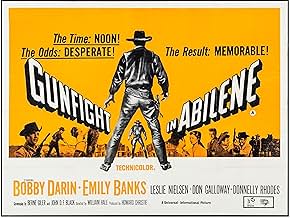
The film is set post civil war (181-1865) in Abilene (a biblical name meaning city of the plains ) , the pattern of the other celebrated cow towns of the Old west . Batting in the Civil War a soldier called Cal Wayne (Bobby Darin) accidently murders his friend. Going back Abilene after the American Civil war he finds his previous girlfriend about to marry the brother (Leslie Nielsen) of the man he murdered . To pay his debt he not only refuses to win her back but takes the job of Marshall , a job he doesn't wishes , when the brother asks him . Later on , Darin becomes the brave sheriff of Abilene and along with his deputy are fighting to stifle the conflicts between homesteaders , cattlemen and a wealthy owner who hire gunfighters . Along the way he develops a loving triangle between two beautiful girls : Amy Martin ( Emily Banks) and Leann (Barbara Werle). The time: Noon! The odds: Desperate ! The result: Memorable !
The picture gets Western action , shootouts , go riding , a love story , and results to be quite entertaining . It's a medium budget film with acceptable actors , technicians, production values and pleasing results . Although it has some stock footage , such as the prison scene near the riverboat and the battle scene in the beginning of the movie , being taken from the 1965 film , Shenandoah directed by Andrew MacLagen with James Stewart . The flick is totally set in Abilene (Kansas) which was the first of the major railhead cattle towns , and including ordinary problems between the ranchers and the farmers . From 1867 to 1872 it was a booming depot , shipping some one million Texas Longhorns by railroad to Kansas City and Chicago and meat markets in the East . The place was selected as a terminus for Texas cattle drives in 1867 . Then the long drives began from Texas over the Chisholm trail . At trail's end in Abilene the rowdy,free-spending cowboys attracted saloon keepers, gamblers , brothels and all types of frontier riff-raff , the town became notorious for its lawlessness . Gunmen were hired for a time to keep the peace in Abilene . With the numerous presence of homesteaders the town prospered , stabilized and grew , its lawabiding citizens decided to discourage the troublesome cattle trade with his transient cowboys and early requested the Texas cattlemen to drive their herds elsewhere , which they soon did and Abilene's role as a wild cow town came to an abrupt ending.
Bobby Darin gives a decent acting as a good guy haunted by a killing refusing to carry a gun , but , subsequently , he straps on a pistol and heads after the cutthroats . Darin was a successful singer and song composer . His music career started out with writing songs and taking demos around to different music producers . His next goal was to make a movie, and that opportunity came in 1960 with the film Come September (1961), for which he also wrote the title song. The movie was filmed in Rome and that's where he met Sandra Dee. She was 16 years old and at the top of her career. They were engaged two months after they met and their son, Dodd Darin, was born a year later. Bobby continued to perform in night clubs and make movies. In 1964 he was nominated for an Academy Award for Best Supporting Actor in Captain Newman (1963). Despite very good reviews, he lost the Oscar to Melvyn Douglas. He went in for heart surgery in 1971 and from that point on he had bouts of ill health. After his recovery he continued to do nightclub acts and the next years singing , until his early death at 37 . He did a popular summer variety show called The Bobby Darin Show (1973) and played other films such as : Run stranger run , The happy end , Cop-out , Hell is for heroes , Pressure point and State Fair . Co-stars the great Leslie Nielsen . His acting career started at a much earlier age when he was forced to lie to his father in order to avoid severe punishment. Leslie starred in over fifty films and many more television films . Oustanding in comedy genre in which he delivered sophomoric punchlines with a deadpan expression, being nicknamed "the Laurence Olivier of spoofs" . He played all kinds of genres as Sci-Fi , Western , and drama , such as Harlow , Forbidden planet , The reluctant astronaut , Resurrection of Zachary Wheeler , Four rode out , The Amsterdam kill , Project kill , Creepshow , Prom night ; but he performed comedy especially , such as : Camouflage , 2001 a space travesty , Wrongfully accused , Mr. Magoo , Dracula : dead and loving , Repossessed , Naked gun : From the files of police squad , Naked gun : The smell of fear , Naked gun : final insult . Support cast is pretty good , including various familar faces , such as : Donnelly Rhodes , Don Galloway , Frank McGrath ,Don Dubbins , Ross Hagen ,Bryan O'Byrne and Michael Sarrazin's film debut .
Enjoyable music by Bobby Darin himself and uncredited Shorty Rogers . Colorful and shimmering cinematography by director of photography Maury Gertsman , Universal International Picture's ordinary . The motion picture was directed in sure visual eye by William Hale , though it has flaws and gaps , being a bit boring . He realized a variety films of all kind of genres , such as : One shoe makes it murder , Stalk the wild child , Journey to Shiloh , Murder in Texas , though especially made TV episodes from famous series , such as : The time tunnel , The invaders , The streets of San Francisco, Kojak , Cannon , Fugitive , Judd for the Defense , Lancer , The Virginian , FBI , Night Gallery . Rating . 5.5/10 , acceptable and passable .
The picture gets Western action , shootouts , go riding , a love story , and results to be quite entertaining . It's a medium budget film with acceptable actors , technicians, production values and pleasing results . Although it has some stock footage , such as the prison scene near the riverboat and the battle scene in the beginning of the movie , being taken from the 1965 film , Shenandoah directed by Andrew MacLagen with James Stewart . The flick is totally set in Abilene (Kansas) which was the first of the major railhead cattle towns , and including ordinary problems between the ranchers and the farmers . From 1867 to 1872 it was a booming depot , shipping some one million Texas Longhorns by railroad to Kansas City and Chicago and meat markets in the East . The place was selected as a terminus for Texas cattle drives in 1867 . Then the long drives began from Texas over the Chisholm trail . At trail's end in Abilene the rowdy,free-spending cowboys attracted saloon keepers, gamblers , brothels and all types of frontier riff-raff , the town became notorious for its lawlessness . Gunmen were hired for a time to keep the peace in Abilene . With the numerous presence of homesteaders the town prospered , stabilized and grew , its lawabiding citizens decided to discourage the troublesome cattle trade with his transient cowboys and early requested the Texas cattlemen to drive their herds elsewhere , which they soon did and Abilene's role as a wild cow town came to an abrupt ending.
Bobby Darin gives a decent acting as a good guy haunted by a killing refusing to carry a gun , but , subsequently , he straps on a pistol and heads after the cutthroats . Darin was a successful singer and song composer . His music career started out with writing songs and taking demos around to different music producers . His next goal was to make a movie, and that opportunity came in 1960 with the film Come September (1961), for which he also wrote the title song. The movie was filmed in Rome and that's where he met Sandra Dee. She was 16 years old and at the top of her career. They were engaged two months after they met and their son, Dodd Darin, was born a year later. Bobby continued to perform in night clubs and make movies. In 1964 he was nominated for an Academy Award for Best Supporting Actor in Captain Newman (1963). Despite very good reviews, he lost the Oscar to Melvyn Douglas. He went in for heart surgery in 1971 and from that point on he had bouts of ill health. After his recovery he continued to do nightclub acts and the next years singing , until his early death at 37 . He did a popular summer variety show called The Bobby Darin Show (1973) and played other films such as : Run stranger run , The happy end , Cop-out , Hell is for heroes , Pressure point and State Fair . Co-stars the great Leslie Nielsen . His acting career started at a much earlier age when he was forced to lie to his father in order to avoid severe punishment. Leslie starred in over fifty films and many more television films . Oustanding in comedy genre in which he delivered sophomoric punchlines with a deadpan expression, being nicknamed "the Laurence Olivier of spoofs" . He played all kinds of genres as Sci-Fi , Western , and drama , such as Harlow , Forbidden planet , The reluctant astronaut , Resurrection of Zachary Wheeler , Four rode out , The Amsterdam kill , Project kill , Creepshow , Prom night ; but he performed comedy especially , such as : Camouflage , 2001 a space travesty , Wrongfully accused , Mr. Magoo , Dracula : dead and loving , Repossessed , Naked gun : From the files of police squad , Naked gun : The smell of fear , Naked gun : final insult . Support cast is pretty good , including various familar faces , such as : Donnelly Rhodes , Don Galloway , Frank McGrath ,Don Dubbins , Ross Hagen ,Bryan O'Byrne and Michael Sarrazin's film debut .
Enjoyable music by Bobby Darin himself and uncredited Shorty Rogers . Colorful and shimmering cinematography by director of photography Maury Gertsman , Universal International Picture's ordinary . The motion picture was directed in sure visual eye by William Hale , though it has flaws and gaps , being a bit boring . He realized a variety films of all kind of genres , such as : One shoe makes it murder , Stalk the wild child , Journey to Shiloh , Murder in Texas , though especially made TV episodes from famous series , such as : The time tunnel , The invaders , The streets of San Francisco, Kojak , Cannon , Fugitive , Judd for the Defense , Lancer , The Virginian , FBI , Night Gallery . Rating . 5.5/10 , acceptable and passable .
A re-make marked by a curious miscasting
Though only 11 years had elapsed since the release of "Showdown at Abilene," Universal re-made this under the title "Gunfight in Abilene" with, surprisingly, Bobby Darin taking over the Jock Mahoney role. It's an unexpected casting which does not pay off since Darin seems out of place in a western and he's simply too small and modest to be the kind of tough lawman who could "clean up" a frontier town. In some scenes, he looks even shorter than leading lady, Emily Banks, and whereas Mahoney appeared on the balcony of the Abilene hotel gloriously bare-chested -- showing off his impressive physique but wearing his pants high enough to hide his navel -- Darin plays this same scene with his shirt on though open a bit at the top. (When Darin wakes up from a nightmare in a brief and dimly-lit scene, however, he's bare-chested whereas Mahoney, in a comparable scene, wears an undershirt.) On the plus side, Darin did contribute a song, "Amy," which is sung under the opening credits and which, though undistinguished, is pleasant enough and which today -- due to a decline in movie-song-writing quality -- might win an Oscar.
The triangular relationship among Jock Mahoney, Lyle Bettger, and Martha Hyer which strengthened the original movie is still of interest here but one can't quite believe that Bobby Darin and Leslie Nielsen had once been close friends.
Though this re-make follows the original quite closely, there are two notable changes. This version begins with a Civil War battle sequence showing Bobby Darin accidentally shooting a friend. Thus the audience knows from the start why the guilt-stricken Darin is reluctant to carry a gun when he returns to Abilene and why he feels he owes a debt to the dead friend's brother. When Darin later confesses the truth to Nielsen, his remarks lack the impact they had in the original version when the audience did NOT know what had happened back in the Civil War battle.
The other change is also questionable. In the new version there's a young blonde woman in Abilene who has a crush on Darin and who pops up in a few scenes. This character does not appear in the original version and she adds nothing to the story.
The re-make is superior to the original in two respects, however. Donnelly Rhodes makes a much more convincing "bad guy" than Ted de Corsia, and Michael Sarrazin's whipping is more effectively staged than Grant Williams' whipping in the 1956 version. Sarrazin is stripped of his shirt and subjected to more punishment and taunts than Williams who, for some inexplicable reason, is allowed to keep his shirt on while being flogged, even though he has a pleasing physique -- as was proved in "The Incredible Shrinking Man" -- and even though Universal had begun to groom him for his "hunk" appeal.
Finally, all the character names from the 1956 version have been changed for the 1967 one.
The triangular relationship among Jock Mahoney, Lyle Bettger, and Martha Hyer which strengthened the original movie is still of interest here but one can't quite believe that Bobby Darin and Leslie Nielsen had once been close friends.
Though this re-make follows the original quite closely, there are two notable changes. This version begins with a Civil War battle sequence showing Bobby Darin accidentally shooting a friend. Thus the audience knows from the start why the guilt-stricken Darin is reluctant to carry a gun when he returns to Abilene and why he feels he owes a debt to the dead friend's brother. When Darin later confesses the truth to Nielsen, his remarks lack the impact they had in the original version when the audience did NOT know what had happened back in the Civil War battle.
The other change is also questionable. In the new version there's a young blonde woman in Abilene who has a crush on Darin and who pops up in a few scenes. This character does not appear in the original version and she adds nothing to the story.
The re-make is superior to the original in two respects, however. Donnelly Rhodes makes a much more convincing "bad guy" than Ted de Corsia, and Michael Sarrazin's whipping is more effectively staged than Grant Williams' whipping in the 1956 version. Sarrazin is stripped of his shirt and subjected to more punishment and taunts than Williams who, for some inexplicable reason, is allowed to keep his shirt on while being flogged, even though he has a pleasing physique -- as was proved in "The Incredible Shrinking Man" -- and even though Universal had begun to groom him for his "hunk" appeal.
Finally, all the character names from the 1956 version have been changed for the 1967 one.
Average Oater with a nice title song
Although this is routine faire, it is interesting to watch Darin and Neilson in a western with an early performance by Michael Sarrazin. The title song "Amy" is nifty, worked into the background music nicely and doesn't wear out it's welcome, as in the case of so many other westerns. The plot is routine, but the action moves the story along to it's predictable conclusion nicely, giving us a good watch.
A good film but pointless re-make
I spent and enjoyable 90 minutes or so watching this film a few months ago and I would have summed this up as a good film and probably given it a higher rating (6-7).
However yesterday I sat down to watch the earlier made "Showdown at Abilene" and for the first 20 minutes had this feeling of "deja-vu". It was then I realised that this was an almost identical re-make of a film that was only 11 years old and wondered why on earth they bothered.
The lead in "Gunfight" is hopelessly miscast; Bobby Darin always seems to come across as a poor-man's Dean Martin and seems to have a constant grin on his face throughout. I am also of the generation that can no longer take Leslie Nielson seriously in ANY film which is a shame as he makes quite a good fist of this role. I am also always uncomfortable watching Michael Sarrazin (although that is an entirely personal thing and admit that this probably has more to do with his "intensity" as an actor than any lack of skill in his trade). Even in this, his first role, he is the stand-out act.
One thing on which I must comment however is Darin's Confederate uniform however is laughable (more Las Vegas than Civil War) and is so tight, he dare not bend over at any time!
To be fair to Gunfight however I thought I should give this another go and then watched the pair back to back.
The original (Showdown) is a much better and much more subtle in its approach to the reasons why he will not carry a gun (I'll say no more for fear of it being a "spoiler"). Had I not seen the earlier film, I would have been quite happy with this version but it is not really a patch on the first one and seems a pointless re-make.
If you have time and love Westerns as much as I do give this a go but if you can only watch one watch the original.
However yesterday I sat down to watch the earlier made "Showdown at Abilene" and for the first 20 minutes had this feeling of "deja-vu". It was then I realised that this was an almost identical re-make of a film that was only 11 years old and wondered why on earth they bothered.
The lead in "Gunfight" is hopelessly miscast; Bobby Darin always seems to come across as a poor-man's Dean Martin and seems to have a constant grin on his face throughout. I am also of the generation that can no longer take Leslie Nielson seriously in ANY film which is a shame as he makes quite a good fist of this role. I am also always uncomfortable watching Michael Sarrazin (although that is an entirely personal thing and admit that this probably has more to do with his "intensity" as an actor than any lack of skill in his trade). Even in this, his first role, he is the stand-out act.
One thing on which I must comment however is Darin's Confederate uniform however is laughable (more Las Vegas than Civil War) and is so tight, he dare not bend over at any time!
To be fair to Gunfight however I thought I should give this another go and then watched the pair back to back.
The original (Showdown) is a much better and much more subtle in its approach to the reasons why he will not carry a gun (I'll say no more for fear of it being a "spoiler"). Had I not seen the earlier film, I would have been quite happy with this version but it is not really a patch on the first one and seems a pointless re-make.
If you have time and love Westerns as much as I do give this a go but if you can only watch one watch the original.


Did you know
- TriviaThe battle scene in the beginning of the film is footage from the 1965 movie, Shenandoah.
- GoofsThe clothing worn by the characters in the film resembles modern Western wear more so than post- Civil War dress. This includes pants with belt loops and shirts with buttons down their entire fronts. Bobby Darin's cowboy hat was the style worn with suits in the 1950s.
- ConnectionsReferenced in Never a Dull Moment (1968)
Details
- Release date
- Country of origin
- Language
- Also known as
- Justicia en Abilene
- Filming locations
- Production company
- See more company credits at IMDbPro
- Runtime
- 1h 26m(86 min)
- Color
- Aspect ratio
- 2.35 : 1
Contribute to this page
Suggest an edit or add missing content