
During a blackout, a New York executive crosses paths with a Broadway actress and her husband.During a blackout, a New York executive crosses paths with a Broadway actress and her husband.During a blackout, a New York executive crosses paths with a Broadway actress and her husband.
- Director
- Writers
- Stars
- Awards
- 1 nomination total




Murray Alper
- Passenger
- (uncredited)

Hy Averback
- Newscaster
- (uncredited)
Larry Barton
- Minor Role
- (uncredited)
- Director
- Writers
- All cast & crew
- Production, box office & more at IMDbPro
5.81K
1
2
3
4
5
6
7
8
9
10
Featured reviews
Where was Doris when her manager approved this script?
Stagy adaptation of Claude Magnier's 1956 French play of the same name incorporates the New York City blackout of 1965 into a stagnant roundelay involving an actress, her husband, an agent plus a young embezzler. Dim comedy doesn't even utilize the central calamity for pointed jokes about life in the Big Apple, instead becoming a strained sitcom plunked down in suburbia. Doris Day never lets a bad script get the best of her; even under the most trying of circumstances, the star gives 100% and usually comes out unscathed. Spoofing her own goody-two-shoes image, Doris gets some laughs later in the picture when she's meant to be (comically) sedated; however, Day's male co-stars (Patrick O'Neal, Robert Morse and Terry-Thomas) are not well-suited to her, and neither is the shapeless hairdo she's sporting. For her part, Doris was quick to dismiss the film as "an alleged comedy", noting it was one of several pictures her husband-manager signed her to without her consent. *1/2 from ****
One of Doris Day's worst comedies uses thin material...
Only the most ardent DORIS DAY fan could find this one even bearable to watch. When one thinks of the wealth of material available for a story about New York City's most famous blackout, a film that could have dealt with numerous real-life stories of what people had to cope with, this scrapes the bottom of the barrel for lack of story-telling originality.
Once again Doris is indignant because she suspects she may have been compromised on the night of the blackout when she returned to her Connecticut lodgings, took a sleeping potion and woke up in the morning with a man who had done the same, wandering into the house by mistake.
Nobody is able to salvage this mess--not Doris, not ROBERT MORSE, TERRY-THOMAS, PATRICK O'NEAL or LOLA ALBRIGHT. As directed by Hy Averback, it's the weakest vehicle Day found herself in, committed to do the film because of her husband's machinations and unable to get out of it. Too bad.
Once again Doris is indignant because she suspects she may have been compromised on the night of the blackout when she returned to her Connecticut lodgings, took a sleeping potion and woke up in the morning with a man who had done the same, wandering into the house by mistake.
Nobody is able to salvage this mess--not Doris, not ROBERT MORSE, TERRY-THOMAS, PATRICK O'NEAL or LOLA ALBRIGHT. As directed by Hy Averback, it's the weakest vehicle Day found herself in, committed to do the film because of her husband's machinations and unable to get out of it. Too bad.
Pants down farce
Doris Day and Patrick O'Neal are husband and wife in this permissive comedy based on a stage play with Terry-Thomas as a stinker, playing a Hungarian but apparently with received pronunciation.
A young man is passed over for promotion by the bosses stupid son so he hatches a plan to steal the companies dividends. When there is a black out in New York, he has difficulty escaping and ends up sleeping with Doris Day.
Its a jolly and pretty well made film and I'm don't really understand all the negative comments. Perhaps because it's a foreign script, or because it's not dripping in gee-schucks All-American schmaltz like the other Doris Day films ?
Product placements - Kodak, The New York Times and Pan- Am. The Kaiser Group (Checker) provided the vehicles, an S series Valiant breaking down.
A young man is passed over for promotion by the bosses stupid son so he hatches a plan to steal the companies dividends. When there is a black out in New York, he has difficulty escaping and ends up sleeping with Doris Day.
Its a jolly and pretty well made film and I'm don't really understand all the negative comments. Perhaps because it's a foreign script, or because it's not dripping in gee-schucks All-American schmaltz like the other Doris Day films ?
Product placements - Kodak, The New York Times and Pan- Am. The Kaiser Group (Checker) provided the vehicles, an S series Valiant breaking down.
Doris betrayed
Although Where Were You When The Lights Went Out is based on a French sex farce I doubt the original play was anything like this film. Especially since there is no French equivalent for Doris Day, no such thing as a virgin, an all French version on their big screen.
I well remember the 1965 blackout on the East Coast, just settling down to dinner with my parents and everything electric went out. But we didn't have half the adventures this cast had.
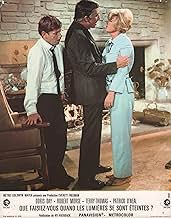
Doris plays herself essentially, an actress with an All American virgin image locked into a long running play with neurotic director Terry-Thomas at the helm and married to Patrick O'Neal an architect. When the blackout strikes there's no evening performance and Doris returns home to find O'Neal with magazine writer Lola Albright who had been doing a feature interview with them before she left for the theater.
In the meantime a jealous Robert Morse being passed over for promotion by his boss Robert Emhardt's idiot son steals two million in cash, something he had been planning for a while. The blackout puts a real crimp into his getaway plan.
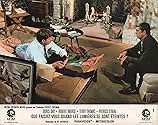
All the principle players manage to wind up at Doris and Pat's Connecticut home and the bedroom comedy begins.
It wasn't the Code that put a damper on this film, it was rather Doris Day and the studio's attempt to remain true to the virginal image that her public expected. This was one of those films toward the end of her career that her husband Marty Melcher put her in to recoup monies he had made bad investments with, her money.
Where Were You When The Lights Went Out has not worn well over the years. Doris was carrying a heavy load here.
I well remember the 1965 blackout on the East Coast, just settling down to dinner with my parents and everything electric went out. But we didn't have half the adventures this cast had.
Doris plays herself essentially, an actress with an All American virgin image locked into a long running play with neurotic director Terry-Thomas at the helm and married to Patrick O'Neal an architect. When the blackout strikes there's no evening performance and Doris returns home to find O'Neal with magazine writer Lola Albright who had been doing a feature interview with them before she left for the theater.
In the meantime a jealous Robert Morse being passed over for promotion by his boss Robert Emhardt's idiot son steals two million in cash, something he had been planning for a while. The blackout puts a real crimp into his getaway plan.
All the principle players manage to wind up at Doris and Pat's Connecticut home and the bedroom comedy begins.
It wasn't the Code that put a damper on this film, it was rather Doris Day and the studio's attempt to remain true to the virginal image that her public expected. This was one of those films toward the end of her career that her husband Marty Melcher put her in to recoup monies he had made bad investments with, her money.
Where Were You When The Lights Went Out has not worn well over the years. Doris was carrying a heavy load here.
A Fairly Standard Comedy for This Particular Time Period
On November 9, 1965 much of the eastern seaboard suffered a power outage and this included huge sections of New York City. To that effect, this film involves several fictional characters who had their lives severely impacted by this development. The first character by the name of "Waldo Zane" (Robert Morse) who works as the treasurer for a large corporation and has just stolen $2 million from it. His escape plan, however, didn't factor in a massive blackout and because of that he winds up at a house in Connecticut trying to get transportation to Boston. In the meantime, an actress on Broadway named "Margaret Garrison" (Doris Day) has had her play cancelled due to the electric shortage and upon heading back to her apartment finds her husband "Peter Garrison" (Robert O'Neal) alone with an attractive journalist by the name of "Roberta Lane" (Lola Albright). Furious at his indiscretion she decides to cancel her planned retirement and heads to her house in Connecticut to consider a divorce. Delighted with this new development her manager "Ladislaus Walichek" (Terry-Thomas) immediately gets in his car and also heads to Connecticut in order to get her to sign a new contract before she changes her mind. Meanwhile, Peter--who is desperate to get back in good graces with his wife--decides to drive to Connecticut to beg for her forgiveness. What he isn't prepared for, however, is the turmoil created when all of the characters show up at his house at around the same time. Now rather than reveal any more I will just say that this was an okay film which had a fairly entertaining plot but was diminished somewhat by rather flat performances by everyone involved. It also didn't help to have the character of Peter Garrison being as unlikeable as he was either. In any case, those interested in a standard comedy from this particular time period might find it amusing to a certain extent and I have rated it accordingly. Average.


Did you know
- TriviaThere appears to be a rights issue tied up with the issuing of this film. While it was a television staple for many years and was released on videocassette several decades ago, it has not been televised or released in digital format since that time. As of 2018, the film has been out of circulation for nearly 25 years.
- GoofsWhen Margaret is sitting on the couch during her interview, the yellow cushions beside her keep moving.
- Quotes
Margaret Garrison: [repeated line]
Margaret Garrison: Hello, Peter, so you're here!
- ConnectionsFeatured in Lionpower from MGM (1967)
- SoundtracksWhere Were You When The Lights Went Out?
Words by Kelly Gordon
Music by Dave Grusin
Performed by The Lettermen
[Title song played over the opening titles and credits, with a reprise played over the end credits]
- How long is Where Were You When the Lights Went Out??Powered by Alexa
Details
- Release date
- Country of origin
- Languages
- Also known as
- Grad u mraku
- Filming locations
- Production company
- See more company credits at IMDbPro
Box office
- Gross US & Canada
- $7,988,000
- Runtime
- 1h 29m(89 min)
- Sound mix
- Aspect ratio
- 2.35 : 1
Contribute to this page
Suggest an edit or add missing content