

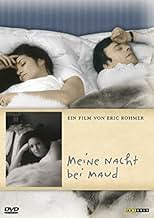
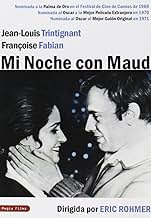
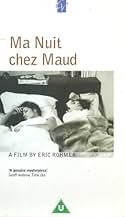
A devout Catholic man's rigid principles are challenged during a one-night stay with Maud, a divorced woman with an outsize personality.A devout Catholic man's rigid principles are challenged during a one-night stay with Maud, a divorced woman with an outsize personality.A devout Catholic man's rigid principles are challenged during a one-night stay with Maud, a divorced woman with an outsize personality.
- Director
- Writer
- Stars
- Nominated for 2 Oscars
- 6 wins & 6 nominations total




- Director
- Writer
- All cast & crew
- Production, box office & more at IMDbPro
Featured reviews
Intellectual meditation of faith
Eric Rohmer's film is full of dialogue. The characters talk and talk, often so intellectually that I had trouble keeping up. But the talk is interesting and intriguing. The main theme (it appeared to me, anyway) is the value of faith in a world where the likelihood of heaven is becoming increasingly unlikely. Jean-Louis, a former ladies man, fights his urges when Maud invites him into her bed. He eventually climbs in, feeling the cold, and begins to kiss her. He eventually pulls away, looking almost angry with himself. He obviously feels that an eternity in heaven, however unlikely the idea is, is worth more than a moment of weakness and happiness.
The dialogue-heavy scenes may not appeal to everyone, it can at times be difficult to engage with the film and bourgeois characters. But it is richly rewarding and a highly intelligent character study. The film has an almost love/hate attitude to the idea of Christianity in a similar way to many of Bergman's greatest films. One of the most intellectually stimulating films of the French New Wave movement.
www.the-wrath-of-blog.blogspot.com
Still fresh
These are among the reasons, I think, for the freshness of the movie. Because the way people talk, cherish their own opinions and express emotions is something which still happens today in human relationships! The film contains exactly situations of the ordinary life -you don't see that movie and think "It's only a film!".
Good performance -as always- of Jean-Louis Trintignant and superb black and white cinematography by Nestor Almendros.
Unique style and rhythm
After Vidal leaves, Maud tells Jean-Louis about her marriage, her ex-husband's Catholic mistress, and the tragic end to her affair with the only man she truly loved. When he is persuaded to avoid a snowstorm and stay overnight, Jean-Louis has to overcome Maud's advances and his own temptations to remain faithful to his ideal mate, a blond, Catholic girl (Marie-Christine Barrault) he recently met at church.
This was the first film I'd seen by Eric Rohmer and it was a puzzle to penetrate the uniqueness of his style and rhythm. Rohmer presents his characters in very natural, almost mundane situations, and heightens the realism by using only natural sounds of the environment. On the surface, the film appears very simple but underneath there is much complexity. Jean-Louis is conflicted between his Catholic principles and his love of sensual pleasure. He lives in a world centered almost entirely on himself, engaging in much philosophizing about choice but never choosing. He operates out of how he "should" or "should not" act rather than out of his experience of what works. When life does not fit his pictures, he deceives himself with endless rationalizations. Through his experience with Maud, however, he is shaken out of need for complete self-control and discovers the epiphany of grace.
Rohmer has a light touch and employs intelligent and witty dialogue to bring his characters to life. In the process, he creates an impersonal elegance that is totally captivating. Rohmer doesn't set out to change our lives just to make us think, and in My Night at Maud's, he succeeds admirably.
The Battlefield of Ideologies
Two men, Jean-Louis and Vidal meet again after 15 years. They decide to go to visit Vidal's friend, Maud. In Maud's apartment the group of three have interesting discussions about Pascal, philosophy, moral and religion. What makes these discussions so interesting is the difference of Vidal, Jean-Louis and Maud. Jean-Louis is a catholic who believes in the holiness of man. Vidal is a Marxist who replaces God with history, he believes in history instead of God. Maud is an atheist, who believes in true short-term happiness. When Vidal leaves the apartment, Jean-Louis gets to a moral dilemma.
Jean-Louis talks a lot about a young blond woman he saw in church, Francoise. He doesn't know anything about her, but she represents religious and an ideal woman to him. Where Maud is the opposite to him. Jean-Louis doesn't believe in short-term happiness. So as he spends the night at Maud's he gets to a moral dilemma. According to his religious beliefs he should resist the temptation of Maud. Again his lie to Francoise is Christian compassion, but it's also a desire to hide his dishonesty.
My Night at Maud's goes very deep. It's not just about what's on surface: the intellectual dialogs and the moral dilemmas. The intelligence of Rohmer goes much deeper. And that is what I like in his films, even if you don't understand everything, the films have something that make you watch them again and again. I'm 17 and when I walked into a dark theater to see this fine film, I was blown away. When the film is over, you have came from a moral journey. So Eric Rohmer's film, obviously doesn't just stop at being the battlefield of ideologies.
Romer at his most conversational
This is the Eric Romer film they warned you about. There is a lot of talk, talk, and more talk. But the talk is very interesting. One of the main topics of discussion is Pascal's famous wager. Pascal believed that if there is even the slightest chance of the Christian heaven being true, then as a matter of probability, one ought to be a believer. Even a minuscule chance of everlasting paradise is worth the bet because infinity (eternity) times even a very small number is infinity. And, of course, if not believing puts one in however small the danger of eternal damnation, then again one should be a believer. But, as Vidal (Antoine Vitez) sagely remarks in the movie, infinity times zero is still zero.
Jean-Louis Trintignant stars as a 34-year-old Catholic mathematician who has a way with women. He runs into his old school chum, Vidal, who introduces him to Maud (Francoise Fabian), who has a way with men. Funny but they don't quite hit it off even though she manipulates him into spending the night with her. Their conversation is witty, subliminal and revealing. Maud believes in the supremacy of love, Jean-Louis in being morally flexible. Although a believing and practicing Catholic, he tells Maud that one is not going against God's will by chasing girls anymore than one is going against God's will by doing mathematics.
The girl that Jean-Louis is currently chasing is 22-year-old Francoise (Maire-Christine Barrault) a blonde, Catholic girl that he has spied at church. At first it seems that although he is certain that she is perfect for him, she is reluctant. They too fence with words as they try to mislead and reveal at the same time, and the audience is intrigued, so much so that at times you might forget you are watching a movie. In this sense a Romer film is like a stage play. Whereas contemporary directors try to get by with as little dialogue as possible, to let the action itself reveal character, Romer is not shy about using dialogue to reveal character, plot, theme--the whole works.
The film begins with a long close shot of Francoise's profile as she listens in church, turning twice briefly to face the camera. She is pretty and intriguing. Although we won't realize it until the movie is mostly over, she is the focal point of the balance between the world views of Jean-Louis and Maud. After the night at Maud's during which Maud uses her intuition and sly intelligence to figure out Jean-Louis's character, he spends the night with Francoise. She uses her instincts to figure out not his character so much as his aptness for her. And then it is revealed how Francoise figures twice in the life of Maud. I won't anticipate the revelation, but be sure and watch for it. Suffice it to say that there are two reasons that Francoise is far from Maud's favorite person! The film ends, as French films often do, with the ironic affirmation of bourgeois values.
For today's DVD hound this movie will play slowly or not at all. The use of dialogue as something over and above the plot and action of the film will seem demanding and perhaps old fashioned. The deliberately drawn out scenes at church may cause you to yawn. But I recommend you stay with it. The movie has a quality that lingers long after the action is gone. The underlying philosophy about the nature of human love and how it conflicts or is compatible with reason and/or religion really does reflect to some extent the quotation above from Pascal, whose spirit is akin, although he denies it, to that of Jean-Louis, the careful protagonist of this very interesting film.
(Note: Over 500 of my movie reviews are now available in my book "Cut to the Chaise Lounge or I Can't Believe I Swallowed the Remote!" Get it at Amazon!)


Did you know
- TriviaJean-Louis Trintignant's character is never called by name in the entire film. He is shown in credits as "Jean-Louis."
- GoofsAfter the night spent at François' student apartment, Jean-Louis Trintignant and Françoise go to church and later talk. For a moment, the boom mic drops into view from the top.
- Quotes
Jean-Louis: Are you still a Marxist?
Vidal: Absolutely. For a Communist, Pascal's wager is very relevant today. Personally, I very much doubt that history has any meaning. Yet I wager that it has, so I'm in a Pascalian situation. Hypothesis A: Society and politics are meaningless. Hypothesis B: History has meaning. I'm not at all sure B is more likely to be true than A. More likely the reverse. Let's even suppose B has a 10% chance of being true and A has 80%. Nevertheless I have no choice but to opt for B, because only the hypothesis that history has meaning allows me to go on living. Suppose I bet on A, and B was true, despite the lesser odds. I'd have thrown away my life. So I must choose B to justify my life and actions. There's an 80% chance I'm wrong but that doesn't matter.
Jean-Louis: Mathematical hope. Potential gain divided by probability. With your hypothesis B, though the probability is slight, the possible gain is infinite. In your case, a meaning to life. In Pascal's, eternal salvation.
Vidal: It was Gorky, Lenin or maybe Mayakovsky who said about the Russian revolution that the situation forced them to choose the one chance in a thousand. Because hope became infinitely greater if you took that chance than if you didn't take it.
- ConnectionsFeatured in The 82nd Annual Academy Awards (2010)
Details
- Release date
- Country of origin
- Official site
- Language
- Also known as
- Moja noć kod gospodjice Mod
- Filming locations
- Production companies
- See more company credits at IMDbPro
Box office
- Gross worldwide
- $11,088
- Runtime
- 1h 45m(105 min)
- Color
- Sound mix
- Aspect ratio
- 1.33 : 1