

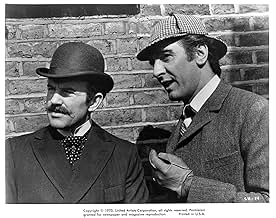
When a bored Holmes eagerly takes the case of Gabrielle Valladon after an attempt on her life, the search for her missing husband leads to Loch Ness and the legendary monster.When a bored Holmes eagerly takes the case of Gabrielle Valladon after an attempt on her life, the search for her missing husband leads to Loch Ness and the legendary monster.When a bored Holmes eagerly takes the case of Gabrielle Valladon after an attempt on her life, the search for her missing husband leads to Loch Ness and the legendary monster.
- Director
- Writers
- Stars
- Awards
- 3 nominations total



Geneviève Page
- Gabrielle Valladon
- (as Genevieve Page)


- Director
- Writers
- All cast & crew
- Production, box office & more at IMDbPro
7.014.5K
1
2
3
4
5
6
7
8
9
10
Featured reviews
Subtle and atmospheric
As a Conan Doyle purist, I had not intended to watch this film when it first appeared on UK TV some years ago. Curiosity overcame me and I switched on at the sequence with Stephens and Genevieve Page on their bicycle. I was immediately fascinated, particularly by the music, which appears to have been specially written for this scene. Elsewhere, in the film, the music is taken from Rozsa's 1956 violin concerto which, unusually, was not written as film music but which partly inspired Wilder to produce the film.
The acting is excellent, particularly by Stephens, slightly less so by Blakely although Watson is probably the most difficult Doylesian character to play. Clive Revill has also been praised for his part. Christopher Lee gives an early display of his impeccable technique. Genevieve Page is perfect in her role and the subtle nuances of her acting are a joy to behold. She also has a beautiful voice, with a wide vocal range.
There is also some brilliant casting. Stanley Holloway as a gravedigger is a witty reference to his playing of that part in Olivier's Hamlet, although his Scottish accent is not the most convincing. Irene Handl made an excellent Mrs Hudson. Frank Thornton was also a fine choice for the tiny part of receptionist at the Diogenes Club. Britons of a certain generation, had they been able to see the missing episodes, would have recognised Noel Johnson as the sea captain in the Naked Honeymooners episode. Johnson had a distinctive and powerful voice and became famous in 1948 as the BBC fictional radio detective Dick Barton.
It is, of course, sad that significant parts of the film have been lost. Nevertheless, In its shortened form, it works well for cinema presentation. Now that domestic DVD players are common, a full-length version would be perfectly acceptable, since viewers would have control over which parts, if any, they might want to skip through. Meanwhile, the German Spy episode in particular stands beautifully on its own. Wilder creates a wonderful feeling of the atmosphere of 1888. The outdoor scenes in Scotland also provide a nostalgic feeling for the year in which filming took place there; presumably 1969 for the 1970 release.
The acting is excellent, particularly by Stephens, slightly less so by Blakely although Watson is probably the most difficult Doylesian character to play. Clive Revill has also been praised for his part. Christopher Lee gives an early display of his impeccable technique. Genevieve Page is perfect in her role and the subtle nuances of her acting are a joy to behold. She also has a beautiful voice, with a wide vocal range.
There is also some brilliant casting. Stanley Holloway as a gravedigger is a witty reference to his playing of that part in Olivier's Hamlet, although his Scottish accent is not the most convincing. Irene Handl made an excellent Mrs Hudson. Frank Thornton was also a fine choice for the tiny part of receptionist at the Diogenes Club. Britons of a certain generation, had they been able to see the missing episodes, would have recognised Noel Johnson as the sea captain in the Naked Honeymooners episode. Johnson had a distinctive and powerful voice and became famous in 1948 as the BBC fictional radio detective Dick Barton.
It is, of course, sad that significant parts of the film have been lost. Nevertheless, In its shortened form, it works well for cinema presentation. Now that domestic DVD players are common, a full-length version would be perfectly acceptable, since viewers would have control over which parts, if any, they might want to skip through. Meanwhile, the German Spy episode in particular stands beautifully on its own. Wilder creates a wonderful feeling of the atmosphere of 1888. The outdoor scenes in Scotland also provide a nostalgic feeling for the year in which filming took place there; presumably 1969 for the 1970 release.
the mystery of the missing film
I only found out recently that the film was heavily cut. Two whole missing sections - The Curious Case of the Upside Down Room and The Case of The Naked Honeymooners never made it to the theatrical release, as well as a couple of other small sections. Where the hell are they? In these days of extended editions, DVD extras, etc, this would be a perfect chance to show Billy's film as he had intended. Touch of Evil was re-cut to Welles original specification recently, so it is possible - providing you still have access to the material. Even if it is too long - a reported 3 hours and twenty minutes - I'd like the chance to make my own mind up.
The film itself is still of interest. Performances are good, it is atmospheric, both visually and musically and the humour not too out of place. The homosexual/misogyny angle is of particular interest and one of the main reasons why Billy set out to try and make a Sherlock Holmes picture in the first place. Many of Billy's films carry these themes, of course, but Holmes mysterious quality leant itself to this interpretation. And so what? He may be in the closet, but he still falls for Gabrielle Valadon. And the end...very touching, beautifully handled.
The film itself is still of interest. Performances are good, it is atmospheric, both visually and musically and the humour not too out of place. The homosexual/misogyny angle is of particular interest and one of the main reasons why Billy set out to try and make a Sherlock Holmes picture in the first place. Many of Billy's films carry these themes, of course, but Holmes mysterious quality leant itself to this interpretation. And so what? He may be in the closet, but he still falls for Gabrielle Valadon. And the end...very touching, beautifully handled.
Not Really Messing With Holmes
This is fun. It wouldn't be if it had strayed too far from the Holmes persona or if it were not a good movie. Holmes is a favorite from childhood, and odd take-offs on him are generally not appreciated. I have settled on the Jeremy Brett series as the definitive version, but enjoy others that are well done. To me, with remakes and other versions, if the piece is well done, it is not only acceptable but enjoyable. With remakes, I don't know what's worse - it being a general flop as a movie or their changing it all around and calling it the same thing. Sometimes, both happen. Usually, if you like the subject matter, you will probably like a good adaptation, if a bit more inventive that the source material. The Seven Percent Solution movie was well done and enjoyable.
I haven't seen a lot of Robert Stephens, but have appreciated what I have. I looked him up and found that this was pretty light fare for his experience. This is a quality portrayal by him, and the others do a good job as well. The overall production is pleasing. The Dr. Watson portrayal mystifies a bit, that here and in other things, they make him sort of ditsy. That doesn't fit the original stories, nor what Holmes' temperament would seem to tolerate as a companion or assistant with his careful work. Maybe it came from the early Rathbone series with Nigel Bruce. Whether intentional or not, he nearly always had a bumbler quality to his portrayal.
This is a worthy production in all aspects, which I would think garnered some critical approval at its time of release. I can see why it would take the public a while to adjust to seeing Sherlock Holmes as presented here. But, it speaks of the film's overall quality that it has aged well.
I haven't seen a lot of Robert Stephens, but have appreciated what I have. I looked him up and found that this was pretty light fare for his experience. This is a quality portrayal by him, and the others do a good job as well. The overall production is pleasing. The Dr. Watson portrayal mystifies a bit, that here and in other things, they make him sort of ditsy. That doesn't fit the original stories, nor what Holmes' temperament would seem to tolerate as a companion or assistant with his careful work. Maybe it came from the early Rathbone series with Nigel Bruce. Whether intentional or not, he nearly always had a bumbler quality to his portrayal.
This is a worthy production in all aspects, which I would think garnered some critical approval at its time of release. I can see why it would take the public a while to adjust to seeing Sherlock Holmes as presented here. But, it speaks of the film's overall quality that it has aged well.
Grand even as an edit
This film is sometimes described as a comedy, and while it has humorous bits (a more sardonic and biting form of humour most of the time), it has never really felt at home being classified as a comedy, in my estimation. I do like the rapid-fire wit that Holmes seems to have here (a bit more in abundance than in the canonical Conan Doyle stories), but the Holmes presented here is a bit more dark and brooding, more akin to the extra-canonical 'Seven Percent Solution' Holmes in many ways.
Wilder was an extraordinary director and genius who sometimes gets carried away with his subject (in this regard, he is sometimes compared with Stanley Kubrick). His films are often of epic-proportions, even though they are not essentially 'epic' subjects. This film is reputed to have been nearly twice as long as the final cut version, but this may be apocryphal in that much of the raw footage never made it to final print and production. The restoration available on the disc currently available is, in fact, rather minimal - a few scenes and a few extras, but not much more than the original release of the film. This is disappointing to many fans, but in fact is more than most of us have had for a long time, as the somewhat choppy film was often mercilessly cut for television broadcast.
Holmes in this case is played by Robert Stephens, an unlikely Holmes in comparison to standards such as Rathbone, Brett, or Gillette, but still an interesting choice - quintessentially British, reserved but daring, brilliant yet flawed and faltering. Colin Blakely presents a stronger Watson than often portrayed before (this film, being made in 1970, presented this as a newer idea for Watson, one that has been picked up by many subsequent productions). Wilder has the actors play at various issues of Victorian sensibility and morality, including the implication (dismissed in the end) that Holmes might have a sexual identity issue. Christopher Lee, who himself plays Holmes in other productions, plays Holmes' smarter brother Mycroft here, to good effect.
The story line does have some inspiration from the canonical stories (the Bruce-Partington Plans, for one), and from Gillette's play (the strange case of Miss Faulkner, introducing an ending that allowed for a love interest for Holmes in the end), but for the most part takes the characters from Conan Doyle and runs far afield. Still, this is must-see film for any fan of Holmes, and any fan of Wilder, who saw this as one of his last great productions.
Wilder was an extraordinary director and genius who sometimes gets carried away with his subject (in this regard, he is sometimes compared with Stanley Kubrick). His films are often of epic-proportions, even though they are not essentially 'epic' subjects. This film is reputed to have been nearly twice as long as the final cut version, but this may be apocryphal in that much of the raw footage never made it to final print and production. The restoration available on the disc currently available is, in fact, rather minimal - a few scenes and a few extras, but not much more than the original release of the film. This is disappointing to many fans, but in fact is more than most of us have had for a long time, as the somewhat choppy film was often mercilessly cut for television broadcast.
Holmes in this case is played by Robert Stephens, an unlikely Holmes in comparison to standards such as Rathbone, Brett, or Gillette, but still an interesting choice - quintessentially British, reserved but daring, brilliant yet flawed and faltering. Colin Blakely presents a stronger Watson than often portrayed before (this film, being made in 1970, presented this as a newer idea for Watson, one that has been picked up by many subsequent productions). Wilder has the actors play at various issues of Victorian sensibility and morality, including the implication (dismissed in the end) that Holmes might have a sexual identity issue. Christopher Lee, who himself plays Holmes in other productions, plays Holmes' smarter brother Mycroft here, to good effect.
The story line does have some inspiration from the canonical stories (the Bruce-Partington Plans, for one), and from Gillette's play (the strange case of Miss Faulkner, introducing an ending that allowed for a love interest for Holmes in the end), but for the most part takes the characters from Conan Doyle and runs far afield. Still, this is must-see film for any fan of Holmes, and any fan of Wilder, who saw this as one of his last great productions.
Strange but enjoyable
Sherlock Holmes (Robert Stephens) and Dr. Watson (Colin Blakely) get involved in a very weird case involving a mysterious French woman (Geneuieve Page), Sherlock's brother Mycroft (Christopher Lee), midgets, Scotland, the Queen and the Loch Ness Monster! Believe it or not they all come together. I originally saw this on TV back in the late 70s but it was so heavily edited (for instance, the entire first half hour was gone because it dealt with gay characters which was still a taboo on TV back then) that I couldn't follow it and gave up. Now it's back on uncut and I'm glad I'm finally able to see it.
A very strange movie but lots of fun. Some people think this is a spoof. It really isn't but there are some very funny moments--my favorite is at the beginning when Holmes blasts Watson for how he writes about his cases--"Watson, I've never said 'elementary my dear Watson' in my life!""Poetic license Holmes". There's also quite a few funny one liners mostly delivered with great relish by Stephens and it does deal with the sexual relations of Holmes and Watson (it was hinted that they were gay lovers). But it does involve a very serious case and the jokes stop towards the end.
Stephens is actually very good as Holmes--he won't make you forget Basil Rathbone but he's not bad. Colin Blakely isn't as big a buffoon as Nigel Bruce was but he tends to overact a little. Page is just terrible as the mystery woman--but then again, English is her second language. Lee, surprisingly, is kind of stiff as Mycroft. He's a very good actor--I'm surprised to see him so bad.
The movie is very lavish (probably because Billy Wilder was involved)...a lot of money and attention was given to sets and costumes, and they actually went on location to shoot the end in Scotland. The cinematography is just beautiful and the movie was never dull. It doesn't always mix the comedy with the drama successfully but it works more often than it misses. As most people know this was HEAVILY edited before it was released and the uncut version doesn't seem to exist anymore. That's too bad but what remains is not bad. Worth catching...a must see for Holmes fans.
A very strange movie but lots of fun. Some people think this is a spoof. It really isn't but there are some very funny moments--my favorite is at the beginning when Holmes blasts Watson for how he writes about his cases--"Watson, I've never said 'elementary my dear Watson' in my life!""Poetic license Holmes". There's also quite a few funny one liners mostly delivered with great relish by Stephens and it does deal with the sexual relations of Holmes and Watson (it was hinted that they were gay lovers). But it does involve a very serious case and the jokes stop towards the end.
Stephens is actually very good as Holmes--he won't make you forget Basil Rathbone but he's not bad. Colin Blakely isn't as big a buffoon as Nigel Bruce was but he tends to overact a little. Page is just terrible as the mystery woman--but then again, English is her second language. Lee, surprisingly, is kind of stiff as Mycroft. He's a very good actor--I'm surprised to see him so bad.
The movie is very lavish (probably because Billy Wilder was involved)...a lot of money and attention was given to sets and costumes, and they actually went on location to shoot the end in Scotland. The cinematography is just beautiful and the movie was never dull. It doesn't always mix the comedy with the drama successfully but it works more often than it misses. As most people know this was HEAVILY edited before it was released and the uncut version doesn't seem to exist anymore. That's too bad but what remains is not bad. Worth catching...a must see for Holmes fans.


Did you know
- TriviaBy the time of filming, Sir Christopher Lee had become famous as Count Dracula. When he and Billy Wilder walked on the shores of Loch Ness at dusk, with bats circling overhead, Wilder said to him, "You must feel quite at home here."
- GoofsThe events start in August 1887 and apparently take place in the following weeks or, at most, months. However, Mycroft Holmes tells Queen Victoria that Kaiser Wilhelm II had Count Zeppelin working on dirigibles that could drop bombs on Buckingham Palace. Wilhelm II did not become Kaiser until 15 June 1888, and Zeppelin did not start constructing rigid airships until the 1890s.
- Alternate versionsOriginally released at 125 minutes; the US laserdisc version adds 12 minutes of unreleased footage, including a sequence known as "The Dreadful Business of the Naked Honeymooners", featuring Jonathan Cecil and Nicole Shelby
- ConnectionsFeatured in The Many Faces of Sherlock Holmes (1985)
- SoundtracksConcerto for Violin and Orchestra Opus 24
by Miklós Rózsa
Details
- Release date
- Countries of origin
- Languages
- Also known as
- Das Privatleben des Sherlock Holmes
- Filming locations
- Production companies
- See more company credits at IMDbPro
Box office
- Budget
- $10,000,000 (estimated)
- Gross worldwide
- $19,930
Contribute to this page
Suggest an edit or add missing content