

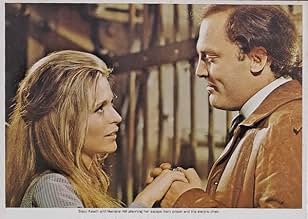
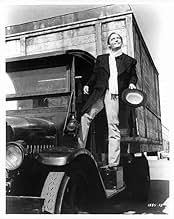
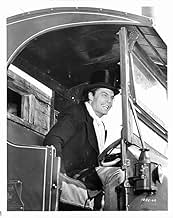
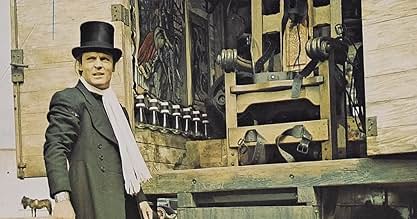
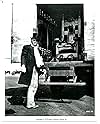
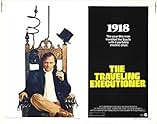
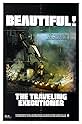
Stacy Keach is electrifying as Jonas Candide, an ex-carny who in 1918 travels around the bayou with a portable electric chair. At $100 a head, he renders his services with loving care. But t... Read allStacy Keach is electrifying as Jonas Candide, an ex-carny who in 1918 travels around the bayou with a portable electric chair. At $100 a head, he renders his services with loving care. But then he falls for a female "client".Stacy Keach is electrifying as Jonas Candide, an ex-carny who in 1918 travels around the bayou with a portable electric chair. At $100 a head, he renders his services with loving care. But then he falls for a female "client".
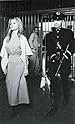


Marianna Hill
- Gundred Herzallerliebst
- (as Mariana Hill)


James Sloyan
- Piquant
- (as James J. Sloyan)


Charles Tyner
- Virgil
- (as Bill Durham)


- Director
- Writer
- All cast & crew
- Production, box office & more at IMDbPro
6.3487
1
2
3
4
5
6
7
8
9
10
Featured reviews
`The traveling executioner' is a black comedy love-story with a western undertone.
A short word on this marvelous rare to find movie; Well what can I say, except we find here a Stacy Keatch in what my humble opinion may be, one of his greatest roles ever put by him onto screen. He's an executioner who gets paid 100 bucks for each execution. The year we're in is 1918 South states of America. `The traveling executioner' is a black comedy love-story with a western undertone. It's the music that creates that pleasure full funny western feeling. What for sure is marvelous in this movie. The moment he's starting philosophizing to the condemned to death by his electric chair are `quality moments' in this movie. Not even to mention the funny truck he drives thru the country to visit every possible jail to for fill his task. The conversations are sometimes hilarious. Example, the moment he rents out hookers to some inmates. They each have to pay him, and on the amount they pay, he decides how much time they get.
Executioner, `Well for this you get room 5 and 4 minutes'. Inmate, `What kinda cover can I shoot in 4 min?' Executioner, `Well you gat from now 4 minutes, so start shooting'.
So the humor is one of a kind, and the love tale is great. `The contract killer badly in love with his victim'. The story goes on to a strange, though org. road. I try not to spoil too much, but will the executioner exchange his chair for her life, or will he even meet his own electric chair for real by trying to save her. Well it is a fact he doesn't leave any way unexplored to rescue her from her death sentence. Are you in for a funny black romantic comedy movie. With a superb, strong acting Stacey Keatch go for this one, for sure a must see!
Dario/
Executioner, `Well for this you get room 5 and 4 minutes'. Inmate, `What kinda cover can I shoot in 4 min?' Executioner, `Well you gat from now 4 minutes, so start shooting'.
So the humor is one of a kind, and the love tale is great. `The contract killer badly in love with his victim'. The story goes on to a strange, though org. road. I try not to spoil too much, but will the executioner exchange his chair for her life, or will he even meet his own electric chair for real by trying to save her. Well it is a fact he doesn't leave any way unexplored to rescue her from her death sentence. Are you in for a funny black romantic comedy movie. With a superb, strong acting Stacey Keatch go for this one, for sure a must see!
Dario/
Fields of Ambrosia
One of the great forgotten cinematic gems of yesteryear! From 1970, a young, whipcord fit, badass Stacy Keach stars as Jonas Candide, a traveling executioner who cruises the American South with his beloved portable electric chair, pulling the switch on murderers and thieves in 1918. Keach is shockingly good as he gets caught up in a scheme to save the life of a beautiful German woman slated for execution.
Keach's trademark facial scar is on full display here, not obscured by a mustache as it would be almost forevermore in later films. It adds something to the role, like a tiny crack in an otherwise perfect human statue. The film also features character actor Bud Cort in an early role.
The opening and finale scenes where Keach delivers Jonas' Fields of Ambrosia monologues are some of the best in 1970s cinema, and Jonas Candide is one of the great characters of Seventies film, he's a drunkard, a womanizer, a liar, a glutton, (the massive meal Candide sits down to eat after an execution has to be seen to be believed, massive plates of biscuits, Canadian bacon and Darwin knows what else) yet beneath it all he has a heart, Jonas, like the film, is darkly funny and darkly lovable.
Fantastically directed by Jack Smight, with a fine score by Jerry Goldsmith, and the seemingly only feature film screenplay credit by forgotten rebel screenwriter Garrie Bateson.
If there ever was a Traveling Time Traveler, a jump back into the wayback machine could correct the travesty of not nominating this film for Oscars for Best Actor, Best Director, Best Original Screenplay and Best Picture in 1970!
Keach's trademark facial scar is on full display here, not obscured by a mustache as it would be almost forevermore in later films. It adds something to the role, like a tiny crack in an otherwise perfect human statue. The film also features character actor Bud Cort in an early role.
The opening and finale scenes where Keach delivers Jonas' Fields of Ambrosia monologues are some of the best in 1970s cinema, and Jonas Candide is one of the great characters of Seventies film, he's a drunkard, a womanizer, a liar, a glutton, (the massive meal Candide sits down to eat after an execution has to be seen to be believed, massive plates of biscuits, Canadian bacon and Darwin knows what else) yet beneath it all he has a heart, Jonas, like the film, is darkly funny and darkly lovable.
Fantastically directed by Jack Smight, with a fine score by Jerry Goldsmith, and the seemingly only feature film screenplay credit by forgotten rebel screenwriter Garrie Bateson.
If there ever was a Traveling Time Traveler, a jump back into the wayback machine could correct the travesty of not nominating this film for Oscars for Best Actor, Best Director, Best Original Screenplay and Best Picture in 1970!
Underrated gem of 1970
This hard-to-find cool little film starring Stacy Keach is really special. A great performance by Keach (along with other early films of his, such as The Heart is a Lonely Hunter, Fat City, Judge Roy Bean, Brewster McCloud, and The Dion Brothers) and a fascinating study of this quirky traveling man who pushed his luck. Why is this not on video or DVD?
Before Keach became a Hollywood hack (with the exception of Long Riders) he made a series of films that showed the tremendous promise he had on stage. After the TV show Caribe he seemed to slide into obscurity except for Mike Hammer. This is a charming film that slipped under the radar in 1970 and is well worth your time. An 8 out of 10.
Before Keach became a Hollywood hack (with the exception of Long Riders) he made a series of films that showed the tremendous promise he had on stage. After the TV show Caribe he seemed to slide into obscurity except for Mike Hammer. This is a charming film that slipped under the radar in 1970 and is well worth your time. An 8 out of 10.
Perhaps executions seemed quaint in America's "liberal hour"
This is an exceptionally difficult movie to see. As others have noted, it has not received a DVD release, and the VHS video is difficult to track down and probably prohibitively expensive if found.
I saw it just the once, on TV, about ten years ago, but it made a strong impression on me. Stacy Keach gives a very brilliant performance as that most paradoxical of beings: a likable, humane executioner. He is ably supported by Bud Cort who adds his undertaker character to the gallery of eccentric young men that were his early stock in trade.
I also recall the general atmosphere of levity, a failure to take the central theme of the movie - death - very seriously. This is possibly explained by the fact that in 1970 (or, more probably 1969, when the film is likely to have gone into production) the death penalty itself probably seemed to have become a permanent relic of the past, unlikely to be employed again as the United States joined most of the developed world in rejecting it de facto if not yet de jure. (This abolition was only confirmed in 1972, and was short lived, as it happened.) The movie - although much blacker in its comedy - has a similar feel to "Butch Cassidy and the Sundance Kid" (or its TV doppelgaenger, "Alias Smith and Jones"). In these, the Wild West had been somehow not merely domesticated, but suburbanised, and there was an overlay of late 60s/early 70s Southern Californian sensibilities on the period setting. "The Traveling Executioner" does something similar to the Deep South of the late 1910s.
The return of capital punishment in the U.S. in the late 1970s (and its mounting use in the 80s and 90s) is likely to distort the perceptions of those too young to remember the atmosphere of the time in which the movie was made, when its black humour appeared to be excused by the fact that the actual horrors of execution that it so lightheartedly depicted seemed unlikely to reappear.
I saw it just the once, on TV, about ten years ago, but it made a strong impression on me. Stacy Keach gives a very brilliant performance as that most paradoxical of beings: a likable, humane executioner. He is ably supported by Bud Cort who adds his undertaker character to the gallery of eccentric young men that were his early stock in trade.
I also recall the general atmosphere of levity, a failure to take the central theme of the movie - death - very seriously. This is possibly explained by the fact that in 1970 (or, more probably 1969, when the film is likely to have gone into production) the death penalty itself probably seemed to have become a permanent relic of the past, unlikely to be employed again as the United States joined most of the developed world in rejecting it de facto if not yet de jure. (This abolition was only confirmed in 1972, and was short lived, as it happened.) The movie - although much blacker in its comedy - has a similar feel to "Butch Cassidy and the Sundance Kid" (or its TV doppelgaenger, "Alias Smith and Jones"). In these, the Wild West had been somehow not merely domesticated, but suburbanised, and there was an overlay of late 60s/early 70s Southern Californian sensibilities on the period setting. "The Traveling Executioner" does something similar to the Deep South of the late 1910s.
The return of capital punishment in the U.S. in the late 1970s (and its mounting use in the 80s and 90s) is likely to distort the perceptions of those too young to remember the atmosphere of the time in which the movie was made, when its black humour appeared to be excused by the fact that the actual horrors of execution that it so lightheartedly depicted seemed unlikely to reappear.
Great Entertaining Movie with Unusual Emotional Kick
I saw this film in Mexico around 1971 and I was so mesmerized by Stacy Keach's performance as a very eccentric traveling electrocutioner hired by Southern prisons to do the dirty deed. His hypnotic presentations to the condemned prisoners were heavenly and sublime as he always captured their attention by taking them to the "Fields of Ambrosia". I do remember thinking back then (1971) that these prisoners were being given a lot more than their warden ever bargained for. This was back in time when Soylent Green had come out and Edward G. Robinson was accepting the gift promised if he went along with assisted suicide. (This was set in the future when there was not enough food for the population and his remains would be used for processed food for people.) His quid pro quo was to watch pictures of all the extinct wildlife and other ecstatic beautiful scenes that no longer existed and nobody had had the privilege to ever see). Stacy Keach made the imminent execution so painless, that you would have thought the prisoners were wanting to die and experience the "Fields of Ambrosia". I am 70 years old and I do not go to many current movies any more as they are without art, taste, merit, etc, but I wonder why those who control the release of this movie won't let us old timers see it some more.


Did you know
- TriviaThis was filmed at Alabama's then recently closed Kilby Prison off of Coliseum Blvd. in Montgomery. As part of an agreement with the state for filming rights, filmmakers were supposed to have demolished the prison's massive walls with pyrotechnics during/after the film. However, the walls were so thick, three charges failed to do the job, and their remnants stayed around for years afterwards.
- GoofsAn important plot point is the existence of a portable electric chair which makes the career of "traveling executioner" possible. Unfortunately, as shown in the movie, it can't work. To perform an execution Keach "starts" a big electric generator in his horse-drawn van. But the generator has no power source! At the time the story takes place the internal combustion engine was new and rudimentary. The only transportable source of mechanical power was the steam engine. There were no diesel powered generators. Of course a steam engine large enough to produce the necessary mechanical power to turn the electric generator would have been almost as large as the van and would have required hours to build up enough steam to do the job. Also, a substantial amount of coal to make the steam would be needed. In any case, no motive power is shown and this explains why there were likely no traveling electrocutionists. Why a remote prison would not simply hang convicted criminals is likewise not explained.
- Quotes
Jonas Candide: [seduced by Gundred] Her ass is too good to fry!
- ConnectionsEdited into The Lost Empire (1984)
- How long is The Traveling Executioner?Powered by Alexa
Details
- Runtime
- 1h 35m(95 min)
- Sound mix
- Aspect ratio
- 2.35 : 1
Contribute to this page
Suggest an edit or add missing content