IMDb RATING
6.3/10
657
YOUR RATING

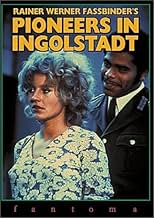
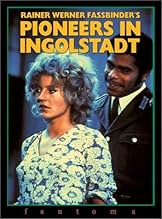
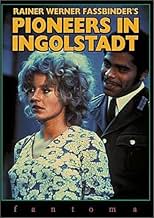
Berta, a naive young maid, searches for love when the army engineers come to town to build a bridge.Berta, a naive young maid, searches for love when the army engineers come to town to build a bridge.Berta, a naive young maid, searches for love when the army engineers come to town to build a bridge.
- Director
- Writers
- Stars


- Director
- Writers
- All cast & crew
- Production, box office & more at IMDbPro
6.3657
1
2
3
4
5
6
7
8
9
10
Featured reviews
nope
This was the first Fassbinder's films to get any kind of remotely mainstream distribution. It finds the autuer in an interesting transitional phase from the Bresson-by-way-of-Straub/Huillet aesthetic of his earliest films to the Sirkian melodrama of what is considered his "mature" style.
This movie is also a fascinating, rare depiction of life under the Nazis before the beginning of WWII and the horrors we most associate with the Reich. Here, the Nazi "Pioneers" are almost like New Deal-style government sponsored work crews, improving the national infrastructure. But the film repeatedly implies that the march to war and slaughter were not merely the result of orders from above but also of the overboiling ids of men injected with nationalist and militarist fantasies who had no way of fully working out their violent/sexual impulses in their own cultural milieu.
10hasosch
Laying out topics for future movies
I cannot deny when many people think that "Pioniere Von Ingolstadt" (1971) was more of less an apprentice piece for Fassbinder, although he had already done a couple of feature films before. I have also no major arguments against those who criticize that both film and play (by Marielouise Fleisser) are basically content-less (why Brecht seriously recommended to perform it "not as whole, but in its parts"): "Pioneers" come into a small Southern German town, the girls, oppressed by the Bavarian patriarchs, are eager to escape with the next-best soldier who comes across them. However, they are disappointed, because they experience sex where they expect love. And the pioneers build a bridge -a really strange metaphor. Is this bridge, that probably never get finished, a connection between the oppressors and the oppressed, the rich (patriarchs) and the poor (servants, the two female lead-characters Alma and Berta or A and B)? The movie raises more question than it gives an answer why Fassbinder did it. Considering that social problems, especially such involved with women, will become central in Fassbinder's later work, we may speculate that here, he laid out all the topics to which he would come back in his following films.
fine, but for Fassbinder completists only
Pioneers of Ingolstadt is one of the early works of the inspired, prolific dramatic director RW Fassbinder, and it may be a very good minor work but minor all the same. It's about a group of soldiers who have been brought to the small town of Ingolstadt to build a bridge. Not much drama happens there as that goes as planned; the meat of the film is the interactions with the local women (i.e. Hanna Schygulla, Irm Herrmann who one might recall from The Merchant of Four Seasons), and how they have some varied personalities (Schygulla wants true love, Herrmann likes to fool around, another girl has... her own thoughts), while the men are, perhaps by design, practically all the same.
It speaks to how much I like Hannah Schygulla and some of Fassbinders other early/consistent players that this was not only watchable but okay, though at the same time it left me wanting more from the characters and from some of the filmmaking itself. As I have worked through Fassbinder's early filmography (as in before Whity and Beware of a Holy Whore and his breakthrough year 1972), I have found it somewhat hit and miss. Even more then his other work, this has such a detached feeling about it, how everyone is disillusioned but also holding back their emotions (in the Bressonian influence I'm sure), and I felt something I don't like when I'm watching a Fassbinder film: boredom.
Its like, we get it, these soldiers toiling at this small town bridge and the local girls who have nothing much else better to do than spend their time with these "pioneers" as they're ironically called, are at best aimless and at worst miserable and cruel and (in their way perhaps) more or less deserve each ether. But this point is driven by Fassbinder, adapting a play he didn't write for German TV, to the point where I didn't care that much for anyone. If it weren't for the natural screen presence of (most of) the actors it might be one or Rainer's lessor films - or, to put it another way, he's explored many of the same themes in other, stronger, more memorable works, or at least with more memorable characters.
And who knows, maybe it wasn't the best idea for me to check this out at the end of a very long work day on 5 hours of sleep. It also doesn't help that the cameraman here has some strange inspirational ideas like... Having a cheap one-light on a camera pointed at actors walking and talking in a dark street. But that's just one example.
It speaks to how much I like Hannah Schygulla and some of Fassbinders other early/consistent players that this was not only watchable but okay, though at the same time it left me wanting more from the characters and from some of the filmmaking itself. As I have worked through Fassbinder's early filmography (as in before Whity and Beware of a Holy Whore and his breakthrough year 1972), I have found it somewhat hit and miss. Even more then his other work, this has such a detached feeling about it, how everyone is disillusioned but also holding back their emotions (in the Bressonian influence I'm sure), and I felt something I don't like when I'm watching a Fassbinder film: boredom.
Its like, we get it, these soldiers toiling at this small town bridge and the local girls who have nothing much else better to do than spend their time with these "pioneers" as they're ironically called, are at best aimless and at worst miserable and cruel and (in their way perhaps) more or less deserve each ether. But this point is driven by Fassbinder, adapting a play he didn't write for German TV, to the point where I didn't care that much for anyone. If it weren't for the natural screen presence of (most of) the actors it might be one or Rainer's lessor films - or, to put it another way, he's explored many of the same themes in other, stronger, more memorable works, or at least with more memorable characters.
And who knows, maybe it wasn't the best idea for me to check this out at the end of a very long work day on 5 hours of sleep. It also doesn't help that the cameraman here has some strange inspirational ideas like... Having a cheap one-light on a camera pointed at actors walking and talking in a dark street. But that's just one example.
Fassbinder makes an early sketch over sex thematic's approach!!!
I really enjoy Fassbinder pictures, they have a sex thematic, exploiting this vast field not yet properly expanded, he makes an early sketch about to came, in a small city soldiers coming to build a rustic wooden bridge, then women's town interact with these soldiers hoping getting marry or something, however Alma (Irm Hermann) a beauty girl who just wants make sex by money, such behavior bother other single women on their purposes, Bertha (Hanna Schygulla) a former friend of Alma finds a lonely soldier who she falling in love, seemingly a right choice, among all this portrait Fassbinder expose to the audience his criticism and pessimism over this stormy hard days, aside some unfit sequence the movie flow easily, it's an art movie, it shall be treat as such, whatever other readings will be clearly doomed to failure, the ornery German Rainer Werner Fassbinder was an avant-garde director and deserves a better understanding over this stylized work!!!
Resume:
First watch: 2020 / How many: 1 / Source: DVD / Rating: 7.5
Resume:
First watch: 2020 / How many: 1 / Source: DVD / Rating: 7.5
connections vs. divisions
Rainer Werner Fassbinder was one of the leaders of New German Cinema in the 1970s. His movies often looked at Germany in the wake of WWII, and he directed almost nonstop before dying of a drug overdose in 1982. One of his early movies was "Pioniere in Ingolstadt", based on a Marieluise Fleißer play. Premiering in 1928, the play focused on the mending of a bridge by a group of army members. The people in the nearby town steal some of the wood to build a diving board. As a result, an endeavor which could have united the army and the townspeople ends up dividing them.
The setting of Fassbinder's movie is ambiguous; it looks like a cross between the 1920s and 1960s. Also, the movie emphasizes the recruits' taking sexual advantage of the women in the town, and how one of the women longs for a more meaningful relationship. In the end, this isn't Fassbinder's best movie but an OK one. His best movies are probably "The Marriage of Maria Braun" and "Veronika Voss".
The setting of Fassbinder's movie is ambiguous; it looks like a cross between the 1920s and 1960s. Also, the movie emphasizes the recruits' taking sexual advantage of the women in the town, and how one of the women longs for a more meaningful relationship. In the end, this isn't Fassbinder's best movie but an OK one. His best movies are probably "The Marriage of Maria Braun" and "Veronika Voss".


Did you know
Details
Box office
- Budget
- DEM 550,000 (estimated)
Contribute to this page
Suggest an edit or add missing content