IMDb RATING
6.9/10
517
YOUR RATING
Told from the Japanese perspective, this war drama captures the events of World War II's Battle of Okinawa - a massive amphibious assault by U.S. troops that left more than 150,000 Japanese ... Read allTold from the Japanese perspective, this war drama captures the events of World War II's Battle of Okinawa - a massive amphibious assault by U.S. troops that left more than 150,000 Japanese civilians dead.Told from the Japanese perspective, this war drama captures the events of World War II's Battle of Okinawa - a massive amphibious assault by U.S. troops that left more than 150,000 Japanese civilians dead.
- Director
- Writers
- Stars
- Director
- Writers
- All cast & crew
- Production, box office & more at IMDbPro
6.9517
1
2
3
4
5
6
7
8
9
10
Featured reviews
Not very good
The film is pretty bad across the board. Even ignoring the poor special effects due to budget, the direction and editing is poor. A tighter script and decent editing would have done wonders for what could have been a good film. The story line is grim, of course, but is badly handled and is an emotionless tale of waste. To get an emotional response from an audience you need to care about the characters, and that empathy is what the movie truly lacks. The film is a docudrama, but lacks drama and the power of a documentary. It's worth a look, but is certainly not a good film. Compare BoO with Story of a Prostitute, Fires on the Plain, or The Burmese Harp, and you'll understand why it is a forgotten film.
Ambitious film overhwelms filmmakers
From the director of the terrific "Japan's Longest Day", this is an ambitious documentary-styled recreation of the battle for Okinawa, where hundreds of thousands of soldiers and civilians were abandoned by the Japanese military in order to better protect the mainland. The soldiers fortified themselves in caves and fended of an overwhelming American attack over a period of several months. Unfortunately, the filmmaker's talents don't match their ambitions. "Japan's Longest Day" was a fascinating film written by Shinobu Hashimoto about a little known military revolt at the end of the war. Okinawa is dramatically inept with misplaced bits of humor, and the crowd scenes never number more than 50, making it seem far less epic than it purports to be. The photography is bland and the blood very fake. The desperation never seeps in like it should, but the film does a good job of showing what they went through. It also shows that when the going gets tough, the Japanese commit suicide - according to this film it must have been the leading cause of death. The events depicted are similar to "Sands of Iwo Jima" - so if you like that you might like this. Okinawa is still occupied by American forces. Script by Kaneto Shindo ("Onibaba").
Great Film On A Horrible Battle
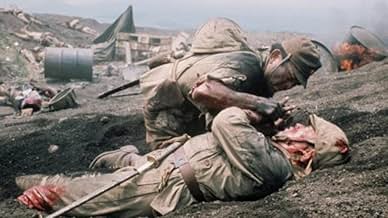
Battle of Okinawa is a film directed by the now legendary Kihachi Okamoto. It stars Tatsuya Nakadai and Tetsuro "I'm in every Japanese film" Tamba. Both show off their acting chops in this film and deliver outstanding performances. Don't get me wrong though, there are dozens of actors in this film with almost equal scream time as these two men. This is definitely an ensemble piece on one of the most gruesome slaughters on the Japanese armies front. This film is not easy to watch. It is much more violent than "Letters From Iwo Jima" and as in "Iwo" we see how fanatical the Japanese army was at this point in history. Being taken prisoner was not an option and losing meant death or forever living in dishonor. This notion is even implemented to civilians who in this move kill themselves in droves. Tatsuya Nakadai's character is one of the few characters who believes that suicide in not the only option in defeat. He is the western voice in the film for his character even studied in America. This is a hard core war film that takes no prisoners. I recommend you go out and buy this film for it is now available in R1 DVD thanks to the fine folks at AnimEigo.
It feels like a live-action Wikipedia page.
This is an exhaustive (and exhausting) account of events surrounding the Battle of Okinawa, beginning with pre-invasion defense preparations (starting in July 1944), then moving to the aerial bombardment, to the US invasion, and finally to ground combat. In its desire to be "complete" and thoroughly document the battle (from the Japanese POV, of course), it shortchanges story and characters. It feels like three hundred mini-vignettes rapidly spat out by a machine gun rather than a smoothly flowing, cohesive whole.
As for historical context and accuracy, others have already pointed out their reservations about the Japanese being framed as noble, even heroic, warriors fighting the good fight against overwhelming odds. This complaint about its narrative framing also applies to virtually every Japanese film about World War II. In the collective cinematic imagination of Japanese WWII films, the "war" is treated almost as a cosmic, non-human, event that simply happens TO them. Unlike in many German films where characters ponder "will the world forgive us?" or "now our chickens are coming home to roost. We will now reap what we have sown", in Japanese films, it is almost always "oh poor us. We are losing. It's so sad. Why must we lose? What about our honor? What about our children?"
Inaccurate and melodramatic
I'm really surprised at the positive reviews this film has received and the high IMDb rating. Reading them at times I wondered if we was watching the same movie. I'm going to have to disagree with the other reviewers and say that the film doesn't work, either historically or dramatically.
Historically, it's wildly inaccurate. The whole movie suffers from the need to portray the Japanese in the best possible and most heroic light. A few examples: by April, 1945, the Japanese pilot corps had been almost totally destroyed. The Japanese were unable to train new pilots at the rate they were being killed. This is one reason why they resorted to suicide attacks. And yet we are to believe that large air forces still exist and were not employed in Okinawa because the army was unwilling to attack the American forces and recapture the air fields to the north. Another example is the Yamato. The Japanese Navy in the north had been almost destroyed, and what remained lacked fuel, but the admiralty felt the need to make some sort of gesture and sent their largest battleship. The plan had always been to beach and scuttle the ship on Okinawa and use it as a gun platform, but instead we are told that it's mission was to bravely sail amongst the Americans and fight until it was out of ammo. Unfortunately before she could do that, she was attacked by those dastardly Americans who flew gigantic squadrons of planes against her (100 planes attacking a single ship at once?). What tripe.
Unlike movies like "Tora Tora Tora" or "Midway", there is no attempt to personalize or portray the other side as anything but mindless, bloodthirsty automatons. The Americans are shown as surprisingly weak, unable to cope with the Japanese in hand to hand combat, and most of the Japanese appear to die by artillery fire or mowed down by tanks. It's the kind of chauvinism one would expect from a John Wayne movie.
Now, I don't expect historical accuracy from a John Wayne movie, but I do expect it to be entertaining. However, this movie is just too confusing and poorly written. Worse of all, it resorts to melodrama. I lost count of how many times women and children were used to manipulate the audience's emotions.
All in all, I don't recommend it.
Historically, it's wildly inaccurate. The whole movie suffers from the need to portray the Japanese in the best possible and most heroic light. A few examples: by April, 1945, the Japanese pilot corps had been almost totally destroyed. The Japanese were unable to train new pilots at the rate they were being killed. This is one reason why they resorted to suicide attacks. And yet we are to believe that large air forces still exist and were not employed in Okinawa because the army was unwilling to attack the American forces and recapture the air fields to the north. Another example is the Yamato. The Japanese Navy in the north had been almost destroyed, and what remained lacked fuel, but the admiralty felt the need to make some sort of gesture and sent their largest battleship. The plan had always been to beach and scuttle the ship on Okinawa and use it as a gun platform, but instead we are told that it's mission was to bravely sail amongst the Americans and fight until it was out of ammo. Unfortunately before she could do that, she was attacked by those dastardly Americans who flew gigantic squadrons of planes against her (100 planes attacking a single ship at once?). What tripe.
Unlike movies like "Tora Tora Tora" or "Midway", there is no attempt to personalize or portray the other side as anything but mindless, bloodthirsty automatons. The Americans are shown as surprisingly weak, unable to cope with the Japanese in hand to hand combat, and most of the Japanese appear to die by artillery fire or mowed down by tanks. It's the kind of chauvinism one would expect from a John Wayne movie.
Now, I don't expect historical accuracy from a John Wayne movie, but I do expect it to be entertaining. However, this movie is just too confusing and poorly written. Worse of all, it resorts to melodrama. I lost count of how many times women and children were used to manipulate the audience's emotions.
All in all, I don't recommend it.
Did you know
- TriviaDirector Hideaki Anno has mentioned that this is the film he has watched the most in his life, well over 100 times.
- ConnectionsReferenced in Twenty Years of African Cinema (1983)
- How long is Battle of Okinawa?Powered by Alexa
Details
- Release date
- Country of origin
- Language
- Also known as
- Bitka za Okinavu
- Production company
- See more company credits at IMDbPro
- Runtime
- 2h 29m(149 min)
- Color
- Sound mix
- Aspect ratio
- 2.40 : 1
Contribute to this page
Suggest an edit or add missing content