IMDb RATING
6.3/10
9K
YOUR RATING

Pasolini's artistic and always vividly cinematic retelling of eight of Chaucer's famous tales.Pasolini's artistic and always vividly cinematic retelling of eight of Chaucer's famous tales.Pasolini's artistic and always vividly cinematic retelling of eight of Chaucer's famous tales.
- Director
- Writers
- Stars
- Awards
- 1 win total



Orla Pederson
- Pilgrim
- (as OT)

Derek Deadman
- The Pardoner
- (as Derek Deadmin)

George Bethell Datch
- Host of the Tabard
- (as George B. Datch)


- Director
- Writers
- All cast & crew
- Production, box office & more at IMDbPro
6.38.9K
1
2
3
4
5
6
7
8
9
10
Featured reviews
Superb Film
I'm rather bemused by some of the negative comments above. This film - in my humble opinion - is one of the greatest ever made, and my personal favourite of all P.P. Pasolini's. Pasolini brings life to Chaucer in a way my poor teachers at school could never have dared. In the film, Pasolini casts himself as Chaucer; daydreaming, laughing at his own tales, being berated by his wife. And therein lies the clue to this film. It's not just an interpretation of the Canterbury Tales, it's a portrayal of its author. For all claims of "smut" (see above), I can honestly say that your imagination must be pretty dull not to laugh at certain earthy, dream-like scenes. Absolutely non of the scenes in this movie can be branded as bad-taste. They're absolutely accurate. Pasolini showed deep understanding of the English psyche throughout; the examples are too numerous to mention. If you're looking for an explanation of The Canterbury Tales, you won't find it in this film. But if you're looking for how to go about interpreting it for yourself, you'll find no better. This movie is one that I will keep, and you can bet my kids are going to see it when they get a little older too.
Pasolini dared to show the medieval era as extremely dirty, indecent, vulgar
This is the second in Pasolini's series of setting classic bawdy tales to film
In this case, he selected eight of Chaucer's Canterbury Tales, including the infamous miller's tale and the incident with the red hot poker kiss
The tales revolve around a group of pilgrims who are journeying to the shrine of Saint Thomas a Becket of Canterbury The trip is so boring that they begin telling each other stories that soon get obscene, gory and very sexy Pasolini adds another motif to his visualization by placing Chaucer himself into the movie, periodically cutting to him writing at his desk...
Pasolini inserts pleasure and amusement at social customs, especially marriage Some of the stories are funny, others are deadly serious The scene where a young man is burned for making love to another of his own sex, for example, is chilling...
In fact, Pasolini's using non professional actors, is more in keeping with the tone of the original than the usual romanticized versions...
The tales revolve around a group of pilgrims who are journeying to the shrine of Saint Thomas a Becket of Canterbury The trip is so boring that they begin telling each other stories that soon get obscene, gory and very sexy Pasolini adds another motif to his visualization by placing Chaucer himself into the movie, periodically cutting to him writing at his desk...
Pasolini inserts pleasure and amusement at social customs, especially marriage Some of the stories are funny, others are deadly serious The scene where a young man is burned for making love to another of his own sex, for example, is chilling...
In fact, Pasolini's using non professional actors, is more in keeping with the tone of the original than the usual romanticized versions...
Best Italian film ever
When I was going to see "Canterbury Tales", I knew Pasolini was infamous director who made crazy films, that weren't for everyone's taste.When I saw it. It was one of those movie experiences that change the way you see films. It's not that I loved this film, I don't see how I can use word "love" here. It's just that from the beginning to the end I couldn't believe my eyes. Sequence after sequence, the movie became one of the most original films I ever seen in my life. Wife having sex standing on her husband's shoulders, woman farting in the face of the young boy who loves her, drunken man, p***ing on dining people, giant ass, that defecates with demons, it's shocking, yes, but it's not the point. The point is,we believe every single thing we see on the screen. Of course, it's because Pasolini uses natural lightning, unprofessional actors, and partly because when there is fucking on the screen, it's not simulation, it's real f**king (what other film can be classified as "porn", and also have Oscar-winning costume designer in its credits?). But it's not the reason. I always admired Pasolini, because he was one of those people, who make others respect them, who have remained hip even twenty years after they are dead. And being this incredibly fascinating person, he could put part of the magic that made him the person he was into his movies.
The weakest link.
It is the second part of Pasolini's "trilogy of life" and IMHO,the weakest :part of the reason can be found in the fact that it's merely more of the same ;after" Il decameron' the sensation of surprise has disappeared.Bawdiness,bawdiness and bawdiness,and a good dose of scatology.Besides,the stories,adapted from Chaucer are less interesting than in "IL decameron" ;the only good really good segment,as far the script is concerned ,is the one with the students and the miller's family:the mistaken identities are hilarious.But what remains is never really exciting.The scene in which a gay is literally "fried " is downright disturbing,coming from a director like Pasolini;the sequence is treated seriously ,almost without humor-unless the donuts seller counts-.
No one can argue the splendor of the cinematography;most of the times,it looks like pictures at an exhibition:the moist misty landscapes -particularly in the students' sequence- sharply contrasts with the mediterranean overcome by the heat ones in "il decameron";and the score,which includes old English traditionals is first-rate too.Ninetto Davoli,Pasolini's favorite actor,does his usual (almost silent) stint,in the grand tradition of Charlie Chaplin,which almost seems supernatural in this context;One should add that Josephine Chaplin is also part of the cast:some kind of double tribute.
The script is the Achille's heel of the movie."Il fiore della mille e una notte" will set the record straight and redeem Pasolini,for it's without a doubt the peak of the trilogy of life,with its numerous stories " à tiroirs".
No one can argue the splendor of the cinematography;most of the times,it looks like pictures at an exhibition:the moist misty landscapes -particularly in the students' sequence- sharply contrasts with the mediterranean overcome by the heat ones in "il decameron";and the score,which includes old English traditionals is first-rate too.Ninetto Davoli,Pasolini's favorite actor,does his usual (almost silent) stint,in the grand tradition of Charlie Chaplin,which almost seems supernatural in this context;One should add that Josephine Chaplin is also part of the cast:some kind of double tribute.
The script is the Achille's heel of the movie."Il fiore della mille e una notte" will set the record straight and redeem Pasolini,for it's without a doubt the peak of the trilogy of life,with its numerous stories " à tiroirs".
well put together
Making a film about the Canterbuy Tales, one that lasts one to two hours, presents one with the decision of how to go about it.
The logical approach would be to tell of the pilgrimage itself, and then splice 2 or 3 tales at a time, probably beginning with the joke tales, like the miller's.
It would be doubtful that one could get all the stories in, and still have a pilgrimage tale.
Here, the pilgrimage is pretty much forgotten, just mentioned at the beginning.
The cuts between stories are sometimes straights cuts, and sometimes back to Chaucer writing the tale.
The bawdiness is kept, although it is done more Italian style than English. There is a mixture of the two cultures involved here.
The stories stay fairly true to form.
It would take a huge budget to include the squire's story, and indeed, the squire's story would take some interpretation to finish. Sadly, it is left out.
Which leaves the pardoner's story as the "thriller" story. I was very much hoping this story, a natural finale, would be the climax.
I wasn't disappointed. The pardoner's tale is the masterpiece in terms of action and adventure. It isn't exactly the very last tale, but close enough to serve as the climax, as there are two very brief joke tales that follow it.
Would I piece it together like this? Probably not. I think each person would direct this in a different way, with about a half dozen general methods.
However, I liked the way this film was done. It stayed very true to form, in my opinion. Most of the tales are "raunchy humor" tales, showing the mores of what one would expect to be puritan people, most of them professionals in religion. This was well done.
The logical approach would be to tell of the pilgrimage itself, and then splice 2 or 3 tales at a time, probably beginning with the joke tales, like the miller's.
It would be doubtful that one could get all the stories in, and still have a pilgrimage tale.
Here, the pilgrimage is pretty much forgotten, just mentioned at the beginning.
The cuts between stories are sometimes straights cuts, and sometimes back to Chaucer writing the tale.
The bawdiness is kept, although it is done more Italian style than English. There is a mixture of the two cultures involved here.
The stories stay fairly true to form.
It would take a huge budget to include the squire's story, and indeed, the squire's story would take some interpretation to finish. Sadly, it is left out.
Which leaves the pardoner's story as the "thriller" story. I was very much hoping this story, a natural finale, would be the climax.
I wasn't disappointed. The pardoner's tale is the masterpiece in terms of action and adventure. It isn't exactly the very last tale, but close enough to serve as the climax, as there are two very brief joke tales that follow it.
Would I piece it together like this? Probably not. I think each person would direct this in a different way, with about a half dozen general methods.
However, I liked the way this film was done. It stayed very true to form, in my opinion. Most of the tales are "raunchy humor" tales, showing the mores of what one would expect to be puritan people, most of them professionals in religion. This was well done.


Did you know
- TriviaRemarkably, this is the only major cinematic take on Geoffrey Chaucer's classic tales.
- GoofsSome of the women have tan-lines from bikinis.
- Quotes
The Wife from Bath: There's nowhere in the Gospels that says we ought to stay virgins. Anyway, tell me, what were the genital organs made for at the creation? Not to lie dormant I suppose. And nobody's going to tell me they were just put there to piss through. Mark you, I use it for that as well. And every man must serve his wife in wedlock...
- Alternate versionsThe original UK cinema version was cut by the BBFC with edits to anal sex shots, a man being whipped, and Rufus urinating on the crowd during the 'Pardoner's Tale' segment for an 'X' certificate. The cuts were fully restored in 2001 and the certificate downgraded to a '15'.
- ConnectionsFeatured in Playboy: The Story of X (1998)
- SoundtracksThe Old Piper
written by Carl Hardebeck in 1912
performed by Frank McPeake
Played over the opening credits and sung frequently by Perkin the Reveler in the Cook's Tale
- How long is The Canterbury Tales?Powered by Alexa
Details
- Release date
- Countries of origin
- Official site
- Languages
- Also known as
- Los cuentos de Canterbury
- Filming locations
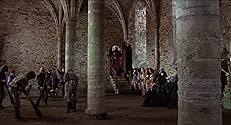
- Battle Abbey, East Sussex, England, UK(merchant's tale: hall interior)
- Production companies
- See more company credits at IMDbPro
Box office
- Gross worldwide
- $9,028
- Runtime
- 1h 51m(111 min)
- Sound mix
- Aspect ratio
- 1.85 : 1
Contribute to this page
Suggest an edit or add missing content